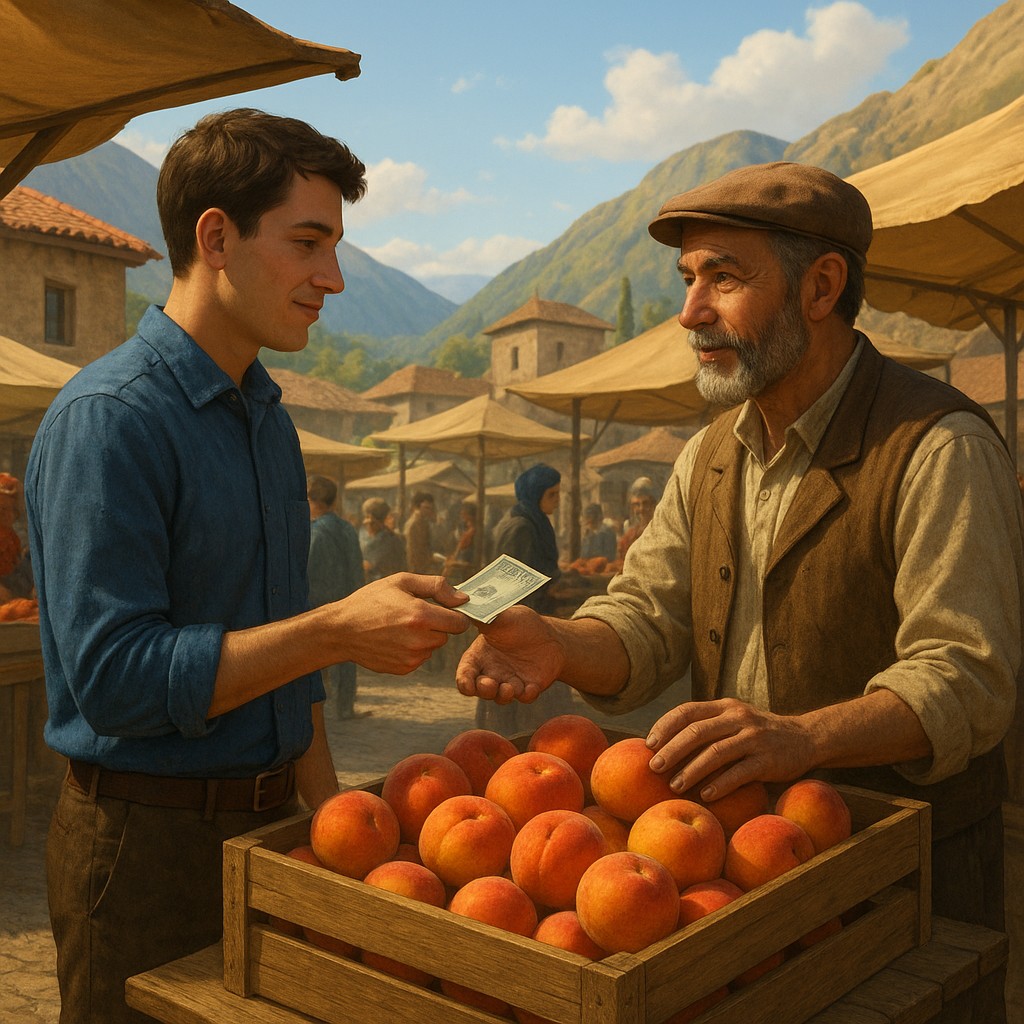
Imagine you are standing in a busy open-air market in a small mountain village. You spot a crate of perfect, sun-ripened peaches. You hand the vendor a banknote, he hands you the fruit, and you walk away. This simple exchange feels instant, but it actually rests on a massive, invisible foundation of belief. You believe the peaches aren't rotten in the middle, and he believes the paper you gave him is real money rather than a clever photocopy. If either of you doubted the other, the trade would stop. You would demand to slice open every peach before paying, and he would pull out a chemical detection pen and a UV light to inspect your cash. Suddenly, a five-second interaction becomes a ten-minute ordeal.
This invisible foundation is what economists call social trust. It is the secret ingredient that separates stagnant economies from global powerhouses. When we talk about economic growth, we often focus on "hard" factors like factories, technology, or natural resources. Yet, the "soft" factor of trust acts as the lubricant for the entire machine. Without it, the gears of commerce grind against one another, creating friction that heats up the system until it eventually jams. By looking at trust through the lens of transaction costs, we can see why some nations sprint toward prosperity while others remain trapped in a cycle of suspicion and paperwork.
The Invisible Tax of Mutual Suspicion
In the world of economics, every action has a price tag that goes beyond the sticker price of the goods. These are known as transaction costs: the time, effort, and money spent simply making a deal happen. In a low-trust society, these costs act as a pervasive, hidden tax on every single interaction. Imagine you want to hire a contractor to fix your roof in a city where trust is at rock bottom. You cannot simply take them at their word. You must hire a lawyer to draft a bulletproof contract, pay an inspector to verify the materials used, and perhaps even hold the payment in an escrow account, a neutral third-party holding area, managed by someone who also takes a cut.
These extra steps are defensive measures. They don't make the roof any sturdier or the shingles any prettier; they exist solely to prevent you from being cheated. In a high-trust environment, that same roof gets fixed based on a solid recommendation and a firm handshake. The resources that would have gone to the lawyer and the escrow agent are instead saved or invested elsewhere. When you multiply this effect by millions of transactions across an entire country, the difference in efficiency is staggering. High-trust societies effectively operate with a massive discount on the cost of doing business, allowing them to outpace competitors who are bogged down by the weight of their own cynicism.
Why Handshakes Outperform Fifty-Page Contracts
The beauty of a high-trust environment lies in its agility. When people expect others to keep their word, the pace of business moves from a crawl to a sprint. This is particularly clear in innovation hubs or tight-knit markets where deals worth millions are often struck verbally before a single document is signed. Because the participants trust that the social or legal consequences of cheating are too high to risk, they can bypass the bureaucratic gatekeeping that slows down progress. This allows capital and ideas to flow toward their most productive uses without getting stuck in the plumbing of administrative oversight.
In contrast, low-trust environments are weighed down by heavy "agency costs," which are the expenses involved in making sure people do what they were hired to do. If a business owner doesn't trust their employees, they must install surveillance cameras, implement complex log-in systems, and hire managers whose only job is to watch the other workers. This creates a pyramid of observers watching observers. While this might reduce theft, it also kills initiative. Employees in such systems rarely innovate because they are too busy following rigid protocols designed to prove they aren't stealing. The result is a stiff, slow-moving organization that can easily be disrupted by a lean, high-trust competitor that empowers its staff to make decisions on the fly.
The Arithmetic of Growth and Friction
To visualize how these concepts play out in the real world, we can compare how different types of economic friction manifest based on the level of social trust. While no society is perfectly trusting or perfectly suspicious, different cultures tend to lean toward one end of the spectrum, fundamentally altering their economic landscape.
| Feature of Transaction |
High-Trust Environment |
Low-Trust Environment |
| Contracting |
Standardized, brief, or verbal |
Custom, lengthy, and hyper-legalistic |
| Monitoring |
Peer-based or results-oriented |
Constant surveillance and micromanagement |
| Security |
Minimal physical barriers needed |
High spend on guards, walls, and bars |
| Credit Access |
Based on reputation and history |
Requires heavy collateral or high interest |
| Speed of Pivot |
Rapid; based on mutual agreement |
Slow; requires renegotiating documents |
| Dispute Resolution |
Informal mediation or social pressure |
Protracted, expensive litigation |
This table illustrates that trust isn't just a "nice-to-have" social virtue; it is a hard economic asset. When a company doesn't have to spend 15 percent of its revenue on compliance and verification, it can spend that money on Research and Development. Over decades, this compound interest of saved time and diverted capital creates the massive gap we see between high-income and low-income nations. Trust creates a virtuous cycle where success breeds more trust, while suspicion creates a poverty trap where the cost of checking everything makes even simple projects unprofitable.
The Vulnerability of the Open Gate
However, high-trust systems are not invincible. In fact, they possess a specific structural weakness: they are incredibly vulnerable to social predators. Because the system is built on the assumption of honesty, it often lacks the robust immune system needed to fend off a dedicated deceiver. Think of a community garden where everyone helps themselves and leaves a few dollars in a jar. This works perfectly until a single individual decides to take all the vegetables and the jar itself. Because there were no locks or guards, the predator can cause outsized damage before the community even realizes what has happened.
When a high-trust society is entered by dishonest actors who do not play by the same unwritten rules, the instinctive reaction is to start building walls. One bad actor can force a thousand honest people to start using 50-page contracts. This is why protecting social capital is so difficult. It takes generations to build the cultural expectation that "we don't cheat here," but it only takes a few high-profile scandals to destroy that belief. Once the transition is made from a handshake-based system to a lawyer-based system, it is incredibly expensive and culturally difficult to go back. The gates of trust, once bolted, rarely swing open easily again.
The Role of Institutions as Trust Substitutes
If trust is so vital but so fragile, how do modern economies function when they grow too large for everyone to know each other? This is where formal institutions like the rule of law and transparent courts come into play. These institutions act as "synthetic trust." If I don't know you personally, I can still trade with you because I trust the legal system to punish you if you defraud me. In this sense, a reliable court system acts as a low-cost backup for social trust. It provides a safety net that allows strangers to collaborate without needing to spend years building a personal friendship first.
The most successful modern economies find a balance between organic trust, which is cultural honesty, and institutional trust, such as reliable laws. When both are present, transaction costs plummet to almost nothing. You see this in the way modern e-commerce works. You send money to a stranger on the other side of the country because you trust the platform's rating system and you trust your credit card company to reverse the charge if the item never arrives. When these layers work together, the economy expands into a global, frictionless web that generates wealth at a scale previously unimaginable in human history.
Building the Foundations of a Prosperous Future
Understanding the mechanics of trust changes how we view the world around us. It teaches us that the choices we make in our daily interactions, whether we choose to be reliable, whether we honor our small promises, and whether we act with integrity even when no one is watching, are actually small investments in the collective wealth of our society. We aren't just being "nice" when we are trustworthy; we are actively reducing the friction that holds back human progress. By fostering environments where the handshake still carries weight, we contribute to a system that is faster, leaner, and more capable of solving the world's most complex problems.
You now have a framework to see the hidden forces shaping your local economy and the global stage. Whether you are an entrepreneur looking to build a high-performing team or a citizen interested in the prosperity of your nation, remember that the most valuable currency is not the paper in your wallet, but the confidence others have in your word. As you go forward, look for ways to build bridges of reliability. In a world where suspicion is expensive and slow, being someone who can be trusted is not just a moral triumph, it is a superpower that fuels the engine of human achievement.