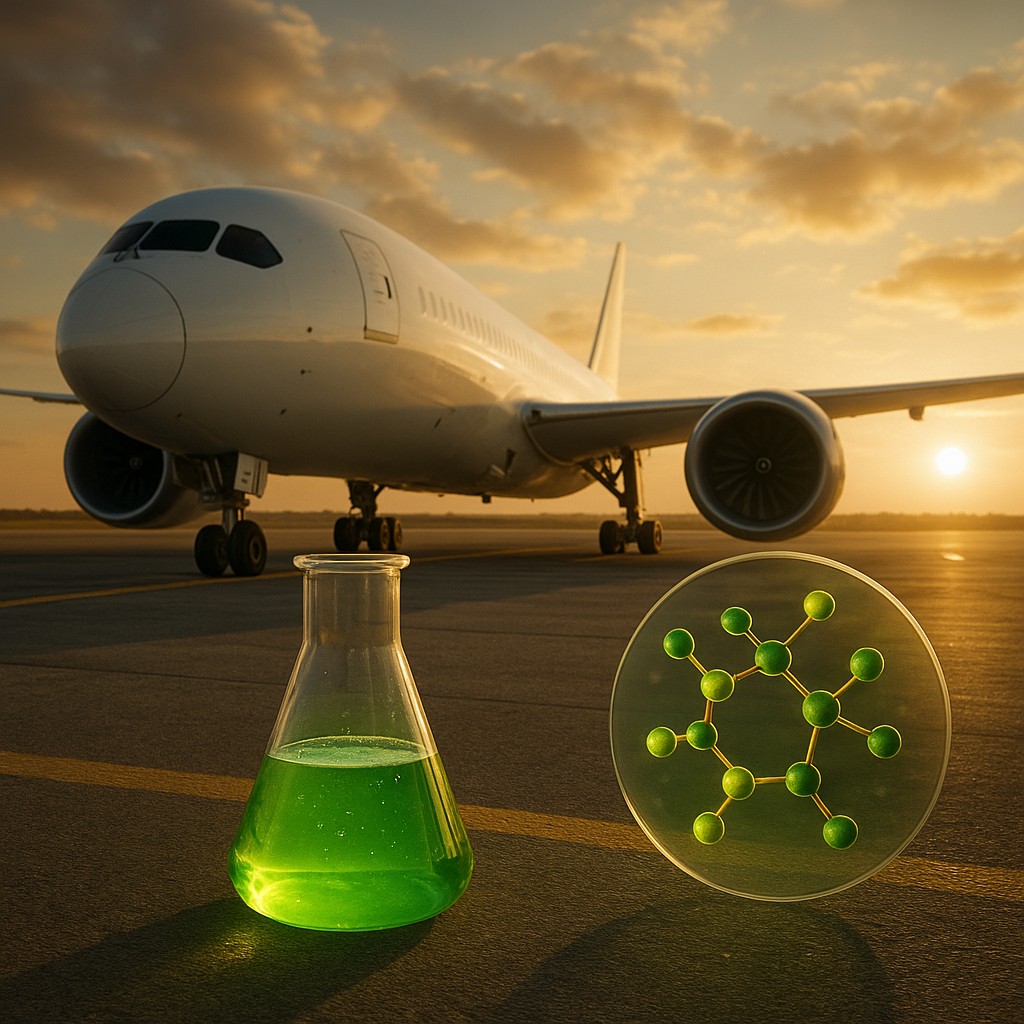
Imagine standing on the tarmac, watching a massive Boeing 787 Dreamliner prepare for takeoff. As those giant turbines begin to hum, you are likely thinking about the staggering amount of fuel required to lift several hundred tons of metal and humans into the sky. For decades, the aviation industry has been the "problem child" of the green revolution. While cars have pivoted toward electricity and homes have embraced solar panels, airplanes have remained stubbornly tied to petroleum.
The reason is a frustrating mix of physics and geography: batteries are heavy, and the sky is very, very big. To fly from London to New York, an electric plane would need a battery so heavy that the aircraft could never actually leave the ground.
This is where the logic of "drop-in" chemistry enters the picture. Instead of waiting for a miracle battery or building a fleet of futuristic, hydrogen-powered spaceships that do not exist yet, we are learning to hack the fuel itself. Sustainable Aviation Fuel, or SAF, is a masterclass in practical environmentalism. It is a story about taking the world's trash - things like used cooking oil, agricultural waste, or even captured carbon dioxide - and refining them until they work exactly like the kerosene we have used for a century. It is the ultimate "fake it until you make it" strategy, and it is currently the most realistic way to stay globally connected without overheating the planet.
The Chemistry of a Secret Agent
To understand why SAF is such a big deal, we first have to understand why jet engines are so picky. A modern jet engine is one of the most precisely engineered machines in history. It operates at extreme temperatures and pressures, relying on fuel not just for power, but also to lubricate pumps and keep rubber seals tight.
Traditional jet fuel is a complex chemical cocktail. If you try to swap it for something even slightly different, like pure ethanol or vegetable oil from a grocery store, the engine will quite literally melt down. Seals might shrink or swell, causing leaks, and the combustion process could become unstable - the last thing you want at 35,000 feet.
Sustainable Aviation Fuel is designed to be a chemical twin. Through advanced refining, scientists take organic matter and rearrange its molecules until they are identical to those in fossil-based kerosene. This is what makes it a "drop-in" fuel. You do not need to change a single bolt on the airplane. You do not need to retrain mechanics or redesign the fuel pipes at the airport. You simply pour the new fuel into the same tanks that held the old stuff. In many current trials, airlines use a blend of 50% traditional fuel and 50% SAF, but recent tests have shown that engines from makers like Rolls-Royce can run perfectly fine on 100% SAF.
This "drop-in" capability is the industry's secret weapon. Building a new commercial aircraft costs hundreds of millions of dollars, and these planes are built to last thirty years or more. If we had to wait for every airline to replace their entire fleet with "green" planes, real change would not happen until the next century. By changing the fuel instead of the machine, we can start cleaning up the planes already in the air today. It turns the global aviation network into a "plug-and-play" system where the upgrades happen at the refinery, not in the hangar.
From Deep-Fried to High-Flying
Where does this fuel actually come from? If you have ever walked past the back of a fast-food restaurant and caught a whiff of old grease, you have smelled the future of flight. One of the most common ingredients for SAF is HEFA (Hydroprocessed Esters and Fatty Acids). In simpler terms, this is used cooking oil and animal fat. Instead of clogging sewers or ending up in landfills, this grease is collected, cleaned, and treated with hydrogen to create a high-energy liquid that jet engines love. It is a perfect example of a circular economy: turning a waste product into a high-value resource.
But we cannot power global air travel on leftover french-fry oil alone. There simply is not enough grease in the world to satisfy the thirst of every Boeing and Airbus. This is why the industry is moving toward "second-generation" sources. These include farm waste like corn husks and wheat stalks, or "cover crops" grown specifically for fuel that do not compete with food production.
Some companies are even experimenting with "Power-to-Liquid" technology. This involves using renewable electricity to split water into hydrogen, then combining that hydrogen with carbon dioxide captured directly from the atmosphere. This creates a synthetic fuel that is even cleaner than the bio-based versions.
| Fuel Type |
Source Material |
Equipment Changes Needed? |
Lifecycle Carbon Reduction |
| Traditional Jet A-1 |
Crude Oil |
No |
0% (Baseline) |
| HEFA-SAF |
Used Cooking Fats |
No (Drop-In) |
Up to 80% |
| Synthetic e-Fuel |
Captured CO2 + Green H2 |
No (Drop-In) |
Up to 95% |
| Hydrogen Fuel |
Renewable Electrolysis |
Yes (Major Hardware Changes) |
100% |
| Electric Battery |
Renewable Grid |
Yes (Entirely New Planes) |
100% |
As the table shows, SAF is the only option that offers deep carbon cuts without forcing us to scrap our current planes. While hydrogen and electricity are the "gold standard" for zero emissions, they are currently limited to very short hops, such as twenty-minute flights between islands. For the long-haul, heavy-lifting flights that connect continents, SAF is the only player ready to go right now. It is a bridge between our carbon-heavy past and a zero-emission future, allowing us to act immediately while radical new technologies mature.
The Nuance of the Net-Zero Equation
It is important to address the "elephant in the cockpit" regarding SAF: the exhaust pipe. If you stand behind a jet engine burning 100% SAF, it still releases carbon dioxide. This can be confusing. How is a fuel "sustainable" if it still emits CO2?
The answer lies in the difference between a "closed loop" and an "open loop." When we pump oil out of the ground, we take carbon that has been buried for millions of years and add it to our atmosphere for the first time. That is an open loop that increases the total amount of carbon in our air.
SAF, however, works like a recycled loop. The plants used to make the fuel (or the CO2 captured from the air for synthetic fuel) absorbed carbon while they were growing. When that fuel burns in an engine, it simply releases that same carbon back into the atmosphere. You are not adding new carbon to the system; you are just moving existing carbon in a circle. When you look at the entire lifecycle, from the farm to the wing, SAF can reduce total emissions by 80% or more compared to fossil fuels. It is not a "zero-emission" tailpipe, but it is a "net reduction" for the planet.
However, we must stay grounded. SAF is currently much more expensive than traditional jet fuel, often costing two to four times as much. There is also the challenge of production scale. Right now, SAF accounts for less than 1% of global aviation fuel. To make a real dent in climate change, we need to build thousands of new refineries and create massive supply chains for waste collection. It is a monumental task requiring cooperation between governments, airlines, and fuel producers. This is why you see so many headlines about "test flights" and "partnerships" - the industry is trying to build the market from scratch while the planes are already mid-air.
Avoiding the "Total Replacement" Trap
We often think of environmental progress as a series of "Great Replacements." We traded candles for lightbulbs and horses for cars, and we hope to trade gas stations for chargers. But some systems are so massive and vital that a total replacement is a recipe for stalled progress. If we tell the world we can only save the climate by stopping all flights until we invent a magic zero-carbon plane, we end up doing nothing because the cost of stopping is too high.
SAF teaches a different lesson: the power of "seamless integration." By focusing on a drop-in solution, we are choosing the path of least resistance for the biggest impact. We are acknowledging that the global economy depends on flight, but the fuel powering those flights needs a radical update.
This approach allows us to make progress in steps - 10% today, 30% tomorrow, and 100% later. It is like "patching" our current software rather than waiting for a whole new operating system. This shift in perspective is helpful because it encourages us to look for other drop-in solutions, whether that is swapping an old furnace for a heat pump or using recycled materials in existing factory lines.
There is also a hidden benefit to SAF: air quality. Traditional jet fuel contains impurities like sulfur that create soot and contrails (the white lines seen behind planes). Because SAF is manufactured to such high purity, it produces far fewer particles. This means cleaner air around airports and fewer contrails, which actually trap heat in the atmosphere. While we solve the carbon problem, we also get the side effect of clearer skies and healthier lungs for people living near runways.
A Greener Horizon
Looking ahead, the success of Sustainable Aviation Fuel will depend on how creative we get with our waste. The next time you see a field of leftover corn stalks or a truck collecting old grease, think of them as the "hidden batteries" of the aviation world. We are not just looking for one single answer; we are building a menu of solutions that allow us to keep exploring the world without destroying it. The era of "all-or-nothing" environmental strategy is fading, replaced by the "drop-in" revolution.
The journey toward sustainable flight is a marathon, not a sprint. However, the fact that we can already power a multi-million-dollar jet engine with recycled grease is a miracle of modern science. It reminds us that humans are exceptionally good at solving puzzles when the stakes are high. We do not always need to reinvent the wheel; sometimes, we just need to change what makes the wheel turn. As SAF production grows, the dream of a guilt-free trip across the ocean moves from a flight of fancy to a flight of fact.
The next time you board a plane, you should feel a sense of cautious optimism. The industry is in the middle of a quiet chemical transformation that does not require us to give up the wonder of travel. The engine of change is already running; we just need to keep feeding it the right fuel. By supporting policies that encourage SAF and choosing airlines that invest in it, you become part of the transition. The sky is not the limit for our ingenuity - it is the laboratory where we are proving that even the hardest problems can be solved with clever chemistry and steady persistence.