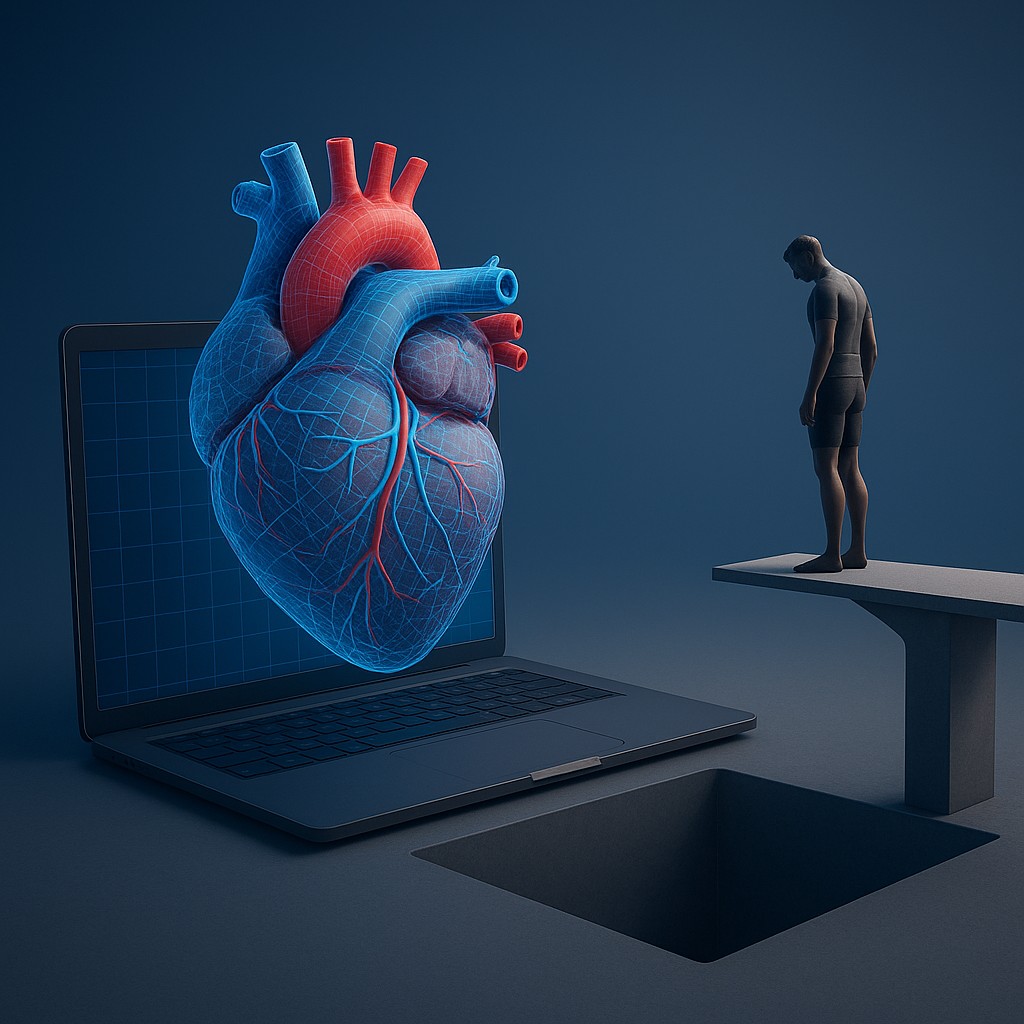
Imagine standing on the edge of a high-dive board, staring down into a pool that might be filled with water - or might be solid concrete. In traditional medicine, that is often what it feels like for the first person to test a new heart medication. For decades, the jump from testing a drug in a petri dish or a lab rat to testing it in a living human has been a gap filled with fear and uncertainty. We can see how a chemical affects a rodent or a single cell, but the human heart is a complex, rhythmic engine of electricity and pressure that does not always follow the rules.
We are now seeing a shift in this story that sounds like a plot from a sci-fi movie. Instead of crossing their fingers and hoping a new drug doesn't stop a volunteer’s heart, researchers are beginning to use "in silico" trials. This term comes from the silicon chips that power our computers, and it refers to running full-scale clinical trials inside a virtual world. By building a high-quality "digital twin" of a human heart, scientists can simulate exactly how a drug interacts with a specific patient’s unique anatomy without ever touching a needle to skin.
Decoding the Blueprint of a Digital Heart
To understand how a computer can predict a heart attack, we first have to understand what a digital twin actually is. This is not just a 3D animation like you would see in a video game; it is a mathematical model built from thousands of complex equations. These equations describe how minerals like sodium, potassium, and calcium flow in and out of heart cells. When you take a pill, those chemicals act like keys that fit into "locks" on the cell membranes. A digital twin simulates these interactions at a molecular level, letting researchers see if a drug might accidentally jam a lock that keeps the heart’s rhythm steady.
The real breakthrough happens when these cell models are scaled up to the size of the whole organ. A heart is not just a clump of cells; it is a pump with a specific shape and a precise firing sequence. By using data from MRI and CT scans, researchers can map the unique shape of a patient’s heart, including any scar tissue or physical quirks. This allows the simulation to track the "wavefront," or the path of electricity, as it moves through the muscle. If a drug causes the signal to lag or spin in circles, the computer flags it as a risk for an irregular heartbeat. It is essentially a massive stress test conducted in a world where the risks are zero.
Moving Beyond the "One Size Fits All" Method
Historically, medical research has struggled with the "Average Joe" problem. Drugs are often tested on a diverse but limited group of people, and the results are averaged to see if the drug is safe. However, biology is deeply personal. A drug that is perfectly safe for a 20-year-old athlete might be fatal for a 70-year-old woman with a minor genetic mutation. In silico trials allow researchers to move away from these dangerous averages and toward a more detailed understanding of risk across different types of people.
In a virtual trial, scientists can create a "population" of thousands of digital twins. They can intentionally program some hearts to have weak electrical signals, others to have high blood pressure, and others to represent different ethnicities or genders. By running the same drug through ten thousand different virtual versions of the heart, researchers can catch "edge cases" - those rare but deadly reactions that might not show up in a real-world trial of only a few hundred people. This method does not just protect the majority; it protects the outsiders who are often ignored by traditional statistics.
The Mathematical Filter for Toxic Compounds
The process of developing new drugs is notoriously wasteful. Out of thousands of compounds that look promising in a lab, only a tiny fraction ever make it to pharmacy shelves. Most fail because they turn out to be toxic to the heart - a discovery that often happens far too late, after millions of dollars have already been spent. Digital modeling acts as a high-tech filter, allowing researchers to fail fast and fail cheap. If a computer model shows that a compound causes an irregular heartbeat in 15 percent of simulations, that drug is scrapped before a single dollar is spent on manufacturing it for humans.
This "simulate and verify" approach is a radical change from the old "guess and check" method. By filtering out the failures early, scientists can focus their energy on the compounds that the simulations show are truly safe. This creates a much faster path to the market. It is important to remember that these models are not just guessing; they are grounded in decades of biological data. The goal is not to replace human trials entirely, but to ensure that by the time a drug reaches a person, we already have a "cheat sheet" predicting exactly how their body will react.
Comparing Trial Methodologies
To see why the medical community is so excited about this shift, it helps to compare the traditional pipeline with the new digital approach. The differences in speed, cost, and safety are significant.
| Feature |
Traditional Clinical Trials |
In Silico (Digital) Trials |
| Primary Risk |
High (Potential for human harm) |
Zero (No biological exposure) |
| Data Source |
Small groups of human volunteers |
Massive virtual populations |
| Speed |
Years of recruiting and monitoring |
Days or weeks of computation |
| Cost |
Billions of dollars in logistics |
Cost of server time and software |
| Flexibility |
Hard to change variables mid-trial |
Can tweak any variable instantly |
| Ethical Hurdles |
Significant (Invasive procedures) |
Minimal (Data privacy focused) |
The Data Quality Paradox
While it is tempting to think of digital trials as a magic wand, there is a catch that computer scientists call "GIGO" - Garbage In, Garbage Out. A digital heart is only as accurate as the biological data used to program it. If our understanding of a specific protein in the heart is wrong, our computer model will be wrong in exactly the same way. We are effectively building a map of a territory we are still exploring. This means that while these models are becoming incredibly advanced, they still rely on constant updates from real-world research to stay useful.
There is also the challenge of complexity. The heart does not exist in a vacuum; it is constantly influenced by the nervous system, hormones from the kidneys, and the changing pressure of the lungs. Most current models focus heavily on the heart's electrical and mechanical systems, but they are still catching up when it comes to simulating the "crosstalk" between different organs. As we get better at modeling the entire human body as a connected system, the predictive power of these digital twins will only grow.
Navigating the Ethical and Regulatory Landscape
As with any technology that moves faster than the law, digital twins raise some fascinating ethical questions. If a computer model predicts that a drug will be safe for you, but it ends up hurting you, who is responsible? Is it the scientist who designed the drug, the programmer who built the model, or the agency that approved the simulation? Government bodies like the FDA are currently working to create rules for how virtual data can be used to support drug applications. We are entering an era where data is becoming a recognized form of biological evidence.
Furthermore, there is the question of data privacy. To build a digital twin of your heart, a company needs incredibly detailed information about your genetics and your health. This is the ultimate "fingerprint." Making sure these digital replicas are used to save lives rather than to hike up insurance prices is a hurdle that society will have to clear as the technology goes mainstream. Despite these challenges, the momentum is unstoppable because the potential benefits - personalized medicine with no side effects - are simply too great to ignore.
Embracing the Future of Personalized Medicine
We are standing at the edge of a new era where "testing it out" no longer requires a leap of faith. The move from physical experiments to digital simulations is one of the greatest jumps in medical history. It moves us toward a future where healthcare is not just a reaction to illness, but a prediction of health. Imagine a world where your doctor runs a thousand simulations of a new treatment on your digital twin before you ever take the first pill, ensuring the path chosen is perfectly suited to your body.
This intersection of math, biology, and computing is more than just a tech milestone; it is a testament to human ingenuity and our desire to reduce suffering. By mastering the "silicon heart," we are paving the way for a safer, faster, and more compassionate form of science. As these models get better and our data becomes more precise, the line between the virtual and the biological will continue to blur. The digital twin is not just a model; it is a promise that the future of medicine will be as steady and reliable as a healthy heartbeat.