Imagine for a moment that it is five o’clock on a Tuesday in July. The sun is still baking the pavement, and every person in your city has just walked through their front door to perform the same ritual: they crank the air conditioning, open the fridge for a cold drink, and plug in their electric vehicle. Miles away, at a massive central power station, turbines are spinning at their absolute physical limits to keep up with this sudden, violent surge in demand. If that demand exceeds what the plant can produce by even a tiny fraction, the entire system can collapse like a house of cards, leaving millions in the dark.
For nearly a century, our solution to this problem was brute force. We built "peaker" plants, which are expensive, high-pollution gas generators that sit idle for 360 days a year just to handle those few hours of extreme heat. But the way we move energy is changing. Instead of relying on one lumbering giant to lift a heavy weight, we are beginning to realize that the same load can be lifted more easily by ten thousand ants working in perfect harmony. This is the birth of the Virtual Power Plant, or VPP, a digital symphony that turns your basement battery and your neighbor’s thermostat into a collective shield against blackouts.
The Flaw of the Centralized Giant
To understand why we need a virtual alternative, we have to look at the fragility of the traditional model. For decades, the power grid has been a one-way street. Energy was produced at a central hub, boosted to high voltages, and sent across hundreds of miles of wire to reach your lightbulb. This system is remarkably efficient at moving large amounts of power, but it is notoriously inflexible. A massive coal or nuclear plant is like a freight train; it takes hours, sometimes days, to speed up or slow down. When a heatwave strikes and demand spikes in minutes, these giants cannot react quickly enough.
This creates a dangerous gap between the power we need and what the "train" can provide. To bridge this gap, utilities have historically relied on those peaker plants. Because these plants are only used occasionally, they are a financial black hole. Furthermore, because they must start up instantly, they usually burn fossil fuels that release high concentrations of pollutants. We have essentially been keeping a fleet of old, gas-guzzling trucks in the garage just in case we need to make a five-minute trip to the grocery store once a year.
The VPP flips this script by moving energy "production" closer to the people who use it. In truth, a VPP doesn't always produce new electricity. Often, it "creates" energy by convincing thousands of devices to stop using it for a few minutes. If a thousand homes each dim their lights by ten percent and pause their pool pumps for twenty minutes, the effect on the grid is exactly the same as if a small power plant had suddenly come online. It is the art of subtraction disguised as addition.
The Digital Conductor and the Battery Orchestra
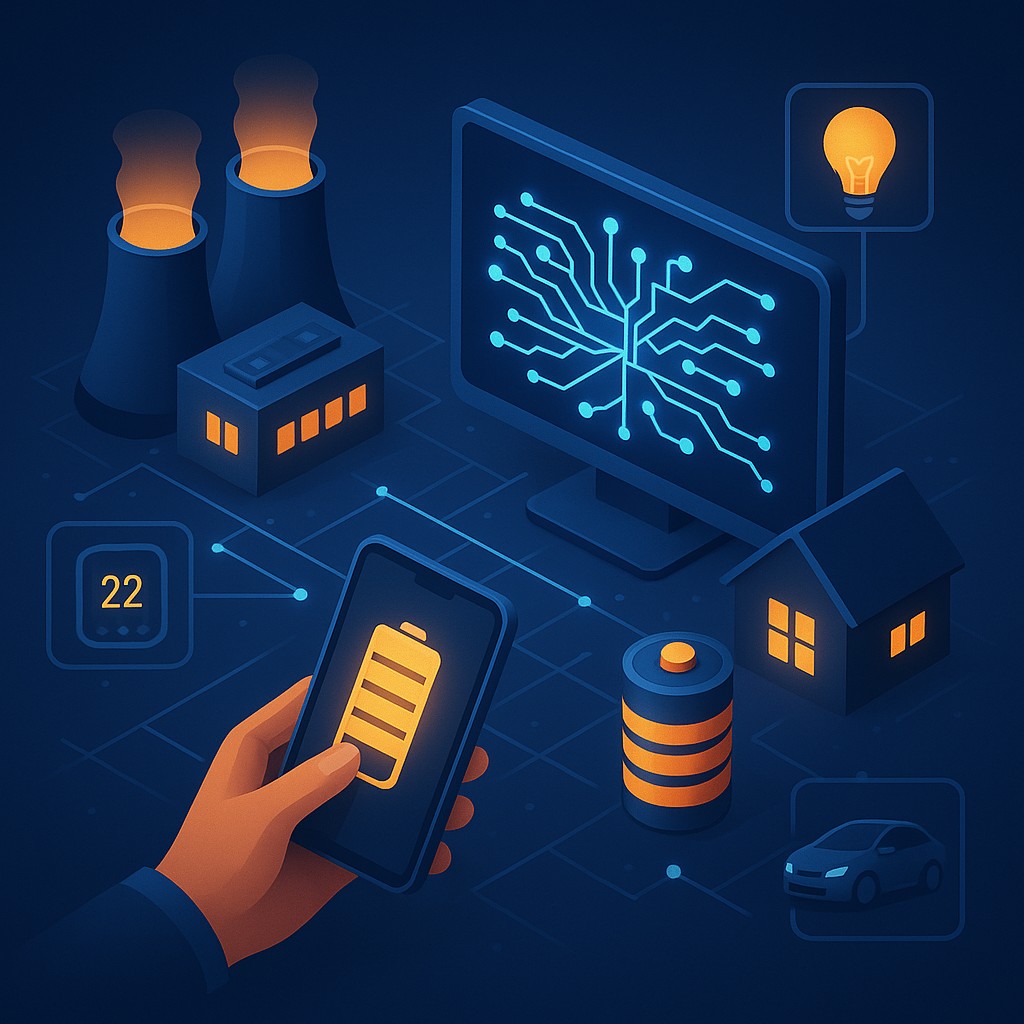
A Virtual Power Plant is not a physical building with smokestacks and security fences. Instead, it is a sophisticated layer of software living in the cloud, acting as a conductor for an orchestra of "distributed energy resources." These resources include home battery systems like the Tesla Powerwall, smart thermostats, electric vehicle chargers, and even smart water heaters. Each device is relatively small on its own, but when they are networked together, they have the strength of a mid-sized utility plant.
The secret to a VPP is the "signal." When the grid operator notices that demand is reaching a critical level, they send a digital alert to the VPP software. Within milliseconds, the software communicates with thousands of individual devices. It might tell five hundred EVs in a specific suburb to pause their charging for half an hour. It might ask three thousand home batteries to feed a small amount of stored solar energy back into the house so the building doesn't need to pull from the grid. Because these adjustments are spread over such a vast number of users, the impact on any single person is nearly invisible. Your beer stays cold and your car still charges, but the grid stays standing.
| Feature |
Traditional Power Plant |
Virtual Power Plant (VPP) |
| Physical Footprint |
Massive central facility |
Thousands of small, scattered devices |
| Response Time |
Minutes to hours |
Seconds |
| Primary Fuel |
Coal, Gas, or Nuclear |
Existing stored energy or reduced usage |
| Cost to Build |
Billions of dollars |
Cost of software and networking |
| Environmental Impact |
High emissions |
Zero direct emissions |
| Resiliency |
Fails if one major line cuts out |
High resilience due to decentralization |
The Tiny Sacrifices That Save Cities
One of the biggest hurdles to widespread VPP adoption isn't technology, but the psychology of control. Understandably, people are often hesitant to give a utility company the "remote control" to their appliances. However, the brilliance of a VPP lies in the fact that it operates on the margins. It doesn't turn off your AC in the middle of a 100-degree day; instead, it might lower the temperature by two degrees an hour before the peak hits. This process, called "precooling," turns your home into a thermal battery that stays cool even if the AC unit takes a short break later.
Think of it as a community cooperative for electrons. By participating, homeowners often receive credits on their utility bills or direct payments. In places like California and South Australia, VPPs have already proven their worth. During record-breaking heatwaves, these networks have successfully "shaved" the peak off the demand curve, preventing rolling blackouts without firing up a single extra turbine. This shifts the grid from a model where supply must chase demand, to one where demand is smart enough to wait for a moment of stability.
This decentralization also makes the grid much harder to break. In a traditional system, a single squirrel or a falling tree branch on one high-voltage line can darken an entire county. In a VPP world, power is everywhere. Even if a main line goes down, a neighborhood with many VPP-linked batteries can operate as a "microgrid," keeping the lights on locally while the rest of the world waits for repairs. We are essentially moving from a single point of failure to a web of many points of support.
Correcting Myths About Remote Control
Whenever we talk about smart devices and utility control, a few common misconceptions pop up. The most frequent myth is that the utility can "empty" your EV battery, leaving you stranded for your morning commute. In reality, VPP agreements are governed by strict rules set by the user. You can tell the system, "Never let my car battery drop below 80 percent," or "Do not adjust my thermostat if the house is above 74 degrees." The VPP only plays with the energy you have explicitly labeled as "excess."
Another misconception is that VPPs are only for the wealthy who can afford solar panels. While home batteries are a huge part of the system, "demand response" (the act of using less) is available to almost anyone with a smart device. Renters with smart thermostats or even "smart plugs" on their appliances can join the network. It is a democratic approach to energy where everyone, from someone in a studio apartment to a mansion owner, contributes what they can to their neighborhood's stability.
Finally, there is the idea that this is a "future" technology that is still decades away. In truth, the software is already being used by major companies and utilities globally. From New England to Japan, thousands of residents are already earning money by letting their water heaters take a "nap" during peak hours. We aren't waiting for a breakthrough in physics; we are simply waiting for our gadgets to start talking to each other.
The Architecture of a Collective Future
As we integrate more renewable energy like wind and solar, the need for VPPs will only grow. Solar power is great, but it tends to disappear exactly when the sun goes down and everyone turns on their ovens. Wind is fantastic, but it doesn't always blow when we have a deadline to meet. The VPP acts as the ultimate buffer, smoothing out the jagged edges of renewable energy and making it a reliable, 24/7 resource.
- Aggregation: Software groups thousands of homes into a single "block" of power.
- Forecasting: AI predicts when a heatwave or storm will stress the grid before it happens.
- Optimization: The system decides which devices should discharge power and which should just turn off.
- Verification: The utility confirms the energy was saved and pays the participants.
This system represents a fundamental shift in our relationship with electricity. For a century, we have been passive consumers, flipping a switch and expecting the world to move for us. Now, we are becoming active participants in a living network. Your home is no longer just a place where you consume power; it is a vital organ in a giant, city-wide body.
The transition to virtual power plants is more than just a clever engineering trick; it is a roadmap for living sustainably on a planet with limited resources. By using intelligence instead of hardware, and coordination instead of combustion, we are building a world where a heatwave doesn't have to break the system. You are no longer just a customer of the grid; you are a guardian of it. Your electric vehicle might just be the reason your neighbor's lights stay on tonight. This is a quiet, digital revolution, turning our homes into the power plants of tomorrow.