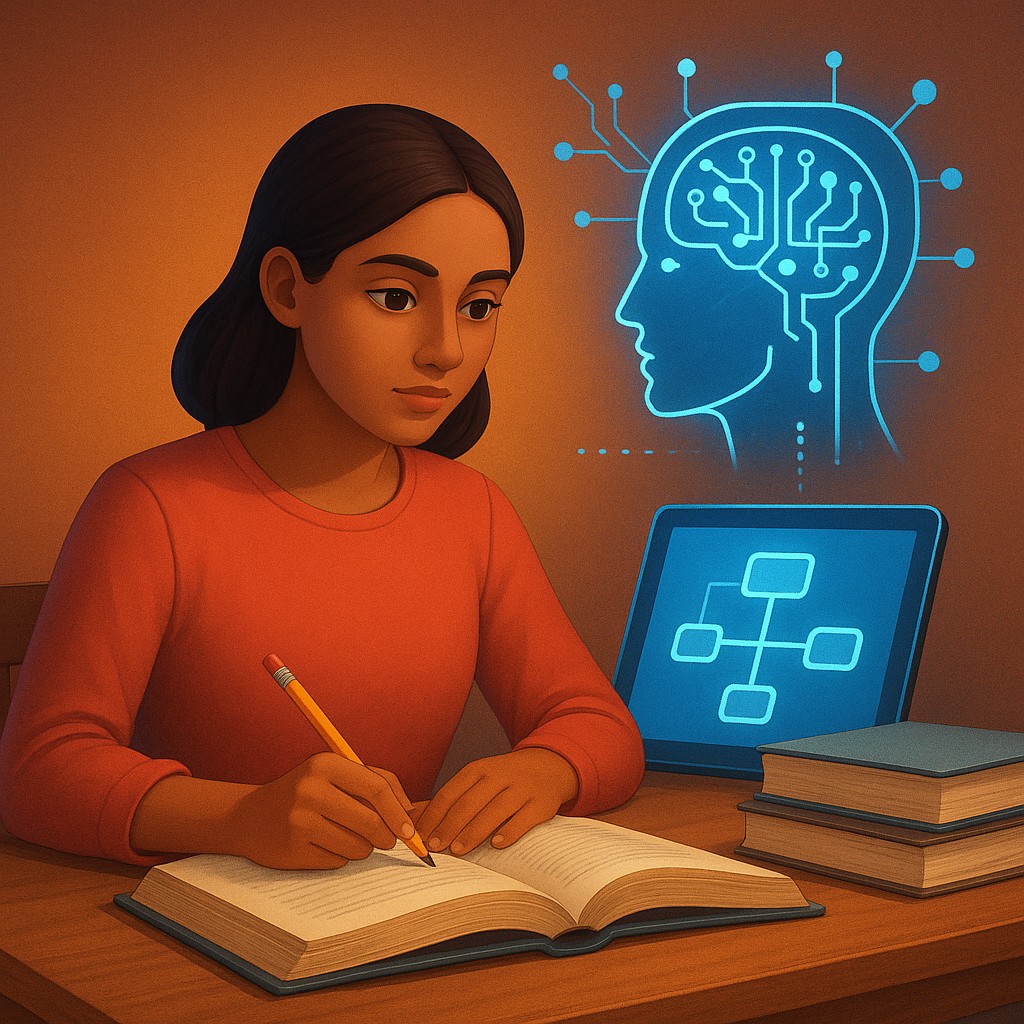
Imagine sitting down for your first day at a new school, and instead of a syllabus, you are handed a graduate thesis on quantum physics. You would probably close the book and walk out. Humans do not learn by absorbing a massive, chaotic pile of information all at once. We need a scaffold. We start with simple letter sounds and basic math before we ever move on to Shakespeare or calculus. This step-by-step layering lets our brains build a steady foundation. By the time we reach complex ideas, we already have the mental framework needed to make sense of them.
For years, however, we treated artificial intelligence like a digital trash compactor rather than a student. The common wisdom in the Silicon Valley tech race was that more data was always better, no matter the order. Developers fed Large Language Models (LLMs) almost the entire internet at once. They threw Nobel Prize-winning novels into the same pile as messy social media fights and broken computer code. While this "brute force" method eventually worked, it was incredibly wasteful. It took massive amounts of electricity and computing power to help the machines find the signal through all that noise. Now, a quiet change is happening in AI labs as researchers adopt a more human-like approach called curriculum learning.
The Mental Makeup of a Digital Student
To understand why the order of information matters, we have to look at how an AI actually processes a sentence. When a model "trains," it isn't reading the way you are. Instead, it is playing a high-stakes guessing game. It tries to predict the next word in a sequence based on patterns it has seen before. When we give a model a randomized mess of data, we are asking it to learn the rules of logic and the chaos of internet slang at the exact same time. This creates "noise" that the model must fight through. It is like trying to learn how to drive a car while also studying for a pilot's license. The two skills might share some ideas, but the conflicting rules only slow you down.
Curriculum learning fixes this by introducing a hierarchy. By starting with "clean" data, such as children's books or edited textbooks, the model builds a rock-solid grasp of grammar and reasoning. It learns that "the cat sat on the mat" is a likely sentence before it ever has to deal with the strange "word salad" of an internet forum. This early stage acts as a filter. Once the model knows what "correct" language looks like, it can handle messy or contradictory info later on without losing its way. It becomes a more resilient learner because it has a point of reference for what actually makes sense.
Efficiency and the End of the Data Binge
One big myth in AI is that the smartest model is always the one that has seen the most data. In reality, developers are finding that a model trained on 100 billion high-quality, well-ordered words can often beat a model trained on a trillion random ones. This is mostly because of how "pre-training loss" works. When a model hits data that is too hard for its current level, it makes wild, incorrect guesses. Each bad guess forces the system to adjust its internal settings to compensate, which burns through expensive computer processing time. If the data is too messy, the model can even "diverge," basically becoming so confused by contradictions that it stops improving entirely.
By using curriculum learning, developers keep the model in a "flow state," where the difficulty of the data matches the machine's current ability. This stops the system from wasting energy trying to solve problems it isn't ready for yet. It also leads to much faster training. Because the model isn't constantly un-learning the nonsense it picked up from low-quality websites, its progress is steady and predictable. We are moving away from the era of "Big Data" and into the era of "Smart Data," where the lesson plan is just as important as the computer's design.
How Information Is Ranked
How do researchers decide what is "easy" or "hard" for a machine? It isn't just about the length of the words. In curriculum learning, data is ranked using scoring math that looks at several different markers. These markers help create a sorted "playlist" of information for the AI to consume over several months.
| Type of Measurement |
What It Checks |
Why the AI Needs It |
| Perplexity Score |
How "surprising" a text is to a basic model. |
Lower scores mean the text follows standard patterns, making it a good starting point. |
| Fact Density |
The ratio of unique facts to the total number of words. |
High density is harder to process; the model needs a foundation before digesting heavy info. |
| Structural Cleanliness |
Use of proper grammar and logical flow. |
Keeps the model from picking up bad habits or "broken" speech patterns early on. |
| Contradiction Risk |
How much the data goes against common knowledge. |
Sorters filter out conspiracy theories or niche slang until the model knows the basic truth. |
By using these criteria, developers make sure the model doesn't get overwhelmed. For example, a model might spend its first two weeks reading only Wikipedia and classic literature. Once it masters those, researchers introduce technical manuals. Only at the very end is it exposed to the chaotic world of social media or complex legal papers. This mirrors how a child learns to speak using simple sentences long before they try to write an essay or a line of code.
Avoiding the Trap of Digital Confusion
One of the biggest risks in training an AI is "catastrophic forgetting." When a model is hit with a wall of conflicting info, such as two websites arguing over a date in history, it can struggle to find the truth. If this happens too early, the model's basic logic can become warped. Curriculum learning acts as a safety net by making sure the "truth" is established through reliable sources first. By the time the model sees a website claiming the moon is made of cheese, it has already read enough science books to know that this specific claim is an outlier that shouldn't be taken seriously.
This method also helps solve "hallucinations," where an AI confidently says something that is false. Many hallucinations happen because the model can't tell the difference between a fictional story, sarcasm, and a factual report. If a model learns these distinctions through a structured plan, it is much better at keeping those categories separate. It develops a sense of "context" that a randomly trained model often lacks, much like a student learns the difference between a chemistry lab and a creative writing class.
The Future of Tailor-Made Intelligence
Looking ahead, curriculum learning suggests we might soon have AI models "schooled" for specific jobs from day one. Instead of one giant model that tries to know everything, we might see models that follow a medical, legal, or engineering path. This would make them much more reliable than the "jack-of-all-trades" models we use today. By carefully picking the order and quality of what an AI learns, we aren't just making them faster; we are making them more logical and better at handling the subtle details of human thought.
This shift reminds us that intelligence is not just about how many facts you can memorize. It is about the structure of your understanding and the strength of your foundations. As we polish these digital lesson plans, we are discovering that the secret to better AI isn't necessarily more data, but better teaching. By treating these machines more like students and less like databases, we are reaching a new level of performance. The next great leap in technology won't come from a bigger hard drive, but from a better syllabus.