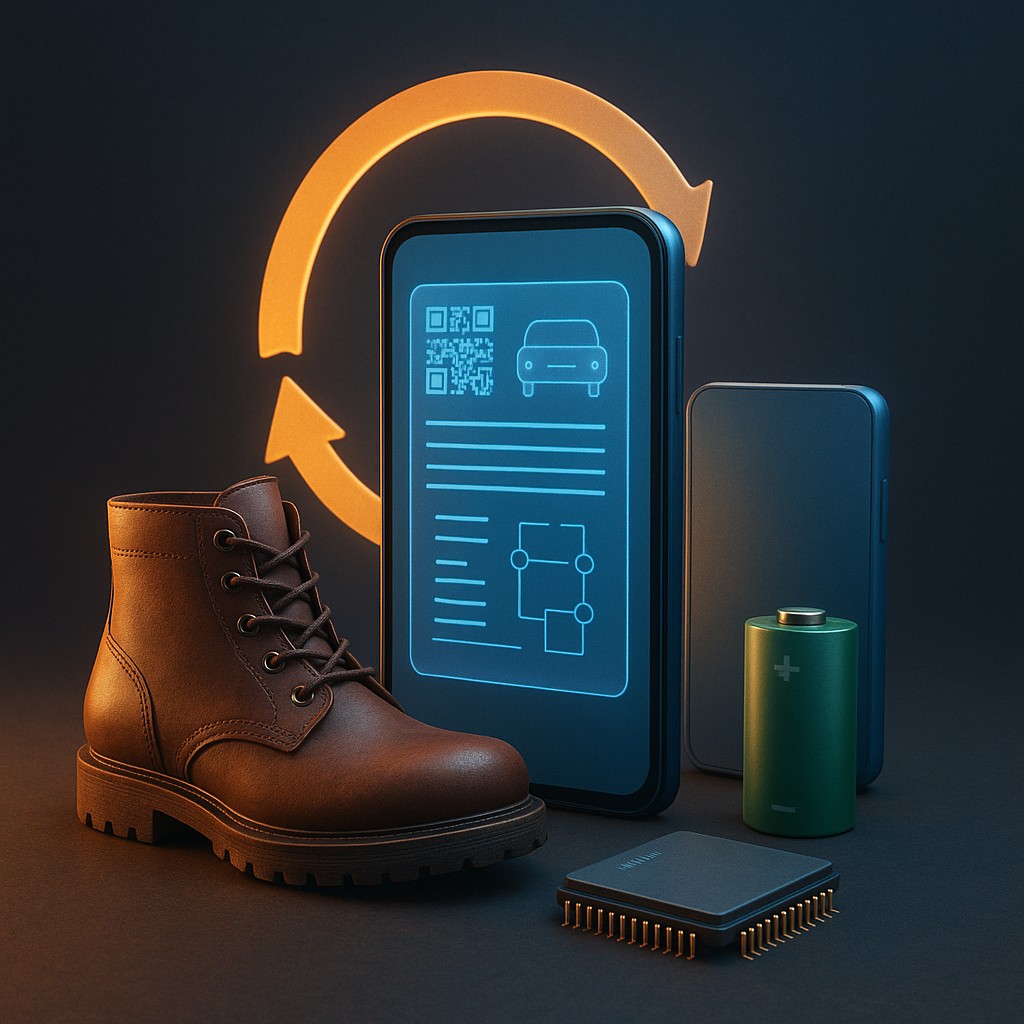
For decades, the global economy has followed a "take-make-waste" model. This system often depends on staying intentionally in the dark. When you buy a smartphone or a pair of leather boots, the history of those items is usually a mystery. You might see a "Made in Italy" tag or a brand logo, but the journey of the individual parts, the chemicals used in the factory, and the specific carbon footprint of that exact item remain hidden. This lack of transparency does more than just frustrate conscious shoppers; it is a major roadblock to a circular economy, where goods are recycled and reused. If a recycler doesn't know exactly which metals are inside a laptop battery, or if a repair technician cannot find the original blueprints for a circuit board, the easiest business choice is often to shred the item and start over.
However, a quiet revolution is changing the inner workings of international trade. We are moving toward a world where every physical object has a "digital twin" that records its entire history. This concept, known as the Digital Product Passport (DPP), is currently being tested in massive international trials across industries like battery manufacturing, clothing, and electronics. Unlike traditional barcodes that simply tell a store what a product is, these passports use digital identity tech to tell a story of where a product has been and what it is made of. By linking the physical and digital worlds, we are effectively giving inanimate objects a voice, allowing them to carry their own paperwork from the factory floor to the recycling center.
The Ghost in the Machine: How Digital Twins Work
To understand the Digital Product Passport, we first have to look at how identity is managed. In the current system, most product data is kept in separate "silos." A leather tannery has its records, the shoe factory has its own, and the store has another set entirely. These systems rarely talk to each other, creating a broken chain where information is lost at every handoff. An item's passport changes this by creating a permanent digital identity. This identity is anchored to the physical product through a "carrier," such as a QR code, an NFC chip, or even a specialized invisible chemical marker. This carrier is the doorway to a "cloud twin," a secure digital ledger that stores verified data about the product's origin, materials, and environmental impact.
The technical heart of this system often relies on Decentralized Identifiers (DIDs). Think of a DID as a permanent web address for a physical object that isn't owned by any single company. If a brand goes out of business or a database is deleted, the product's identity remains reachable because it is hosted on a shared network. This ensures that a repair shop twenty years from now can still scan an old appliance and find safety data or dismantling instructions, even if the original manufacturer no longer exists. It shifts the "ownership" of product data from the corporation back to the product itself, making information a public resource that follows the item throughout its life.
This digital twin is more than just a static file; it acts as a living document. As the product moves through the world, new "events" can be added to its passport. When a high-end jacket is repaired, the tailor can log the fix. When an electric vehicle battery is refurbished to store energy for a power grid, its capacity and health data are updated. This creates a high-quality record that eliminates the guesswork for future owners and recyclers. It transforms the product from a static piece of inventory into a dynamic asset with a verifiable family tree.
Breaking Down Barriers with Universal Frameworks
The biggest challenge in building a global passport system is not the technology itself, but the language used to describe things. If a German car maker uses one code for "lithium-ion" and a Chinese battery recycler uses another, the data becomes useless. This is why recent international trials are focusing on "Universal Frameworks" and shared rules like the United Nations Transparency Protocol (UNTP). These frameworks provide a common vocabulary so that different tracking systems can interact smoothly. They set the ground rules for what data must be shared, who is allowed to see it, and how to prove that the information is actually true.
"Verifiable Credentials" (VCs) are the secret ingredient that makes this data trustworthy. Imagine a factory in Southeast Asia claims it uses 100% recycled cotton. In the old system, you just had to take their word for it, or hope an inspector caught a mistake during a yearly visit. With VCs, a third-party auditor can issue a digital, secure "stamp of approval" linked directly to that specific batch of cotton. When that cotton becomes a shirt, the shirt’s Digital Product Passport contains a tamper-proof link to that auditor's signature. It creates a chain of trust that is mathematically proven, making it much harder for dishonest companies to "greenwash" or fake their environmental claims.
| Feature |
Traditional Barcodes |
Digital Product Passports (DPP) |
| Data Scope |
Basic product ID (SKU) |
Lifetime history and material data |
| Storage |
Private brand databases |
Shared, permanent digital twins |
| Life Cycle |
Ends at the checkout counter |
Continues through repair and recycling |
| Verification |
Reported by the brand itself |
Linked to third-party digital stamps |
| End Goal |
Shipping and inventory |
Reusing and recovering resources |
From Cloudy Chains to Transparent Circles
The ultimate goal of the Digital Product Passport is to spark the "Circular Economy," a system where waste is designed out and materials are kept in use as long as possible. Currently, our recycling systems are incredibly inefficient because we are trying to sort through a mountain of "mystery trash." If a recycler receives a shipment of mixed plastics, they often have to use expensive sensors to guess the chemical makeup of each piece. If they guess wrong, the entire batch of recycled plastic might be brittle or contaminated. A passport eliminates this "information gap" by providing a digital recipe for every part.
Consider the complexity of a modern electric vehicle (EV) battery. It contains cobalt, nickel, manganese, and lithium, often sourced from conflict zones or fragile environments. When an EV reaches the end of its life, the battery might still have 80% of its original capacity, which is perfect for storing solar energy for a home. However, without a Digital Product Passport, a second-hand buyer has no way of knowing how many times that battery was fast-charged or if it has internal damage. The passport provides a "State of Health" certificate that makes the resale market for used parts safe and profitable.
This transparency also empowers shoppers to make decisions based on reality rather than marketing. When you scan a product in a store, the passport can show you the actual carbon footprint of that specific item, accounting for the distance it traveled and the energy used by the factories that built it. This shifts the balance of power; brands can no longer hide behind vague slogans like "Sustainably Sourced." They must provide the raw data to back it up. In this way, the passport acts as a bridge between corporate honesty and consumer choice, turning every purchase into a vote for a more transparent world.
Solving the Privacy Puzzle
While the benefits of transparency are clear, moving toward "glass supply chains" creates a tension between openness and privacy. Companies are often hesitant to reveal their specific suppliers or secret manufacturing techniques, fearing that competitors will copy their success. If a luxury watchmaker reveals the exact source of their specialized springs, they might lose their advantage in the market. To solve this, the next generation of Digital Product Passports is experimenting with technologies like Zero-Knowledge Proofs (ZKPs).
A Zero-Knowledge Proof is a mathematical trick that allows one party to prove a statement is true without revealing the data behind it. For example, a manufacturer could prove to a regulator that "this product was made without child labor" or "this item contains less than 0.1% of a restricted chemical" without revealing their full list of suppliers or the exact chemical formula. This allows for a "need-to-know" model. A recycler might see the material list, a repair shop might see the wiring diagrams, and a shopper might only see the carbon footprint and origin story, all while the company's trade secrets remain encrypted and safe.
Furthermore, there are concerns about personal privacy. If your jacket has a digital passport that is scanned every time you enter a boutique or a repair shop, could your habits be tracked? This is where the decentralized nature of these IDs becomes critical. By using privacy-focused designs, the system can ensure that the "passport" belongs to the object, not the person. The goal is to track the material, not the owner. Ensuring these systems are "private by design" is one of the major hurdles being tackled in current international tests to prevent the circular economy from turning into a surveillance system.
The Future of Living Objects
We are standing at the edge of a world where "waste" is seen mainly as a failure of information. When we throw something away, it is usually because we don't know what it's made of, how to fix it, or who might want its parts. Digital Product Passports provide the missing data that turns "trash" back into "resources." As these systems become part of global trade laws, such as the European Union's sustainable product regulations, they will move from being a voluntary "extra" to a mandatory requirement for doing business.
The transition to a digital, circular economy won't happen overnight. It requires massive cooperation between tech giants, manufacturers, and governments. But the prize is a world where the things we own have a history we can trust and a future we can plan for. It is a shift from a world of disposable gadgets to a world of lasting assets. By giving every product a digital passport, we are finally acknowledging that what we make matters, and that its story shouldn't end just because it left the store.
As you look around your room at the objects surrounding you, try to imagine them not as silent, still things, but as data-rich entities waiting to tell you their story. Imagine the peace of mind in knowing that your favorite sweater can be fully recycled because its "passport" told the recycler exactly which biodegradable dyes were used. We are entering an era of radical honesty in manufacturing, where the digital twin is just as important as the physical item. This is more than just a tracking system; it is a new way of valuing the material world, ensuring that nothing is lost, nothing is hidden, and everything stays in the loop.