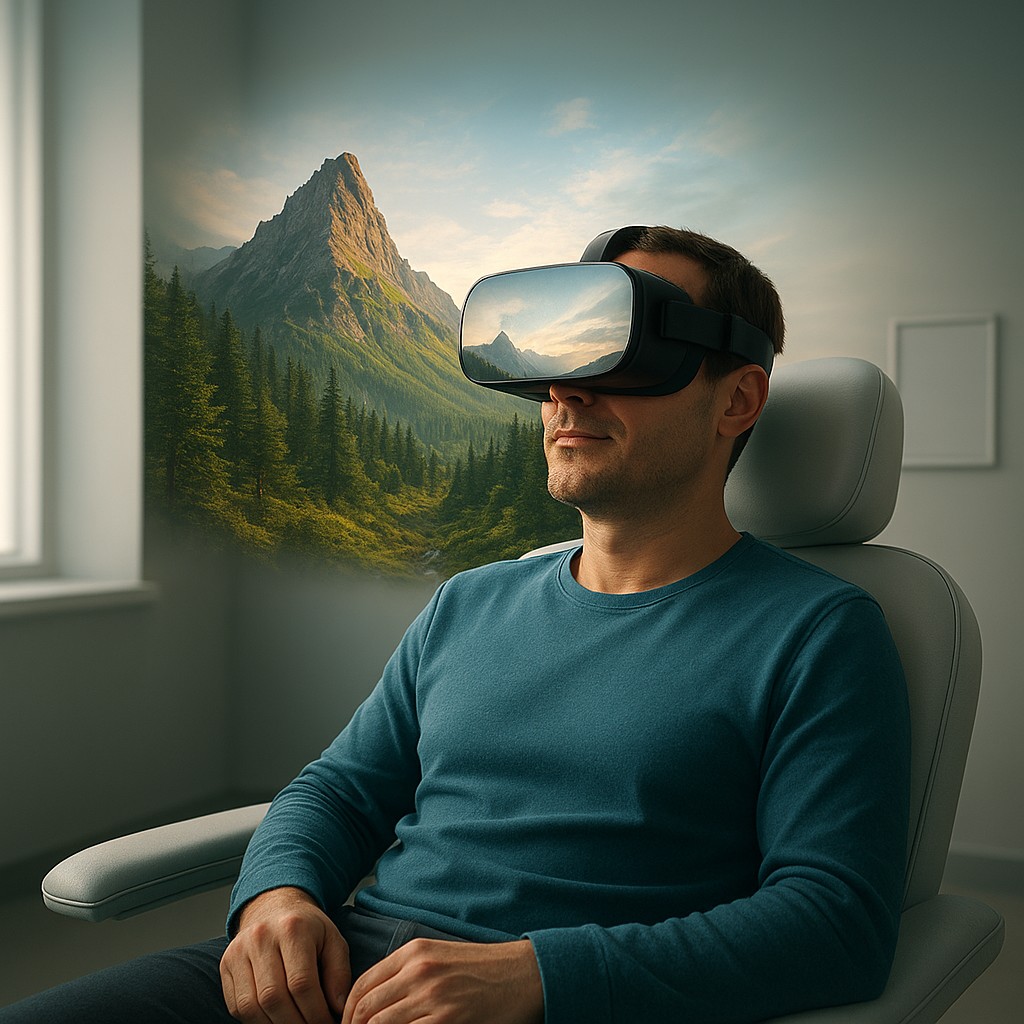
Imagine standing on the edge of a jagged mountain peak. You hear the wind whistling through the pines and smell the rich scent of damp earth. As you look out over the valley, your breathing slows and your heart rate steadies. The throbbing ache in your lower back begins to fade, receding into a quiet hum. Now, imagine that the mountain, the wind, and the scent are all coming from a headset while you sit in a sterile clinic chair. This is more than just a high-tech distraction or a fancy screensaver. It is a targeted neurological treatment designed to hijack your brain's internal pharmacy, proving that the line between "fake" medicine and "real" biology is much blurrier than we ever suspected.
For decades, the placebo effect was the annoying ghost in the machine of clinical trials. Researchers viewed it as "noise" to be eliminated to prove that a chemical drug actually worked. If a sugar pill made someone feel better, it was often dismissed as a trick of the mind - a sign that the patient's pain wasn't "real" enough to need "real" medicine. However, a new frontier in neuroscience is flipping this script. By using digital therapeutics, which are immersive software programs designed to treat medical conditions, scientists are learning how to intentionally trigger the body’s own pain-control system. They are creating "digital placebos" not to fool patients, but to train the brain to self-medicate using its own supply of neurochemicals.
The Internal Pharmacy and the Connection to the Spine
To understand how a digital experience can compete with a pill, we have to look at how the human nervous system is wired. When you stub your toe, "bottom-up" signals travel from your foot to your brain to shout that something is wrong. But the brain is not just a passive receiver of bad news; it is also an active gatekeeper. It has a "top-down" mechanism known as the descending pain modulatory system. This system can send signals back down the spinal cord to literally shut the gates on pain messages before they even reach the conscious mind. This is why an athlete can finish a race on a broken ankle without noticing the injury until they cross the finish line.
The main engine of this system is a brain region called the periaqueductal gray, or PAG. Think of the PAG as a manager in a chemical plant. When the PAG is activated by specific sights, sounds, or moods, it triggers the release of natural opioids like endorphins and enkephalins, as well as dopamine. These are the body's homegrown versions of morphine and "feel-good" chemicals. Digital placebos work by using immersive patterns to stimulate the prefrontal cortex, the part of the brain responsible for complex thinking. This area then orders the PAG to start the "pharmacy" production lines. By immersing the patient in a high-quality digital environment, we aren't just distracting them; we are physically changing the chemistry of the spinal cord.
Comparing Traditional Medicine and Digital Therapeutics
While traditional medicine relies on a molecule finding a receptor, digital medicine relies on a signal finding a circuit. This shift represents a move from basic biochemistry to neural engineering. The following table highlights the fundamental differences in how these two worlds approach chronic pain.
| Feature |
Traditional Biochemical Medicine |
Digital Placebo / Therapeutic |
| How it Works |
Chemical compounds bind to receptors |
Sensory input triggers brain pathways |
| Delivery |
Pills, injections, or creams |
VR, AR, or specialized software |
| Main Side Effects |
Liver damage, addiction, nausea |
Eye strain, motion sickness, or "sim-sickness" |
| Source of Relief |
External synthetic substances |
Internal opioids and dopamine |
| Primary Goal |
Suppress symptoms with chemistry |
Change perception through brain plasticity |
| Duration |
Lasts as long as the drug is in the blood |
Can create long-term behavioral changes |
Tricking the Brain to Silence the Pain
One of the most fascinating things about digital placebos is their ability to engage the brain’s vision and hearing centers so deeply that they bypass the conscious realization that the experience isn't real. The brain is remarkably easy to immerse. When you enter a high-quality virtual reality environment, your thalamus - the brain’s relay station - starts processing these digital inputs as primary reality. If the environment uses "biophilic" designs, such as nature patterns or specific sound frequencies, it reduces activity in the amygdala, the brain’s alarm bell for fear and pain.
This creates a biological feedback loop. As the amygdala quiets down, the prefrontal cortex becomes better at regulating emotional responses to pain. In clinical trials for chronic conditions like endometriosis or fibromyalgia, patients using these digital tools show a significant increase in pain tolerance. Researchers have even conducted "naloxone challenges," where they give patients a drug that blocks opioid receptors. When these receptors are blocked, the pain relief from the digital placebo often vanishes. This proves that the digital experience was literally causing the brain to manufacture its own painkillers. The "trick" isn't in the mind; it is the activation of a biological process that already exists.
The Limits of the Virtual Band-Aid
Despite the potential of digital placebos, it is vital to distinguish between how we feel pain and actual physical damage. If you have a ruptured appendix or a broken bone, a headset will not repair the tissue or stop an infection. Digital therapeutics are designed to manage the "volume" of chronic pain, which is often caused by a sensitized nervous system rather than a fresh injury. In many chronic pain patients, the brain has learned to stay on high alert long after the original wound has healed. The digital placebo helps the brain "unlearn" this sensitivity.
Furthermore, these tools are not a one-size-fits-all solution. Some people are "placebo responders," meaning their genetics or personality makes their pain-control system more reactive to sensory input. Others may find the technology annoying or overstimulating. Therefore, the future of this field lies in personalization, where a digital environment is tailored to an individual’s specific brain activity. We are moving toward a world where a doctor might prescribe "thirty minutes of Glacier Hike" instead of an extra dose of ibuprofen. However, this will always be part of a broader strategy that includes physical therapy and, when necessary, surgery.
Reimagining the Future of Recovery
The rise of digital placebos forces us to reconsider what it means to heal. For centuries, we have viewed the body as a machine that needs external parts and fluids to keep running. When it broke, we added chemicals. But the science of the descending pain modulatory system suggests that the body is more like a sophisticated, self-regulating ecosystem. We are discovering that our experiences can directly rewrite our biology. This shift empowers patients, as it moves the source of relief from a pharmacy shelf to the internal architecture of their own minds.
As we continue to refine these digital tools, they will likely become a standard part of recovery. Imagine a world where healing after surgery happens in a virtual sanctuary that stops pain without the risk of addiction, or where chronic back pain is managed through a smartphone app that uses soundscapes to calm an overactive nervous system. By understanding that our perception can be programmed, we open the door to a more humane and precise form of medicine. The mountain peak in the headset is not a lie; it is a key that unlocks a door to a room where we have always had the power to soothe ourselves.