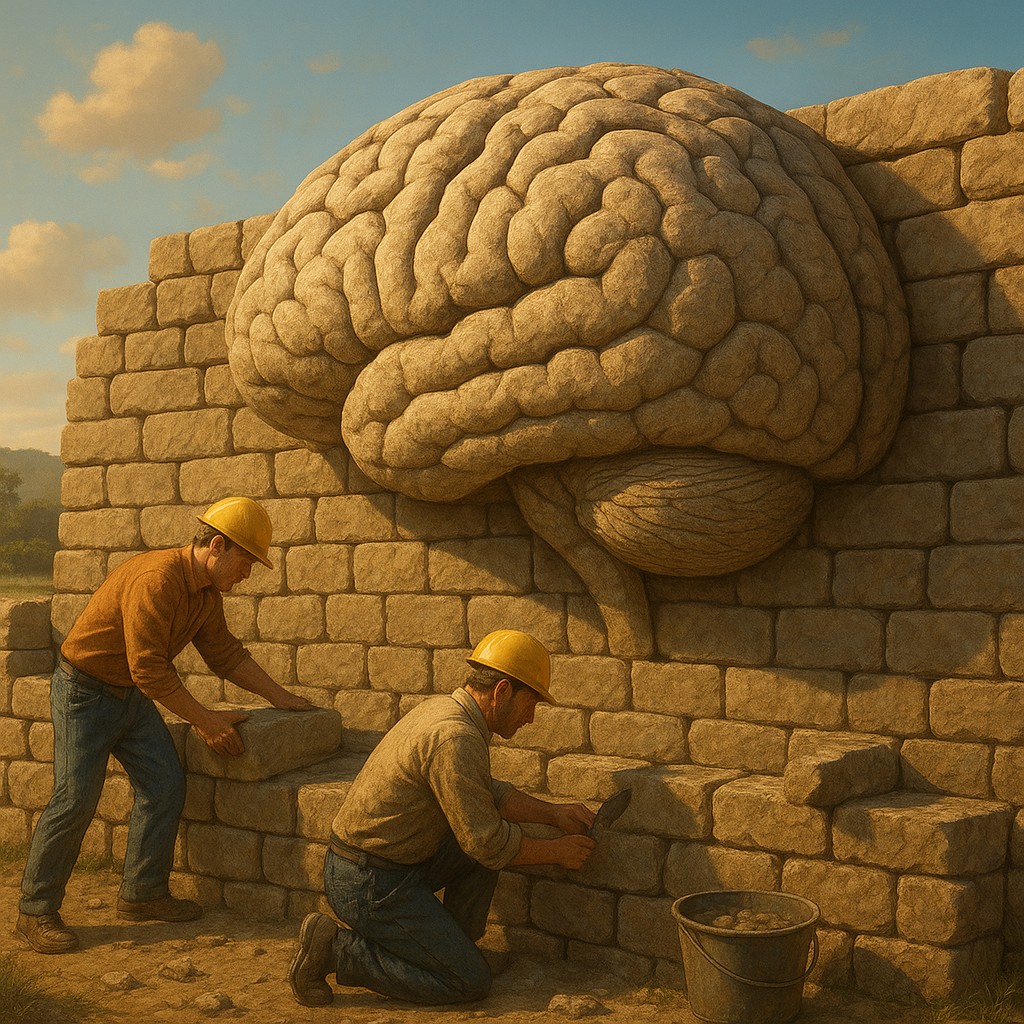
Think of yourself as a landscape architect commissioned to build a grand stone wall meant to last for centuries. You have two choices for your construction crew. The first team arrives in a panic, stacking every stone and pouring all the mortar in one frantic twelve-hour shift, hoping sheer intensity will hold it together. The second crew works for only one hour, but they return a week later to see how the stone has settled. They come back a month later to reinforce the joints, and once more a year later to add the final touches. While the first wall might look grand by sunset, the shifting earth will likely turn it to rubble within a few seasons. The second wall, however, weaves itself into the landscape, its mortar curing deeply to become a permanent fixture of the environment.
Our brains follow this exact architectural rule when processing information. Most of us have spent years trying to "cram" for big moments, falling for the trick that twelve hours of intense focus is just as good as twelve hours of spread-out effort. We feel a false sense of confidence because the facts are still bouncing around our short-term memory, but this is a biological lie. The human brain is not a hard drive that simply records data the moment it enters. Instead, it is an efficient, thrifty organ that actively looks for reasons to delete information to save energy. To convince your brain that a bit of trivia or a complex skill is worth the physical cost of permanent storage, you have to prove it is a recurring need in your life, not just a one-time visitor.
The Brain's Filter for Important Data
The brain is a ruthless editor. Every day, we are hit with millions of sensory details, from the color of a passing car to the specific wording of an email. If we remembered everything with the same intensity, our mental processors would overheat and crash. To manage this load, the hippocampus acts as a middle manager, deciding what gets moved from the "unstable" short-term memory into the "permanent" storage of the long-term cortex. When you cram, you are essentially shouting at this manager for five hours straight. The manager hears you, but as soon as you stop shouting and go to sleep, they assume the crisis is over and clear their desk for tomorrow’s mail.
This biological reality is driven by a process called long-term potentiation. For a memory to become durable, neurons must physically change, building stronger connections and creating new proteins. This is not just a metaphor for "learning"; it is a literal structural renovation of your gray matter. When you see information once and never again, there is no biological reason for the brain to spend energy on those architectural changes. It flags the data as "temporary noise." However, when you run into that information again after you have started to forget it, the brain spots a pattern. It realizes this specific data appeared on Tuesday, Thursday, and the following Monday, signaling that it is a permanent part of your world that needs a forever home.
The Evolutionary Logic of the Struggle
One of the most surprising parts of the "spacing effect" is that the struggle to remember is actually what creates the memory. In a world of instant answers, we often feel like failures if we cannot recall something immediately. In reality, that moment when you are about to forget and you force your brain to reach back and find the information sends a high-priority signal to your synapses. Scientists call this "desirable difficulty." If the information is too fresh, remembering is too easy and the brain does not bother strengthening the path. If the information is totally gone, you are just starting over. The sweet spot is right on the edge of forgetting.
From an evolutionary standpoint, this makes perfect sense. Our ancestors did not need to remember the location of a berry bush they saw once; they needed to remember the ones that grew fruit season after season. A single encounter could be a fluke, but encounters separated by time suggest a permanent landmark. By putting gaps between your study sessions, you are mimicking the natural timing of meaningful information. You are essentially "gaming" your brain's filters, tricking it into believing that French vocabulary or coding rules are as vital to your survival as a reliable source of water.
Designing the Best Review Schedule
If time gaps are the secret to memory, the next question is how long those gaps should be. Scientists have spent decades mapping the "ridgeline" of human memory, looking for the perfect intervals to keep information while doing the least amount of work. While every brain is different, the best results come from a pattern of expanding intervals known as spaced repetition. Instead of reviewing something every day for a week, you look at it today, then in two days, then a week, then a month. Each successful "reach back" pushes the memory further into the future, allowing the next gap to be even longer.
The beauty of this system is how much time it saves. Research shows that someone using spaced repetition can often remember more over the long term while spending only 20% of the time a "crammer" spends. It is the difference between sprinting a mile and taking a light walk over several days; you cover the same ground, but the toll on your body and the long-term impact on your fitness are completely different. With an expanding schedule, you are doing "memory maintenance" rather than "memory construction." You are checking on the stone wall and dabbing a bit of mortar exactly where a crack was starting to form, rather than trying to rebuild the whole thing every time you look at it.
| Learning Strategy |
Immediate Performance |
Long-term Memory |
Mental Cost |
Typical Result |
| Cramming |
Very High |
Very Low |
High |
Forgotten within 48 hours |
| Daily Grind |
High |
Moderate |
Very High |
Burnout or wasted effort on easy stuff |
| Spaced Repetition |
Moderate |
Very High |
Low |
Permanent mastery with fewer hours |
| Passive Review |
Low |
Low |
Low |
False confidence; no real growth |
The Illusion of Knowing and Other Traps
If spacing is so much better, why do we still feel the urge to cram? The answer is a mental trap called the "illusion of fluency." When you read a page of text over and over in one sitting, it starts to feel familiar. Your eyes glide over the words and your brain whispers, "I know this." But familiarity is not the same as mastery. It is a surface-level recognition sitting in your short-term buffer. Because the data is right there in your working memory, you don't have to work to find it, which means no physical changes are happening in your brain cells.
When you step away for two days and return, you will likely find you have forgotten 30% of the material. This feels like failure, which is why most people avoid spacing. It is frustrating to realize you don't know something as well as you thought. However, that frustration is the sound of your brain actually working. When you force yourself to rebuild that forgotten 30%, you are doing the heavy lifting that leads to permanent storage. Cramming feels good because it hides your weaknesses; spacing feels hard because it exposes them. But only by finding and fixing those gaps can you build a mind that actually keeps what it learns.
Using Spacing in a Busy World
To move from theory to practice, you have to change how you look at your calendar. Instead of seeing a "study day" as an eight-hour block, think of it as a series of fifteen-minute appointments spread across a month. If you are learning a language, ten minutes of practice every other day is worth infinitely more than a five-hour marathon on a Sunday. The gold standard for modern learners is using digital flashcard systems like Anki or Quizlet, which use math to handle the timing for you. They track how well you know a concept and automatically show it to you at the exact moment you are most likely to forget it.
However, you don't need special software to use these rules. You can apply the spacing effect to work skills, like public speaking or learning new software, simply by practicing in bursts. Try a new skill for twenty minutes, walk away and do something else for three hours, and then come back for another ten minutes. By breaking the flow, you force your brain to "re-load" the task. This re-loading process is what builds mental muscle. In the professional world, people with "encyclopedic" knowledge aren't always smarter; they are simply the ones who have encountered core concepts repeatedly over the years, letting the spacing effect turn their knowledge into a permanent reflex.
A New Way to Grow
Ultimately, using the spacing effect requires a shift in how we value our time. We live in a culture that prizes "the grind" and "all-nighters," often wearing exhaustion like a badge of honor. But biology does not care about the grind; it cares about rhythm. True mastery is a slow-cooked process, not a microwaved one. When we allow ourselves to take breaks, we acknowledge that our brains are living ecosystems that need rest to flourish. We stop treating our minds like buckets to be filled and start treating them like gardens to be tended.
As you look toward your next challenge, whether it is an instrument, a work certification, or just remembering names, remember the stone wall. Don't throw all your stones at once. Place a few, let them settle, and trust that the struggle of coming back to the task later is the feeling of your brain getting stronger. Learning is not about the hours you spend staring at a page; it is about the wisdom of the silence between those sessions. By mastering the art of the gap, you aren't just memorizing facts, you are building a library of knowledge that will stay with you for life.