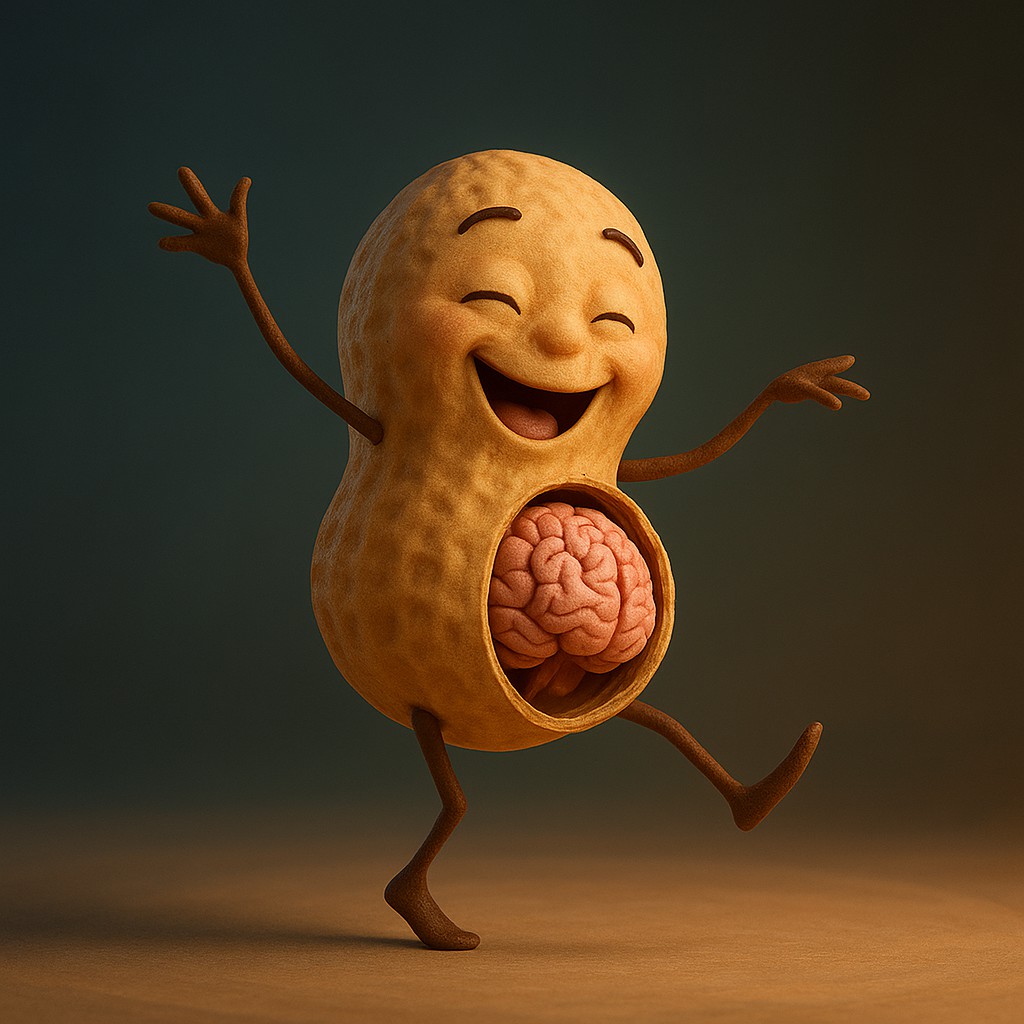
Imagine a small, round creature, light brown, with a shell that clicks softly when it laughs, slender but nimble legs, an expressive face, and a bright little brain tucked away like a treasure inside a nut. Now make it an extraordinary dancer: it floats, twirls, stamps the floor with precision, and tells stories with its movement. If such an animated peanut existed in our world, its life would be more than a string of cabaret acts; it would be a tiny universe for thinking about biology, society, ethics, and what it means to be alive and remarkable.
Before we dive into the details, keep one thing in mind - we are mixing plausible science with imaginative storytelling. That lets us play with serious ideas while keeping a smile. Follow me: we will unpack its theoretical physiology, material needs, social place, possible rights, and how its virtuosity in dance would reshape cultural and scientific landscapes. You will finish knowing not only how it might survive, but how it could enrich our world.
An improbable anatomy, designed for life
For a peanut to have legs, a face, and a brain capable of choreography, you would have to rethink seed structure in biological terms. Its outer shell would become a lightweight exoskeleton - a protective frame like an insect’s, but tuned to allow facial expressiveness. Inside, the seed’s nutritive tissue would evolve into more complex muscle and nerve tissues, with concentrated energy stores to support intense physical activity, like a very long dance session.
The brain, small but dense, would be optimized for movement and spatial perception. Think of a compact but fast nervous system, with circuits specialized for rhythm, coordination, and motor memory. Proprioception - the ability to know where its limbs are without looking - would be highly developed. For respiration and metabolism, simplified organs enabling gas exchange and rapid digestion of high-fat, high-protein meals would be necessary. In short, its physiology would resemble a hybrid of a highly sophisticated invertebrate and a small mammal, designed to save space while maximizing performance.
Food, energy, and recovery after performances
Dancing burns a lot of energy. Our peanut dancer would need a tailored diet: very calorie-dense, easy-to-digest foods like purees, nutrient suspensions, or small pieces rich in fats and proteins. Its small size means a high surface-area-to-volume ratio, so it would lose heat quickly and need regular energy intake and a thermally comfortable environment.
To optimize recovery, its body would develop efficient muscle repair and fatigue management mechanisms. Short, frequent sleep cycles, similar to polyphasic naps, would allow rapid consolidation of motor learning. It would also benefit from external aids - gentle massages, small-scale physiotherapy, and heat therapies - to maintain top performance.
Mobility and safety in a human world
Small size creates mobility and safety challenges. On a sidewalk, a human shoe becomes a mountain, and storm drains turn into dangerous canyons. To live in society, our peanut would need accommodations - custom ramps, adapted crosswalks, micro assistive devices like exoskeletons or miniature vehicles. Public spaces would need to change to reduce hazards: less sharp curbs, more non-slip surfaces, and rules to avoid accidentally crushing tiny beings.
Legally, protective regulations would be required to prevent accidents and exploitation. Zones for small beings might appear, along with protocols in public transport to ensure their safety. Integration into cities would not be impossible, but it would require public awareness and practical adaptations.
Social life, communication, and emotions
An expressive face changes everything. Humans respond strongly to facial traits and emotional signals, even when the being in front of them is very small. Our peanut-dancer could develop a very rich nonverbal language - gestures, facial expressions, posture shifts - and perhaps a small vocal repertoire or high-pitched signals. Its dance would become a channel of communication: expressing joy, anger, requests for help, courtship, or simply storytelling.
There would also be emotional challenges: isolation due to size, misunderstanding, and sometimes cruel curiosity. Social bonds could form with empathetic people, artists, researchers, and children, who often accept difference more readily. Society might create support networks dedicated to these singular beings, including online communities and physical spaces where they are understood and valued.
An artistic career and cultural impact
Imagine the cultural ripple of a tiny, virtuosic dancer. On stage, it would shift aesthetic reference points: choreography designed to play with scale, miniature scenography, and music tailored to highlight subtle body percussion. Its uniqueness would attract media, festivals, and producers. It might become an icon, a symbol of creativity and acceptance of differences.
Dance, in this case, would also act as a universal language. Its art could inspire new forms - miniature dance paired with interactive installations, human collaborations with small artists, performances that require audiences to come closer to catch the detail. This phenomenon would drive innovation in stage design, miniature costumes, and tiny instruments. The performing arts would learn to think in multiple scales.
Ethics, rights, and species conservation
The appearance of such a different living being raises ethical questions. Should it be protected like a wild animal, recognized as a legal person, or treated as an exhibit? The responsible answer leans toward protection and respect for its interests. If the being is conscious and cognitively capable, it deserves fundamental rights: protection from exploitation, access to care, and freedom to choose its career and reproduction.
Conserving any populations should avoid eradication by collection or hunting out of curiosity. If reproduction is possible, managing domesticated versus wild populations would require strict rules to prevent genetic alteration and disease. Biologists, ethicists, and lawmakers would need to collaborate to create frameworks that secure individual welfare and ecological safety.
Myths demystified: what science says and does not say
Several misconceptions will arise automatically. First, the idea that small size automatically means extreme fragility. Not true: many small species are remarkably robust and resilient. Our peanut could be physically tough if its shell and physiology are adapted. Second, the idea that intelligence would be limited because it is small. Again, size and intelligence are not strictly correlated: neuron density and brain architecture matter more.
Third, the fear that its dance would be purely entertaining and devoid of scientific value. On the contrary, its movements would be a treasure trove for biomechanics, motor cognition, and the cultural evolution of body expression. Finally, the idea that social integration would be impossible is exaggerated; history shows societies can adapt laws and practices to welcome different beings, when collective will exists.
Technologies and aids for a full, performing life
A suite of innovations would make its life safer and richer. Medically, portable microscopes and miniaturized instruments would allow appropriate examinations. For mobility, cushioned footwear, stimulating prosthetics, and micro-mobility vehicles would provide freedom and safety. At home, low-height furniture, magnetic surfaces to prevent slipping, and custom protective textiles would ensure comfort.
For a career, micro-scale motion capture, haptic sensors, and spatial audio would give human choreographers tools to collaborate. 3D printing would produce bespoke sets and props. All this would spawn a new industry: miniature object designers, specialized physiotherapists, and safety analysts to certify products for tiny users.
A concrete example of a typical day
A peanut dancer’s day could be surprising and highly structured. It would wake in a snug nest scaled to its size, eat a small calorie-dense meal, and start with short, intense warm-ups. Rehearsals would follow in an adapted studio - finely grained, springy floors, mirrors at the right height - then a break for socializing or interviews. Afternoon creative sessions, and evenings often reserved for performances, stage rehearsals, or educational demonstrations in schools.
After a show, recovery would include restorative nutrition, physiotherapy, and polyphasic sleep to consolidate learning. Balancing public life and private time would be crucial to avoid burnout from media pressure.
Comparative summary of areas affected by its presence
| Domaine |
Effet principal |
Exemples concrets |
| Biology |
Specific physiological adaptations |
Lightweight exoskeleton, compact brain, high caloric metabolism |
| Urban planning |
Need for small-scale accommodations |
Ramps, non-slip surfaces, dedicated zones |
| Culture |
New artistic forms and aesthetics |
Miniature shows, interdisciplinary collaborations |
| Ethics |
New laws and protections |
Legal status, ban on exploitation, mandatory care |
| Technology |
Development of miniaturized tools |
Medical instruments, printed sets, microsensors |
Some practical tips if you meet such a being
- Respect personal space and avoid handling without consent, because even light contact can be traumatic.
- Provide a safe environment and alert the appropriate authorities if needed, to prevent accidents.
- If you are creative or an artist, propose collaborations that respect its vision and limits, by exchanging ideas rather than imposing them.
- Consult health and wellness professionals to adapt care and training programs.
The role of science and art in its future
The presence of such a being would highlight the complementarity of science and art. Scientists would study its physiology to discover new adaptive strategies, while artists would explore bodily expressiveness at a new scale. These interactions could lead to innovations useful to humans, for example rehabilitation methods inspired by hyperdeveloped proprioception, or lightweight materials modeled on its protective shell.
More than that, it would be a teaching opportunity: a captivating case to teach biology, ethics, and urban planning. Schools could use its story to spark curiosity and empathy in students.
In the end, the survival of such a creature in our world would depend less on biological miracles and more on our collective ability to imagine appropriate responses. The arrival of a magnificent peanut dancer would confront us with choices: exploit and monetize its strangeness, or learn and cooperate to build a more inclusive world.
Accept one last image: after a long performance, children gathered around, mouths open, learn to watch the subtleties of movement, to understand the care required to create a show, and marvel at the diversity of life. That is the true gift of such a singular being: it would make us more attentive, more creative, and more responsible. Now go, take a moment to dance at your own scale - even a small step counts, and sometimes a small step tells a great story.