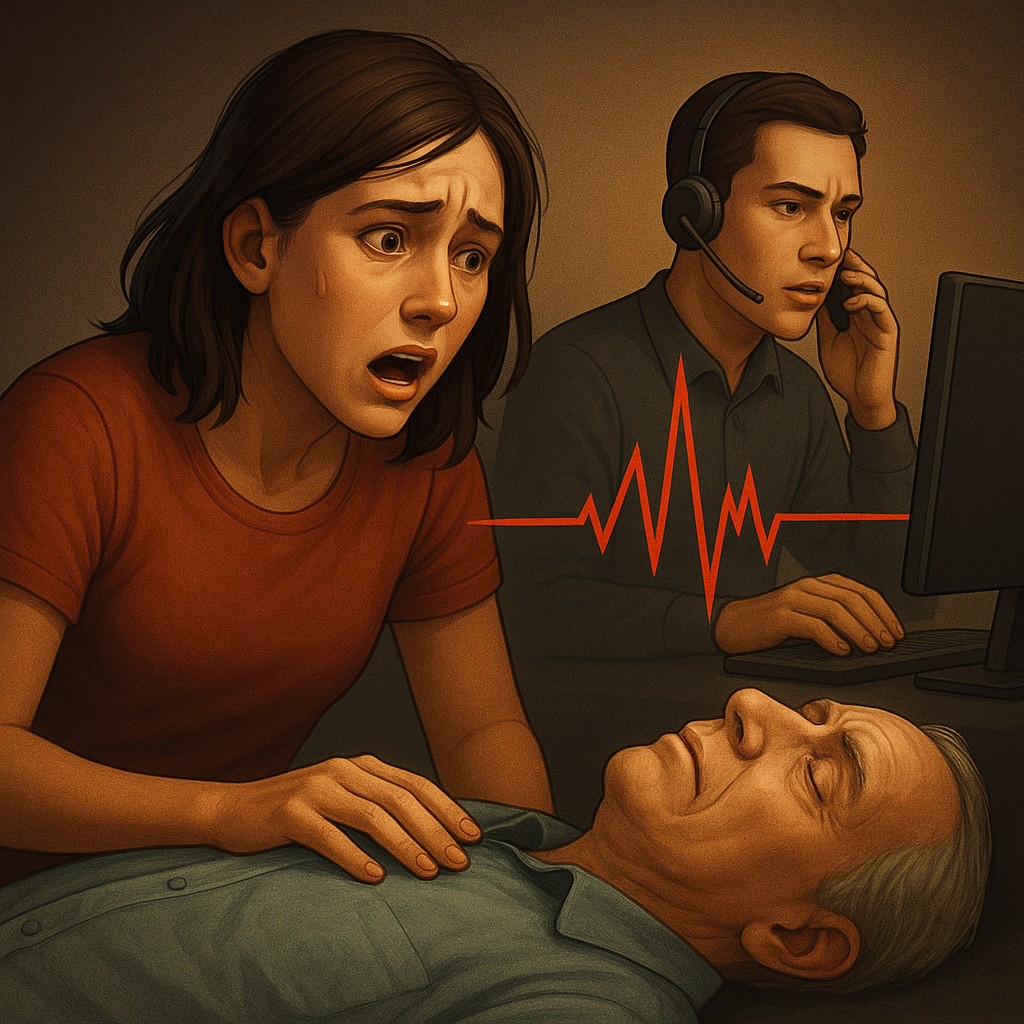
Imagine you are standing over a loved one who has just collapsed. Your heart hammers against your ribs, your palms are sweating, and you have finally reached a 911 dispatcher. In this moment of pure panic, your brain is wired to do two things: seek information and provide context. You want to tell the dispatcher about your father’s history of high blood pressure, what he ate for lunch, and exactly how old he is. You expect a conversation-a polite exchange where a professional listens to your details to help solve the problem. However, on the other end of the line, the dispatcher follows a script that might feel cold, repetitive, or even rude. They cut you off, ignore your stories, and focus like a laser on just two specific questions.
What you are experiencing is a sophisticated psychological and medical intervention designed to fight the brain’s greatest enemy: time. In the world of emergency dispatch, a new communication strategy has taken hold, centered on the "No-No" interval. This protocol recognizes that when the heart stops, the clock doesn't just tick; it screams. Every second spent describing a patient’s medical history or the color of their face is a second where blood is not flowing to the brain. By stripping away the social rules of "polite" conversation, dispatchers use silence and firm redirection as surgical tools to jump-start life-saving action.
The Brutal Physics of the Golden Minutes
To understand why a dispatcher might suddenly stop listening to your explanations, we have to look at the unforgiving biological reality of cardiac arrest. When the heart stops pumping, the brain begins to die within minutes. We often think of death as a single moment, but in medical terms, it is a steady collapse of the body's cells. The goal of a bystander is not to "fix" the heart-that is a job for paramedics with electricity and drugs. The goal of the person on the scene is simply to act as a manual bridge, physically pushing blood to the brain to keep cells alive until help arrives.
Research shows that for every minute that passes without chest compressions, the chance of survival drops by about 10 percent. If a caller spends three minutes explaining that their husband felt "a bit under the weather" before he fell, they have cut his chances of living by nearly a third before they even touch his chest. The "No-No" interval acts as a psychological bypass. It recognizes that the caller is stuck in a "gathering" phase, where they feel that providing more information is helping. The dispatcher’s job is to forcefully move the caller from the "thinking" phase into the "doing" phase, even if the transition feels jarring.
The Logic of the Binary Diagnostic
The "No-No" protocol gets its name from two fundamental questions that must be answered with a "no" to trigger immediate action. Dispatchers are trained to skip long interviews in favor of a binary diagnostic, a simple choice between two options: Is the patient conscious? Is the patient breathing normally? If the answer to both is "no," the dispatcher enters a "go" state. At this point, the assessment phase is over. Any further questions about the patient's age, whether they have a "do not resuscitate" (DNR) order, or their history of heart disease become irrelevant noise that consumes precious oxygen.
This framework is built on the understanding that people under stress are prone to "analysis paralysis." When we don't know what to do, we talk. We describe symptoms in hopes that the expert on the phone will give us a magic diagnosis. The "No-No" interval interrupts this loop. By refusing to engage with non-essential information, the dispatcher forces the caller to focus on the only two things that matter in that window: getting the patient on the floor and starting compressions. This is a shift from a helpful dialogue to a direct command.
Navigating the Friction of Perceived Rudeness
One of the biggest hurdles in using these rapid-fire protocols is the human social contract. We are raised to believe that interruptions are rude and that answering questions is helpful. When a dispatcher tells a frantic caller to "stop talking and listen," it can feel like a slap in the face. This friction is a known side effect of the protocol, but it is a calculated risk. Dispatchers are trained to use "persistent repetition," a technique where they repeat a command with the exact same tone and wording until the caller complies, rather than negotiating or explaining why they are asking.
This intentional silence on "fluff" topics allows the dispatcher to take over the caller's mental space. If the caller is busy answering "How old is he?", they cannot be busy counting "One, two, three, four" for compressions. The table below shows the shift from traditional interrogation-style dispatching to the high-efficiency "No-No" model, showing how time is shifted toward physical intervention.
| Feature |
Traditional Dispatch Model |
"No-No" High-Performance Model |
| Primary Goal |
Gathering info and scene context |
Fast identification and immediate blood flow |
| Communication Style |
Collaborative and conversational |
Directive and command-based |
| Information Priority |
Medical history, age, medications |
Consciousness and breathing status only |
| Handling Interruptions |
Dispatcher listens to caller's story |
Dispatcher redirects caller to compressions |
| Success Metric |
Accuracy of the data file |
Seconds to the first chest compression |
Overcoming the Psychological Barrier to Touch
The "No-No" interval isn't just about saving time; it's about overcoming a deep psychological barrier. Most untrained bystanders are terrified of performing CPR. They fear they will break a rib, do it wrong, or make things worse. Sometimes, they simply cannot believe that the person they love is actually dying in front of them. This state of denial creates a "lag time" where the caller stays on the phone specifically to avoid the terrifying reality of touching the body.
By cutting off the conversation, the dispatcher removes the caller’s "escape hatch." When the dispatcher refuses to talk about anything other than the physical mechanics of the chest compression, they narrow the caller's world until the only thing left to do is push. This is why the protocol often involves the dispatcher literally counting out loud. The rhythm of the dispatcher’s voice becomes a physical metronome that the caller is forced to follow. It replaces the caller’s panic with a rhythmic, external structure. The "No-No" interval is, in essence, a way to trick the human brain into skipping the stages of grief and moving straight to the rescue.
The Evolution of the Dispatcher as a Clinician
Historically, dispatchers were seen as clerks or operators-people who took a message and passed it along to the "real" rescuers. The "No-No" interval represents a major shift where the dispatcher is recognized as the first medical provider on the scene. They are not merely "sending help"; they are providing the most critical medical intervention the patient will receive that day. Compressions started by a bystander within the first sixty seconds are more likely to save a life than the most advanced surgery performed three hours later.
This shift requires incredible discipline from the dispatcher. It is difficult to hear someone screaming for help and respond with a flat, repetitive instruction to move the patient to the floor. It goes against our natural empathy to refuse to answer a question like "Is he going to be okay?" But in the clinical logic of the "No-No" interval, answering that question is a distraction that could cost the patient's life. Being silent on that topic is not a lack of empathy; it is the highest form of professional care. The dispatcher sacrifices their friendly connection with the caller to give the patient the best chance to survive.
Trusting the Silence of the Professional
Understanding these protocols can help us be better responders in our own lives. If you are ever in a situation where you call for help and the person on the other end seems to be ignoring your questions or cutting you off, try to remember the logic of the "No-No" interval. They are not being dismissive; they are clearing the "noise" so they can hear the signal. They are fighting for the seconds that your brain, in its panicked state, is trying to throw away.
The beauty of this system lies in its simplicity. We live in an age of complex medical technology, but the most effective tool we have for cardiac arrest is a human being pushing on a chest as fast and as hard as possible. The "No-No" interval is the psychological bridge that gets us there. It reminds us that in a true emergency, communication isn't about exchanging words; it's about delivering action. By ignoring the non-essentials, we give the heart and brain the only thing they truly need: a few more minutes of life.
The next time you think about the power of communication, remember that sometimes the most life-saving thing a person can do is stop talking. When the "No-No" interval is active, the silence is actually the sound of a system working at its peak. It is a reminder that in the face of death, social niceties take a back seat to the raw, rhythmic work of keeping the fire of life from going out. Stand tall, listen to the instructions, and trust that the person on the phone is leading you through the quietest, most intense battle of your life.