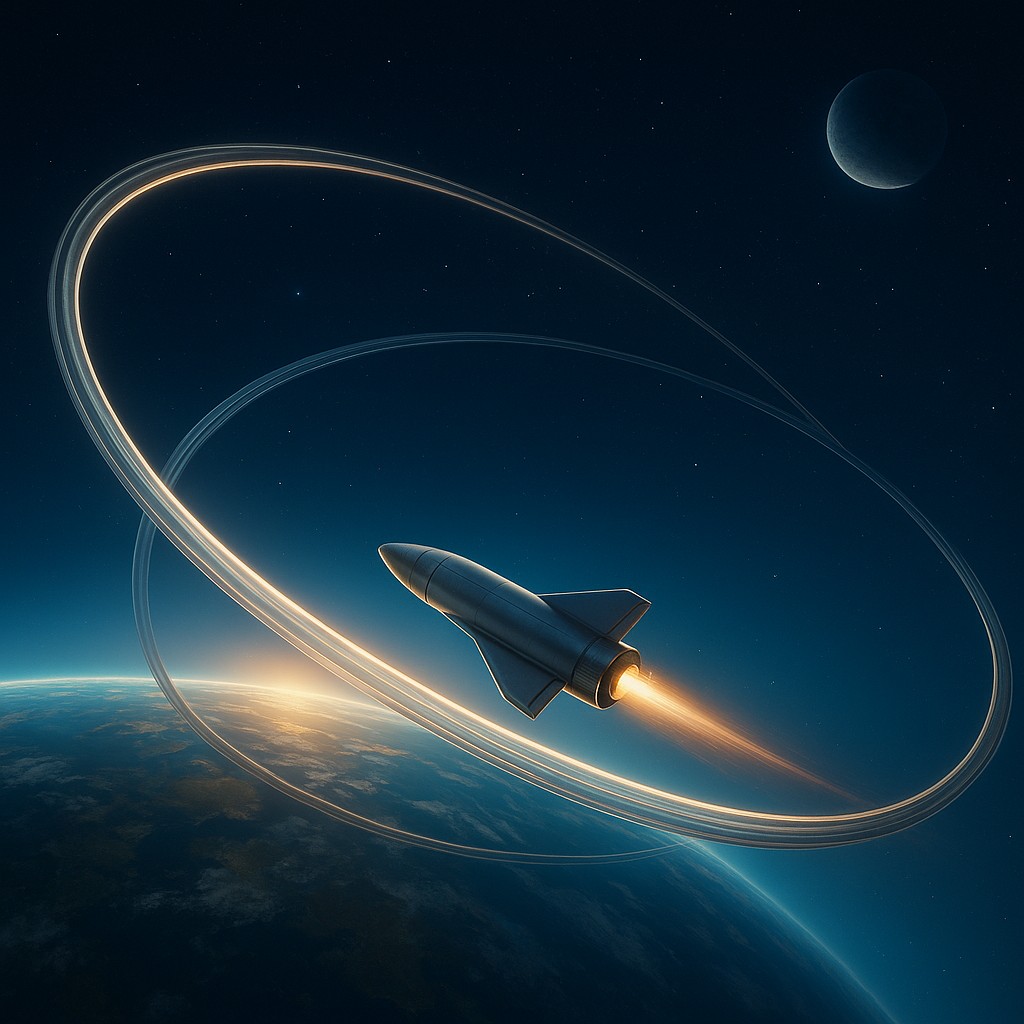
Imagine your morning commute involves a series of giant, invisible rubber bands stretched across your city. Instead of stopping for gas, braking at intersections, or waiting in gridlock, you simply time your movement to hook onto a passing cable, let its natural swing whip you toward your destination, and detach just as you reach your driveway. This is not a scene from a futuristic cartoon, but the emerging reality of orbital mechanics, where space agencies are moving beyond the fuel-hungry rocket equations that have dominated space travel since the 1950s. By shifting our perspective from carrying massive onboard propellant tanks to tapping into the existing rotational, gravitational, and magnetic energy of the Earth, we are essentially building the first electrified rail system of the heavens.
This transition marks a pivotal shift in how we perceive the vacuum of space. For decades, we treated space as a hostile void that demanded a high tax of chemical explosives just to change your speed or orientation. If you ran out of propellant, your mission was effectively a tombstone drifting in the dark. Modern engineers are now asking a much more elegant question, one that relies on the fundamental conservation of angular momentum: what if the vacuum is not a dead zone, but a complex, high-energy landscape waiting to be leveraged? This new approach, known as momentum exchange or orbital tethering, turns the sheer kinetic energy of orbiting objects into a reusable, free-to-use highway system.
The Physics of the Cosmic Slingshot
To understand how a tether works in space, you must first accept that your instincts about movement in orbit are profoundly wrong. On Earth, if you throw a ball, it loses energy due to air resistance and gravity until it stops. In orbit, everything is already falling, and if you move or push against another massive object, you do not just stop, you swap speed. An orbital tether is essentially an incredibly long, high-strength cable, sometimes dozens of kilometers in length, that rotates as it orbits the Earth like a giant, slow-moving propeller. When a spacecraft approaches the end of this rotating cable, it can latch on, ride the momentum of the tether, and be flung out at a different velocity or altitude.
Think of it like a figure skater in a spin, pulling their limbs inward to accelerate. The tether system carries a massive weight at one end and a docking port at the other. By managing the rotation of the structure, the tether conserves angular momentum, meaning that the energy transferred to the spacecraft is stolen from the tether's rotational speed. This is essentially a giant gear shift in the sky. Once the spacecraft releases from the tether, it arrives at its new destination with a speed boost it never had to generate with chemical fire. The tether, having traded some of its momentum, can then be recharged by a smaller electric propulsion thruster or by grabbing another object, essentially resetting the system for the next passenger.
Material Challenges in the Vacuum
While the math of orbital tethers is beautifully simple, the engineering reality is a nightmare of extreme physics. A tether thousands of miles long is not just a rope; it is a structural member that faces intense, conflicting forces. During a transfer, the cable must endure massive tensile stress, as it is being pulled by the orbital acceleration of the Earth at one end and the inertial tug of the payload at the other. Because a tether is so thin and long, it is also highly susceptible to micrometeoroid impacts, which could slice through the cable like a hot wire through butter.
To survive, engineers are looking toward synthetic fibers that are significantly stronger than steel but light enough to orbit without collapsing under their own weight. Materials like ultra-high-molecular-weight polyethylene or even carbon nanotube composites are the frontrunners for these structures. These fibers must not only be strong, but they must also be flexible enough to endure the vibration of docking and the thermal cycling of moving between the harsh, blinding sunlight and the freezing, absolute shadow of the Earth. Protecting these tethers involves clever design, such as weaving them into wide, flat ribbons rather than single strands, so that a small impact creates only a minor tear rather than a catastrophic structural failure.
Refueling Depots as Anchor Points
While momentum exchange handles the getting there portion of space travel, the industry is also simultaneously perfecting the staying there aspect through orbital refueling. If momentum exchange is the highway, refueling depots are the service stations. Historically, a satellite was a finished product when it launched; it had a limited amount of fuel to keep its station-keeping thrusters firing, and when that fuel was gone, the satellite became space junk. By standardizing refueling interfaces, such as the RAFTI port, private companies and space agencies are finally creating a universal way to pump gas in orbit.
This creates a synergistic relationship: a satellite arrives at a high orbit using a momentum tether, refuels at a nearby depot to prepare for its mission, and spends its remaining life doing its job instead of worrying about the fuel margin. This modular approach changes the economics of space hardware. Instead of designing a satellite that can last for twenty years but risking total failure if one valve breaks, designers can now build smaller, specialized satellites that are regularly docked, repaired, and topped off with propellant. The combination of tethered movement and active refueling infrastructure effectively transforms space into an operational theater rather than a series of one-way trips.
Clearing Up Common Orbital Myths
A common misconception is that these orbital systems require a massive amount of input energy to function, similar to how a train needs continuous electricity. In reality, the gravity of the Earth is the engine, and the orbital mechanics are just the transmission. Many people worry that stealing momentum from a tether will eventually slow the space station or the tether down until it crashes into our atmosphere. While this is technically true, the scale is massive; a single tether system can perform thousands of operations before needing an insignificant boost from a low-power electric thruster to regain its original orbital energy.
Another myth is that space is still so empty that docking is essentially finding a needle in a haystack. While space is large, satellites are currently being placed in specific, highly populated shells. The technology required to rendezvous, track, and softly dock a spacecraft to a tether is already being tested by various agencies and commercial entities. We are currently shifting from the pilot-in-the-loop era to an era of automated proximity operations. These systems use light-based sensors and predictive algorithms to close the final distance between craft at speeds that, while high relative to the ground, appear almost stationary between the two docking objects.
| Feature Type |
Chemical Propulsion |
Momentum-Exchange Tether |
| Energy Source |
Onboard chemical propellant |
Orbital angular momentum |
| Lifespan |
Limited by fuel volume |
Sustainable via momentum cycle |
| Flexibility |
High agility but short duration |
High transit efficiency but fixed routes |
| Infrastructure |
Minimal (self-contained) |
Requires orbital docking architecture |
| Primary Constraint |
Rocket equation and mass ratio |
Material tensile strength and docking logic |
Building the Future of Automated Logistics
The path forward for orbital tethers and refueling is not just about keeping the lights on in our satellites; it is about lowering the barrier for humanity to scale its presence in the solar system. If you can move heavy equipment, spare parts, and fuel without the prohibitively expensive cost of lifting everything from the Earth's surface with chemical rockets, you effectively open up the entire cislunar space for research and manufacturing. The tether acts as a crane, lifting goods from low orbit to higher orbits, while the refueling depots act as the warehouses that keep the supply chain moving.
When we look back at the early decades of the twenty-first century, we will likely see this era as the transition from the exploration phase of space to the logistics phase. We are no longer just putting things into space to see if they work; we are building a utility network. Whether it is a tether whipping a telescope into a higher, more stable orbit or a depot-to-depot fuel transfer for a communication array, these mechanisms rely on the same fundamental rules of physics that have existed since the birth of our solar system. The difference is that we are finally learning how to stop fighting the machinery of the universe and started learning how to plug into it.
You are witnessing the transition from the era of the isolated space mission to the era of the interconnected space infrastructure. Every time a new tether test or a refueling demonstration succeeds in the harsh vacuum above, we are building one more link in a chain that connects humanity to the wider solar system. The physics may be demanding and the engineering precise, but the result is nothing short of a new frontier. Keep your eyes on the stars, not just as distant points of light, but as the next, reachable destinations in a world where gravity is no longer a wall, but a tool waiting for you to swing.