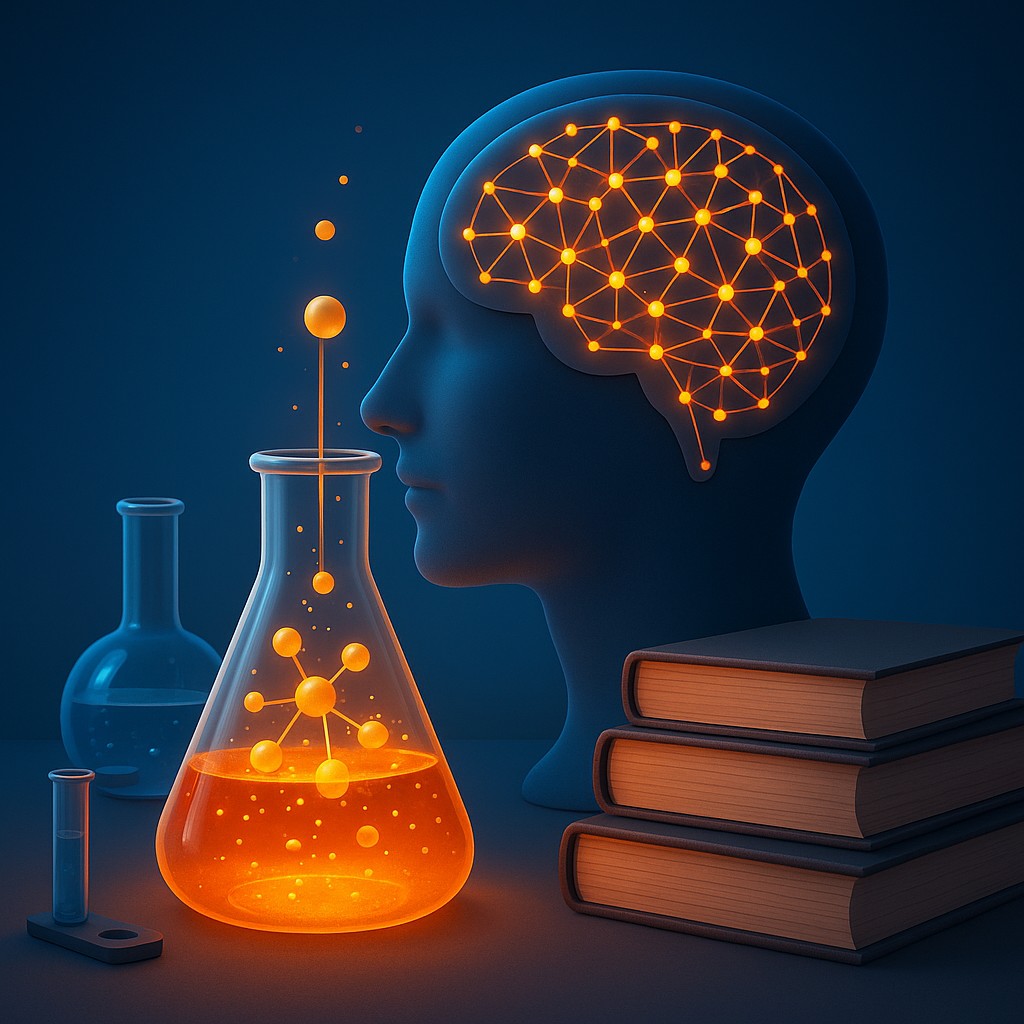
Think of your brain for a moment not as a filing cabinet, but as a high-energy chemistry lab. In the filing cabinet model of learning, every piece of new information is just a folder placed in a drawer. It sits there quietly, taking up space without interacting with the files around it. But in the chemistry lab model, every new fact is a reactive element. When you drop a new concept into the beaker of your mind, it doesn't just sink to the bottom. It begins to collide with everything else already in the liquid, forming bonds, sparking mini-explosions, and creating entirely new compounds that didn't exist a second ago.
This is why the first few years of learning a new subject feel like a grind, while the later years feel like a superpower. You aren't just adding to your knowledge; you are compounding it.
The beauty of this "recombinant" nature of knowledge is that it explains one of the great mysteries of human intelligence: why the smartest people in the world seem to learn things at a terrifying speed. It is easy to assume they have a faster processor or a bigger hard drive, but the reality is more elegant. They simply have more "hooks." If you know a lot about music theory, learning the basics of math or architecture becomes much easier because you already have mental frameworks for rhythm, proportion, and structure. You aren't starting from scratch; you are simply extending a web that already exists. Every new node you add to your mental network doesn't just add one unit of value; it creates a potential connection to every single node you already have.
The Mathematics of the Mental Web
We often fall into the trap of linear thinking. We assume that if we read ten books, we have ten books' worth of knowledge. However, if we look at the way information actually behaves, it follows a more exponential path. In a simple system with three ideas, you might have three potential connections. But as that number of ideas grows to twenty, fifty, or a hundred, the number of unique combinations between those ideas explodes.
This is known in economics and systems theory as combinatorial innovation. It is the reason why the printing press was such a transformational invention. It wasn't just a machine that made books; it was a machine that allowed thousands of existing ideas to finally meet and "breed" with one another.
When you learn a new concept, you are essentially increasing the "surface area" of your intellect. A person with a narrow, specialized education has a smooth, small surface area; many new ideas simply bounce off because there is nothing for them to stick to. A polymath, or even just a curious generalist, has a "sticky" mind full of crags, hooks, and ridges. When a new bit of data floats by, it is almost certain to snag on something. This is the "Matthew Effect" of intelligence: those who have more knowledge find it easier to gain even more. It is an unfair advantage that is available to anyone willing to branch out.
Schemas and the Architecture of Understanding
In psychology, these clusters of interconnected knowledge are called "schemas." A schema is a mental blueprint that helps you organize and interpret information. Think of it as a pre-built Lego baseplate. If you have a "physics" baseplate and someone hands you a "gravity" brick, you know exactly where to snap it in. Without the baseplate, you are just holding a random plastic rectangle, and you will likely lose it under the couch in a few days. The more baseplates you build across different disciplines, from history to biology to cooking, the more receptive your brain becomes to the world around it.
The most fascinating part of learning theory is how these structures allow for "rapid generalization." If you understand the concept of "incentives" in economics, you can suddenly understand why your dog behaves a certain way, why a company’s culture is toxic, or why a political movement is gaining steam. You are using one high-quality mental model to decode three entirely different situations. This cross-pollination is where true creativity lives. It is rarely about conjuring something out of thin air; it is almost always about taking a schema from "Field A" and smashing it into "Field B" to see what happens.
| Learning Model |
View of the Brain |
Key Goal |
Limit |
| The Bucket |
A container to be filled |
Gathering facts |
Limited volume and forgetting |
| The Muscle |
An organ to be exercised |
Increasing raw processing speed |
Biological ceiling |
| The Web |
A network of connections |
Increasing connectivity |
None; grows more efficient with size |
| The Lab |
A site for chemical reactions |
Creating new ideas from old ones |
Limited only by variety of ingredients |
The Myth of the "Clean Slate"
One of the most damaging mistakes in modern education is the idea that we should clear our minds to focus on one thing at a time. While focus is important for deep work, the "clean slate" approach actually makes learning harder. When we try to learn something in a vacuum, without connecting it to what we already know, we are forcing our brains to use rote memory. Rote memory, or memorization by simple repetition, is incredibly fragile. It is like trying to balance a pencil on its tip. If you don't use it, or if you get distracted, the information falls over and disappears.
Associative memory, on the other hand, is like a spiderweb. If one strand breaks, the rest of the web holds the fly in place. This is why you might forget the specific date of a historical event but still remember the "flavor" of the era, the primary conflicts, and how those events resemble a modern-day corporate merger you read about last week. The connections provide the stability. By embracing your existing biases, hobbies, and random trivia, you aren't cluttering your mind; you are reinforcing the floorboards. You should never feel guilty about being a "jack of all trades," because those trades are the very things that will help you master the next "one" thing faster.
Diversification as a Cognitive Strategy
If knowledge grows exponentially through connection, then the most logical strategy for a learner is to seek out "orthogonal" information. Orthogonal information is knowledge that is completely unrelated to your current expertise. If you are a software engineer, reading another book on Python will give you a small, linear increase in skill. But if you read a book on 19th-century naval history or forest ecology, you might discover a pattern of "decentralized command" or "interconnected networking" that completely changes how you think about software architecture.
This is the secret of combinatorial innovation. The most breakthrough ideas often come from the fringes, where two seemingly unrelated fields overlap. To maximize your intellectual growth, you want to collect ingredients that are as different from one another as possible. This creates a wider range of potential chemical reactions. A person who only studies one subject is essentially trying to start a fire with only one stick. A person who studies many things is carrying flint, steel, a magnifying glass, and a blowtorch.
- Read across genres: Don't just stick to non-fiction; fiction provides social and emotional blueprints that are just as vital.
- Explain it to a stranger: Trying to describe a concept to someone outside your field forces you to find a common "hook," strengthening the connection between two different worlds.
- Look for metaphors: Actively ask yourself, "What is this like?" Is an electrical circuit like a plumbing system? Is a poem like a puzzle? These metaphors are the bridges of the mental web.
- Value the "useless": That random documentary on deep-sea squids might be the missing piece for a project you start three years from now.
Embracing the Fog of Forgetting
We often worry about forgetting the details. We feel like failures when we can't remember the specific name of a protein or the third paragraph of a contract. But in the exponential model of growth, the "fact" is often just a delivery vehicle for the "connection." Once the connection is made and your mental web has been reshaped, the delivery vehicle can be thrown away. You don't need to remember every brick used to build a house to live in the house.
The true value of a broad education isn't the ability to win a trivia night; it is the permanent change in how you perceive the world's structure. You are building a high-resolution map of reality. As the map becomes more detailed, navigating new territory becomes second nature. You start to see the hidden strings connecting politics to art, and biology to technology. This sense of "global coherence" is the ultimate reward of learning.
As you move forward, stop worrying about how much you can "hold" in your head. Your brain is not a vessel with a fixed capacity; it is an ever-expanding frontier. Every time you learn something new, you aren't just filling a space; you are creating a new world of possibilities for the next idea to inhabit. Stay curious, stay messy, and keep building your web. The more you know, the faster you will grow, until the act of learning stops feeling like work and starts feeling like an inevitable, beautiful chain reaction.