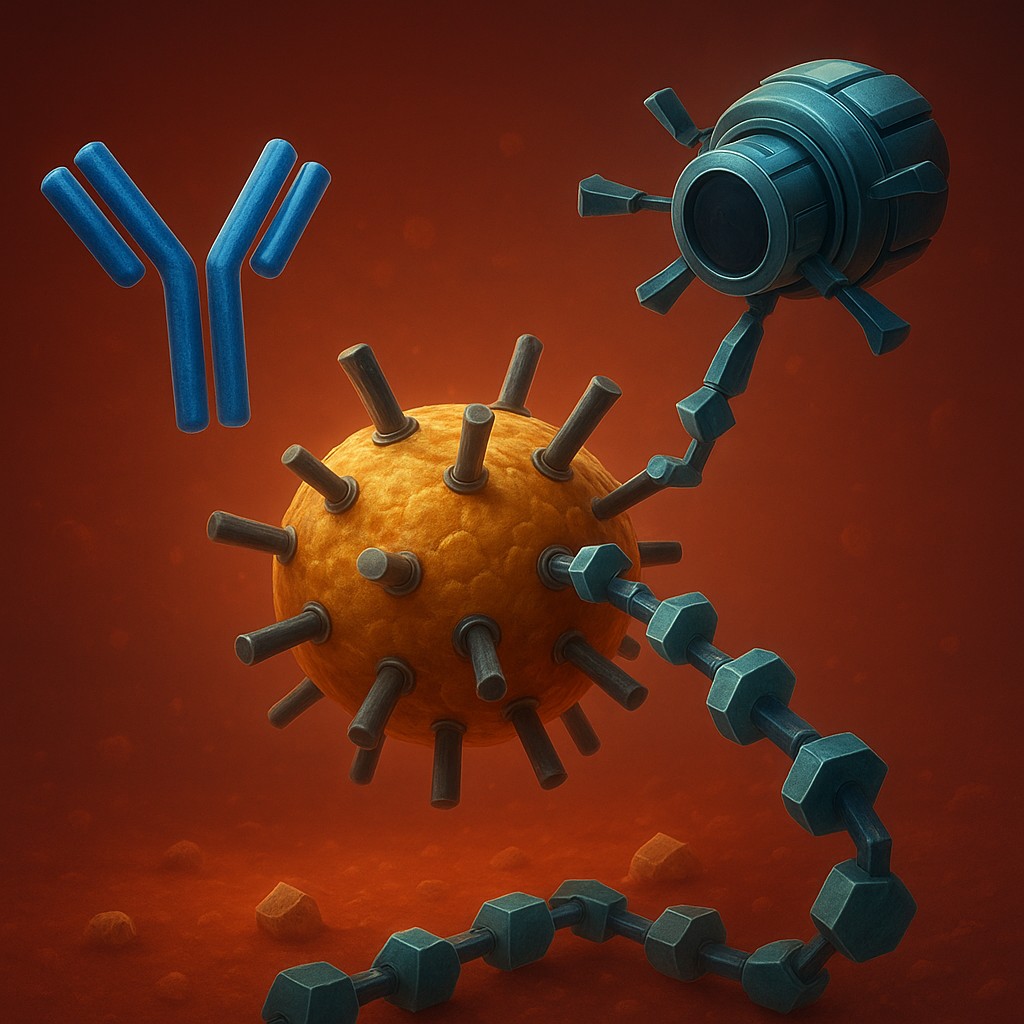
Imagine your body as a high-security facility, protected by layers of sophisticated alarms and heavy machinery. Usually, when we discuss the immune system, we focus on the "detectives" and the "memory" cells. We praise antibodies for acting like forensic markers, tagging an intruder so the rest of the team knows who to hunt. We marvel at white blood cells that act like Pac-Man, gobbling up debris and germs alike. But there is a silent, lethal strike force that is often left out of the highlight reels, even though it is perhaps the most brutal and efficient part of your anatomy. This is the complement system: an ancient, chemical machine that does not just label enemies - it deletes them.
While your adaptive immune system is busy taking notes and building long-term memories of specific viruses, the complement system is already on the front lines, acting with the cold precision of an automated turret. It is a group of over thirty proteins made by the liver. These proteins circulate in your blood in a dormant state, waiting for a single signal that says "invader detected." Once triggered, they set off a fast, domino-like reaction called the complement cascade. This is not a slow biological growth; it is a high-speed industrial assembly line that builds physical weapons directly onto the surface of a bacterium, ending in a mechanical disaster for the intruder.
The Assembly Line of Doom
To understand how the complement cascade works, think of it as a three-stage construction project. The first stage is activation, which can happen in several ways. Sometimes, antibodies already stuck to a bacterium act as the "on" switch. Other times, the complement proteins recognize specific sugar patterns on a germ's surface that clearly do not belong in a human body. Regardless of how the alarm is tripped, the result is the same: the first protein in the chain snaps into an active shape and immediately begins slicing the next protein in the sequence.
This leads to the second stage: a massive amplification of the signal. Imagine a chain reaction where one protein splits two, those two split four, and those four split eight. These broken fragments play multiple roles. Some act like chemical breadcrumbs, calling out to white blood cells like a flare in the night sky. Others act as "glue," coating the surface of the bacterium to make it easier for other immune cells to grab. However, the most terrifying fragments are the ones that lay the foundation for the final hit. They anchor themselves to the intruder's outer shell, creating a landing pad for the immune system’s heavy hitters.
The third and final stage is where things shift from "chemical signaling" to "mechanical assault." The proteins begin to click together like precision-machined LEGO bricks, forming a structure known as the Membrane Attack Complex, or MAC. This is not a metaphor; it is a literal, physical object. The MAC is a hollow, rigid tube made of protein designed to do one thing: pierce the protective wall of a cell. As the final proteins in the sequence arrive, they unfurl and jam themselves deep into the bacterium’s fatty outer layer. It is the microscopic version of hammering a board with a protruding nail into the side of a ship.
Building the Molecular Hole Puncher
The sheer physics of the Membrane Attack Complex is what makes it so fascinating. Most biological processes rely on enzymes changing the chemistry of a fluid, but the MAC is pure structural engineering. The primary architect of this demolition is a protein called C9. Once the "anchor" proteins have lodged themselves into the target's membrane, they recruit a single C9 molecule. This molecule undergoes a radical transformation, unfolding to reveal a "water-fearing" region that can slide easily into the greasy interior of the cell wall.
But C9 does not work alone. Once the first C9 is in place, it acts as a template for another, and another, and another. Between ten and twenty of these C9 proteins link together in a circle, forming a rigid ring shaped like a stovepipe. This ring creates a permanent, open hole through the bacterium’s skin. Under a high-powered electron microscope, a bacterium under attack looks like it has been hit by a burst of microscopic buckshot. Thousands of these tiny, dark circles pepper its surface, each one a permanent breach in its defenses.
This is a death sentence because a bacterium relies entirely on its ability to maintain a pressurized internal environment. It spends a vast amount of energy pumping nutrients in and out to keep its "insides" different from the "outsides." When the MAC punches a hole, that pressure difference vanishes instantly. Water from the surrounding environment rushes into the bacterium to balance the concentration, causing the cell to swell like an overfilled water balloon. Within seconds, the internal pressure becomes too much for the damaged wall to handle, and the bacterium literally pops, spilling its contents into your bloodstream.
Three Paths to the Same End
While the "hole punching" is the grand finale, the body has developed three distinct ways to decide who gets hit. This backup system ensures that no matter how sneaky a germ is, there is a likely trigger for the cascade.
| Pathway Name |
Trigger Mechanism |
Role in Immunity |
| Classical Pathway |
Triggered by antibodies (IgG or IgM) sticking to the surface of a germ. |
Connects the "smart" adaptive immune system to the "brute force" complement system. |
| Lectin Pathway |
Triggered when specialized proteins recognize specific sugar chains on germs. |
Targets common bacterial and fungal patterns without needing previous exposure. |
| Alternative Pathway |
Triggered by the spontaneous breakdown of C3 proteins near a surface. |
Acts as a constant, low-level surveillance system that is always "on." |
The Classical Pathway is the most famous because it highlights immune system teamwork. When you get a vaccine, your body produces antibodies. Those antibodies find a virus or bacteria and stick to it. The complement proteins then see those antibodies and say, "Found one!" It is a bridge between the highly specific recognition of the adaptive system and the indiscriminate destruction of the complement system.
The Alternative Pathway is perhaps the most impressive from a design perspective. It does not wait for a signal. Instead, it relies on a process called "tick-over," where the system's central protein, C3, is constantly breaking down into its active form at a slow, steady rate. If this active fragment lands on a healthy human cell, it is quickly deactivated. But if it lands on a foreign surface that lacks "off-switches," it immediately starts the cascade. It is like a security guard who throws a handful of paint at everyone who walks by; your employees have special chemical wipes to clean it off instantly, but intruders remain covered in paint and are subsequently tackled.
Why We Don't Punch Ourselves to Death
You might wonder why these thousands of "hole punchers" floating in your blood do not accidentally turn your own veins into a colander. This is a very real danger. Because the complement system is so fast and powerful, it is essentially a loaded gun pointed at every cell in your body. To prevent "friendly fire," your own cells are covered in regulatory proteins that act as "don't shoot" signs.
One of the most important is a protein called CD59, also known as protectin. CD59 sits on the surface of your heart, lung, and blood cells like a shield. If a complement cascade accidentally starts on one of your own cells, CD59 steps in at the last second. It binds to the growing complex and physically blocks the C9 proteins from forming the final ring. It is like a safety pin that prevents a grenade from going off. If a cell loses this protection, the complement system will tear it apart as ruthlessly as it would a deadly microbe.
There is also a floating protein called C1-inhibitor that roams the blood, snapping up any complement proteins that activate prematurely in the open fluid. This prevents the cascade from spreading through the blood like a wildfire. When people have genetic flaws in these regulators, the results are devastating. They may suffer from conditions like hereditary angioedema, where the complement system triggers massive, runaway swelling because the "off-switch" is missing. It is a stark reminder that our survival depends not just on the strength of our weapons, but on the precision of our safety catches.
Misconceptions About the "Passive" Immune System
A common myth is that the "innate" immune system (the part you are born with) is less important than the "adaptive" system (the part that learns from vaccines and infections). People often think of the innate system as a blunt, weak instrument that just holds the line until the "real" heroes, like T-cells, arrive. The complement system proves this is entirely backward.
In reality, without the complement system, the adaptive immune system is like a general with no soldiers. Antibodies can identify an enemy, but on their own, they are just sticky proteins; they cannot actually "kill" anything. They need the complement system to act as the executioner. Furthermore, the byproducts of the cascade tell the rest of the immune system how serious a situation is. The small fragments that break off during the process are some of the most potent inflammatory signals in the body. They widen blood vessels, attract hunters, and prepare the body for full-scale war.
Another misconception is that bacteria are helpless. Evolution is an arms race, and bacteria have developed clever ways to hide. Some grow thick, sugary "capsules" that act like armor, making it harder for the MAC to reach their membrane. Others release "decoy" proteins that mimic human off-switches, tricking the system into thinking the bacterium is a friendly cell. This constant back-and-forth is why we are always racing to develop new treatments that can bypass these bacterial shields.
Survival as a Chemical Software Program
When you look at the complement cascade, you are seeing one of nature's most beautiful examples of "biological programming." It is a series of "IF/THEN" statements written in the language of protein shapes. IF a sugar pattern is detected, THEN change shape. IF the shape is changed, THEN recruit the next protein. IF the next protein is present, THEN punch a hole. It is a purely mechanical solution to a biological problem.
There is something deeply reassuring about the fact that even while you sleep, your blood is filled with millions of these tiny, dormant machines. They are not thinking or feeling, and they don’t have to "learn" what an enemy looks like. They are simply built to respond to the laws of chemistry and physics. They represent a fundamental truth about our bodies: we are not just a collection of cells, but a highly coordinated defense system where even individual molecules are programmed to protect the whole.
The next time you feel a fever or see the redness of inflammation, remember that it is likely the sound of the complement cascade at work. Beneath your skin, billions of molecular tubes are being hammered into invaders, turning a chemical signal into a physical explosion. You are a walking fortress, and your complement system is the automated defense grid that ensures even the smallest intruder faces the full, mechanical fury of your evolution. It is a brutal, hole-punching, pressure-popping miracle that keeps you alive every single second of the day.