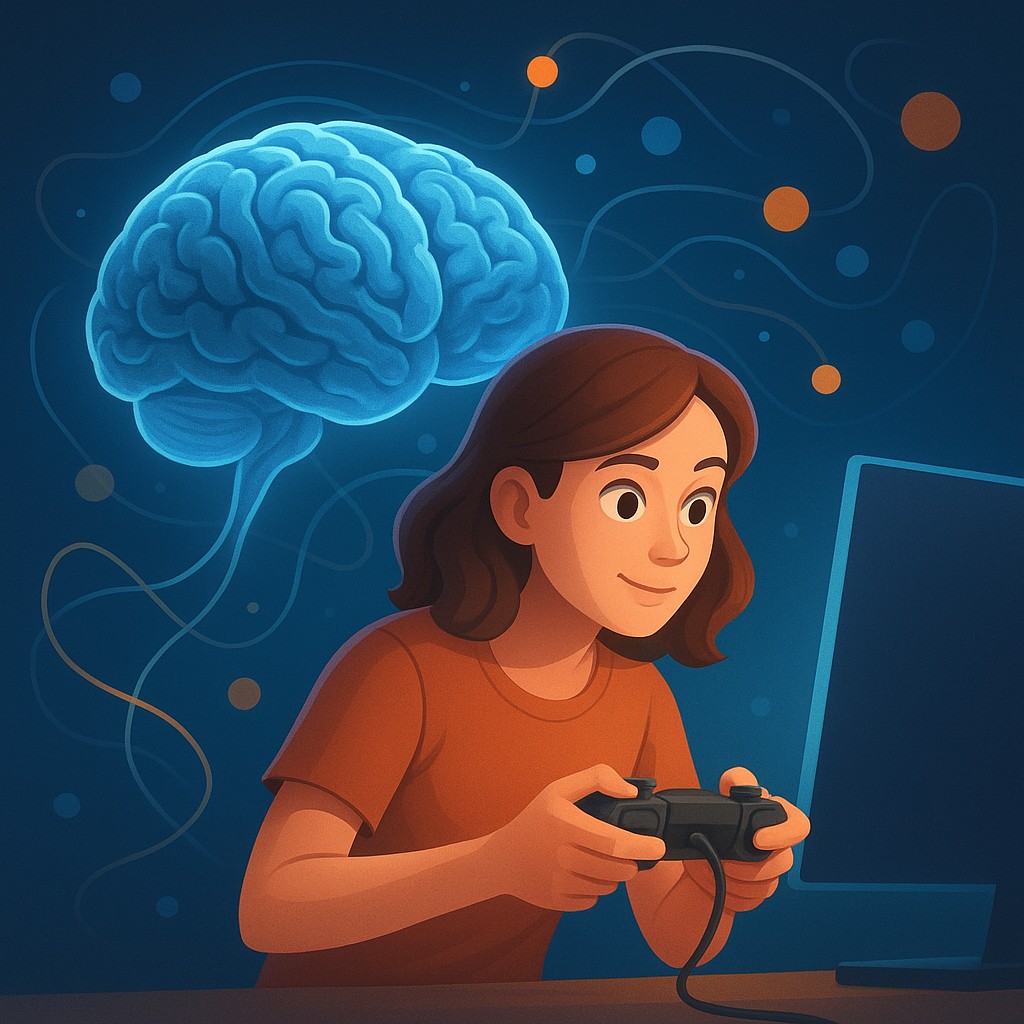
For decades, video games were dismissed as nothing more than a flickering distraction or a lazy hobby confined to dark basements. Parents warned that staring at screens would turn young brains to mush, while critics feared that digital worlds were destroying our ability to focus on reality. However, as the first generation of digital natives has reached adulthood, science has finally caught up with the joystick. Researchers are discovering that video games are far more than entertainment; they are sophisticated "cognitive gyms" that can physically reshape the structure of the brain.
Rather than being a passive activity like watching TV, gaming requires intense participation, constant decision-making, and rapid-fire problem solving. When you play, your brain is hit with a flood of sights and sounds that it must process in milliseconds to trigger a physical reaction. This constant loop of input, analysis, and action creates a perfect environment for neuroplasticity - the brain's remarkable ability to rewire itself and form new connections. Today, we see surgeons playing games to sharpen their hand-eye coordination and seniors using digital puzzles to keep their memories intact.
The Cognitive Upgrades Found Inside the Console
The most immediate benefit of regular gaming is a measurable boost in executive functions. These are the high-level mental skills that allow us to manage our time, stay focused, and switch between tasks efficiently. When you navigate a complex game world, you aren't just looking at images; you are managing a massive inventory of resources, tracking multiple goals, and predicting the moves of enemies or teammates. This high-stakes multitasking trains the prefrontal cortex - the area of the brain responsible for planning and personality - to become faster and more resilient.
Beyond just thinking faster, gaming improves spatial awareness, which is the ability to understand and remember how objects relate to one another in space. Think of this as your internal GPS or 3D-modeling software. Studies show that people who play games involving vast fantasy kingdoms or digital cities show increased "gray matter" in the hippocampus. This is the region of the brain tied to memory and navigation. By constantly mapping out virtual territories, gamers are giving their brain’s internal map a high-intensity workout, which translates to better navigation and visualization skills in the real world.
There is also a significant emotional benefit to gaming that often gets ignored. Games provide a safe place to fail, which is a vital part of learning. In real life, failure can have painful consequences, but in a game, it is simply a prompt to try a new strategy. This builds a "growth mindset," where players learn that persistence and adaptation lead to success. This psychological grit is incredibly helpful in school or at work, helping people see obstacles as puzzles to be solved rather than brick walls.
Choosing the Right Digital Mental Workout
Just as you wouldn't expect to grow huge muscles by only running on a treadmill, you cannot expect every game to provide the same mental gains. Different types of games stimulate different neural pathways. The "best" game for your brain depends entirely on which mental muscles you want to flex. While a fast-paced shooter might improve your reaction time, a slow-paced mystery might be better for logic. Understanding these differences allows you to create a "gaming diet" tailored to your personal goals.
| Game Genre |
Primary Brain Benefit |
Skill Developed |
| Action/Shooters |
Visual Processing |
Shifting attention and peripheral vision |
| Puzzle/Logic |
Fluid Intelligence |
Pattern recognition and reasoning |
| Strategy (RTS) |
Cognitive Flexibility |
Resource management and long-term planning |
| 3D Platformers |
Spatial Memory |
Navigation and mental rotation |
| RPGs |
Social Intelligence |
Complex decision-making and empathy |
Action games, especially first-person shooters, are the heavy lifters of the visual world. Despite the myth that they ruin your focus, these games actually train the brain to filter out "noise" and lock onto relevant targets. Players often develop better contrast sensitivity - the ability to see subtle shades of gray - which is a skill used for driving at night. These games force the brain to make split-second guesses with limited information, which sharpens the efficiency of the entire nervous system.
Building Worlds and Strengthening Memory
If the goal is to fight the effects of aging or improve long-term memory, 3D platformers and open-world games are the gold standard. Research from various universities shows that playing games like Super Mario 3D World or Minecraft can actually increase the size of the hippocampus. Because these games require players to build a mental map of a large space and remember where items are hidden, they stimulate the same parts of the brain used when exploring a new city. This mental stimulation is a powerful tool for staying sharp throughout your life.
Strategy games, meanwhile, are the ultimate exercise for the brain’s "inner manager." In a real-time strategy game, you might manage an entire economy, a military force, and a technology tree all at once. This requires immense cognitive flexibility, or the ability to think about multiple concepts at the same time. High-level players show a remarkable ability to zoom in on a single detail, like a soldier's health, and then zoom out to the big picture without losing their train of thought. This skill applies directly to high-pressure jobs that require multitasking and quick pivots.
Puzzle and logic games provide a more specific but equally important benefit. They target "fluid intelligence," which is the ability to solve new problems without relying on things you already know. When you face a tough level in a physics puzzle, you have to experiment with the rules of that world to find a solution. This keeps your "outside-the-box" thinking sharp. While these games may not give you lightning reflexes, they build the patience and analytical power needed to handle complex projects or math problems in daily life.
Navigating the Myth of the Isolated Gamer
One of the most persistent myths is that gaming is a lonely activity that stunts social growth. In reality, modern gaming is deeply social. Multiplayer games require high levels of cooperation, leadership, and communication. To succeed as a team, players must learn to read their teammates' intentions, give helpful feedback, and stay calm under pressure. These are the exact "soft skills" that employers value most in the modern workforce.
Furthermore, story-driven Role-Playing Games (RPGs) can be a profound tool for building empathy. By stepping into the shoes of a character with a different background, gender, or set of values, players are forced to make moral choices and see the consequences. This "perspective-taking" is a core part of emotional intelligence. It allows players to practice social interactions and conflict resolution in a low-risk environment, which can be especially helpful for those who deal with social anxiety or want to understand different cultures.
It is also important to talk about "screen time" and addiction. Like anything else, the benefits of gaming follow a curve. Research suggests that the positive effects are strongest when gaming is done in moderation, usually around one to two hours a day. Beyond three hours of daily play, the benefits tend to level off, and the risk of negative side effects - like poor sleep or a lack of physical activity - begins to rise. The key is to view gaming as a digital supplement that enhances your natural abilities, rather than a replacement for real life.
Embracing Your Digital Potential
As technology becomes a part of everything we do, the line between "play" and "growth" will continue to blur. Video games are among the most powerful tools ever created for self-improvement, disguised as pure fun. By understanding the science behind the screen, you can turn your gaming sessions from a way to kill time into a targeted method for sharpening your mind, expanding your memory, and building a more resilient personality.
Whether you are navigating a dangerous mountain pass in a virtual world or planning the layout of a digital city, remember that your brain is changing for the better. You are not just a player; you are the architect of your own neural pathways. The next time you pick up a controller, do so with the confidence that you are engaging in a sophisticated form of mental evolution. The levels you clear and the puzzles you solve are more than digital milestones - they are evidence of a faster, sharper, and more capable you. Grab your gear, choose your world, and let the training begin.