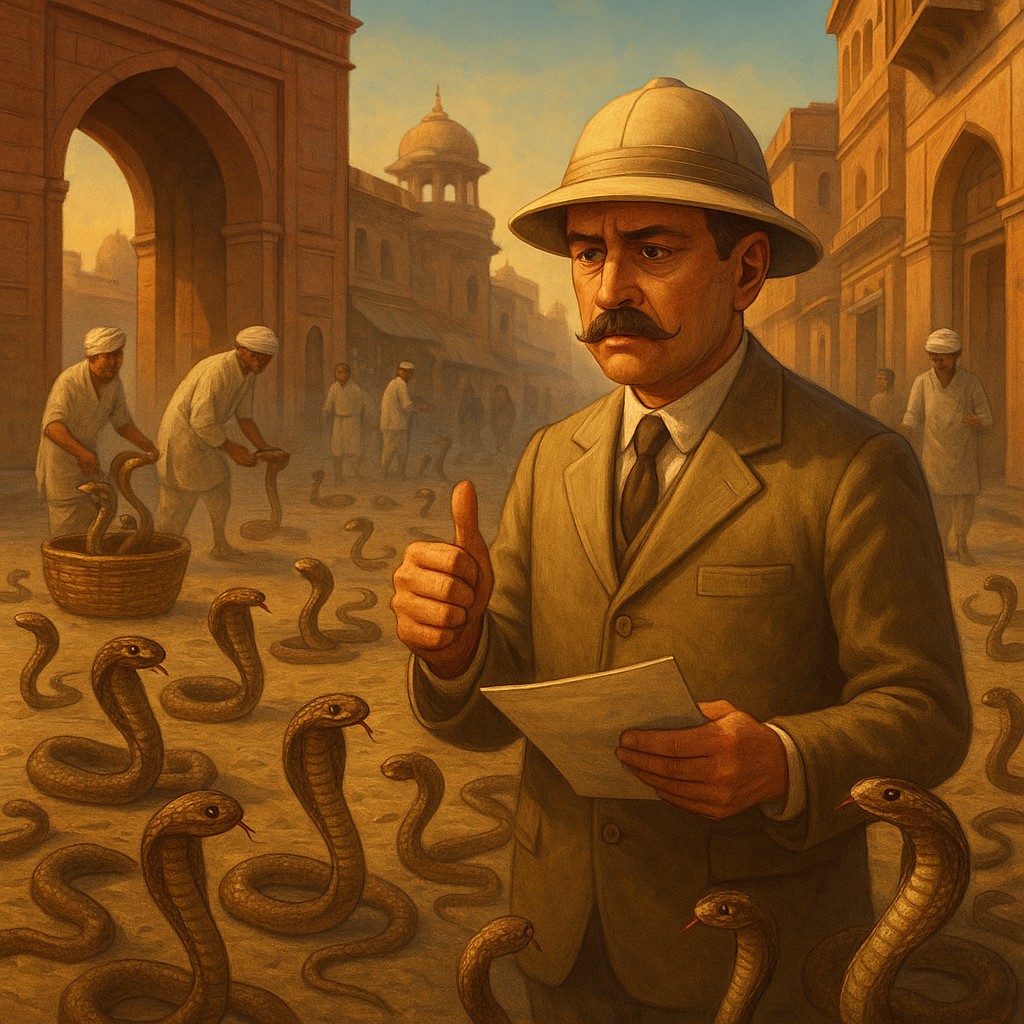
Imagine for a moment that you are a colonial official in Delhi, India, during the British Raj. You face a genuine crisis: the streets are swarming with venomous cobras, putting the public at risk. Your solution is elegant, simple, and based on basic supply and demand. You offer a cash reward for every dead cobra brought to your office.
At first, the plan works perfectly. A steady stream of citizens arrives with dead snakes, the wild population drops, and you prepare a glowing report for your superiors about the efficiency of market-based solutions. But then, things take a strange turn. While people are still turning in high numbers of dead cobras, the streets feel just as infested as before. Eventually, you uncover the unsettling truth. Enterprising locals, realizing they could make a steady living from the rewards, have started breeding the snakes in their backyards.
When you realize you are being scammed and cancel the bounty, the situation turns from comical to catastrophic. The breeders, now stuck with thousands of worthless, venomous snakes that are expensive to feed, simply open their cages and let them go. The end result? The cobra population is significantly higher than it was before you started the program.
This historical anecdote - whether literal or legendary - perfectly illustrates the "Cobra Effect." It is a masterclass in how linear logic crashes and burns when it meets the messy, adaptive, and highly creative reality of human behavior. We like to think of laws and incentives as direct levers, but in reality, they are more like throwing a rock into a complex ecosystem; you might hit your target, but you are guaranteed to cause ripples you never anticipated.
The Logic of the Rational Maximizer
To understand why well-intentioned policies fail, we have to look at the "Rational Maximizer," a hypothetical character living inside every human being. This character does not care about the spirit of the law, the social good, or the "vibe" of a regulation. The Rational Maximizer looks at the specific rules of the game and asks one question: "How can I get the biggest reward for the least effort?"
When a government or a boss sets a goal, they are usually looking at the final outcome. However, the people following those rules are looking at the metric - the specific number used to measure success. The Cobra Effect occurs the moment that metric becomes the target, often at the expense of the actual purpose.
In the cobra case, the goal was "fewer snakes in the city," but the metric was "number of dead snakes turned in." Because there is an easier way to get dead snakes (breeding them) than by hunting wild ones (which is dangerous and slow), the rational person chooses the path of least resistance. This isn't necessarily a sign of malice; it is simply how humans interact with structured systems. We are a species of hackers. We look for shortcuts, optimize for personal gain, and are incredibly good at finding the gaps between what a rule says and what it actually means. When a policy fails to account for this adaptive nature, it essentially sets a trap for itself.
Architecture of a Perverse Incentive
A perverse incentive is a specific type of Cobra Effect where a reward system actually encourages the very behavior it is trying to stop. This happens most often in systems that value raw quantity over quality. When we put a "bounty" on a problem, we accidentally turn that problem into a valuable commodity.
If you pay people to solve a problem, you might accidentally create a world where those people have a financial interest in making sure the problem never actually goes away. It is the paradox of the professional problem-solver: if the problem disappears, so does the paycheck.
This phenomenon shows up in modern offices just as often as it did in colonial India. Consider a software company that decides to reward its programmers based on the number of bugs they fix. On the surface, this sounds like a great way to improve code. However, the programmers quickly realize they can earn more money by writing "sloppy" code with easy-to-fix bugs, which they can then "repair" later for a bonus. The metric (bugs fixed) is maximized, but the goal (high-quality software) is actively sabotaged by the very incentive designed to help it.
| Scenario |
Intended Goal |
The Metric |
The Perverse Result |
| Hanoi Rat Massacre |
Wipe out rats |
Rat tails handed in |
People bred rats, cut off the tails, and released them to breed more. |
| Wells Fargo Quotas |
Increase customer loyalty |
Number of accounts opened |
Employees opened millions of fake accounts to hit their targets. |
| British Rail Punctuality |
Trains arriving on time |
Arrival times at stations |
Conductors skipped stops with waiting passengers to "save time." |
| Corporate Bug Bounties |
Higher quality code |
Number of bugs fixed |
Developers intentionally created "easy" bugs to fix later. |
The Hanoi Rat Massacre and the Failure of Simplification
Perhaps the closest historical relative to the cobra story is the Great Hanoi Rat Massacre of 1902. When the French colonial government in Vietnam built a modern sewer system, they inadvertently created a paradise for rats. To fight the resulting plague, they offered a reward for every rat killed. To make the logistics easier, they didn't require the whole rat - only the tail.
This was a classic mistake of simplification. The French thought they were buying "one less rat," but they were actually buying "one rat tail." The result was a city full of healthy rats that just happened to be missing their tails. Citizens would catch the rats, cut off the tails for the bounty, and release the animals back into the sewers so they could breed and produce more "tail-bearing" offspring. This highlights a critical lesson: you cannot treat a single variable in isolation. A rat is not just a tail; it is a biological unit in a reproductive cycle. By focusing only on the tail, the French decoupled the reward from reality. They were subsidizing the rat population rather than shrinking it.
We see this same unintentional subsidy today in environmental "grandfather clauses." Often, a new law mandates that new factories must meet strict emissions standards, while older factories are exempt. The goal is to phase out pollution gradually. However, the perverse incentive makes old, dirty factories incredibly valuable because they are cheaper to run than new ones. Companies will spend millions to keep a crumbling 1950s plant alive at all costs rather than building a clean one, keeping high-polluting assets in use much longer than if the law had never existed.
Goodhart’s Law and the Corruption of Measurement
To truly understand the Cobra Effect, you must understand Goodhart’s Law, named after British economist Charles Goodhart. The law states: "When a measure becomes a target, it ceases to be a good measure." This is the psychological engine that causes incentives to backfire.
Measures are supposed to be like thermometers; they tell you the temperature of a system without changing it. But once you tell the system it will be rewarded based on what the thermometer says, people find a way to make the mercury rise without actually warming the room.
We see this everywhere in education and healthcare. When school funding is tied strictly to standardized test scores, a teacher’s goal shifts from "educating children" to "raising scores." This leads to "teaching to the test," where students learn to memorize patterns rather than developing critical thinking. The test scores might go up, but actual knowledge might drop. In healthcare, if a hospital is penalized for "readmission rates" (how often patients return shortly after leaving), they might respond by delaying a patient's official discharge or reclassifying a return visit as an "observation" to keep the numbers looking clean on paper.
The danger of the Cobra Effect is that it creates "phantom success." On an administrator's spreadsheet, the project looks like a triumph. But on the ground, the situation is decaying. This creates a dangerous loop where leaders double down on a failing policy because their own corrupted data tells them it is working.
Anticipating the Ripple Effects
If the Cobra Effect is so common, how do we avoid it? The answer lies in moving away from linear thinking and toward systems thinking. Linear thinking says: "If A is the problem, then B is the reward for stopping A." Systems thinking asks: "If I introduce B into this environment, how will C, D, and E react, and how will their reactions change A?"
One effective strategy is to use "counter-metrics." If you are going to reward a specific behavior, you must also track the potential side effects. For example, if you reward a sales team for every new customer they sign up, you should also track the "churn rate" - how many of those customers quit within a month. If the sales team is using dishonest tactics to get sign-ups, their "new customer" numbers will be high, but their "churn" will be just as high. By balancing the two, you force employees to focus on the real goal - long-term growth - rather than just a single number.
Another approach is to reward outcomes (actual results) rather than outputs (tasks completed). This is difficult because outputs, like tail counts or lines of code, are easy to measure, while outcomes, like public health or software stability, take time to appear. However, the more a policy aligns a reward with the final, long-term health of the system, the less room there is for "gaming the system." It requires building trust rather than just building checklists.
Navigating a World of Complex Incentives
As you go through your professional and personal life, keep an eye out for the cobras hiding in the grass. Whether it is a new fitness routine where you prioritize "miles run" but ignore your knee pain, or a company policy that values "hours at the desk" over actual work, the potential for a backfire is everywhere.
Remember that people will always follow the incentive, not the intention. If you want a specific result, you must look at the world through the eyes of the person being rewarded and ask: "Is there a way for me to get this cash without actually doing what you want?"
If the answer is yes, the Cobra Effect is already in motion. Recognizing this isn't about being cynical; it’s about being realistic. It is an invitation to be more creative and holistic in how we solve problems. By understanding the gaps between our rules and our goals, we can design systems that are more resilient and effective. The next time you see a "simple" solution to a complex problem, look for the snake breeders. They are almost certainly there, waiting to turn your well-meaning bounty into a thriving new industry.