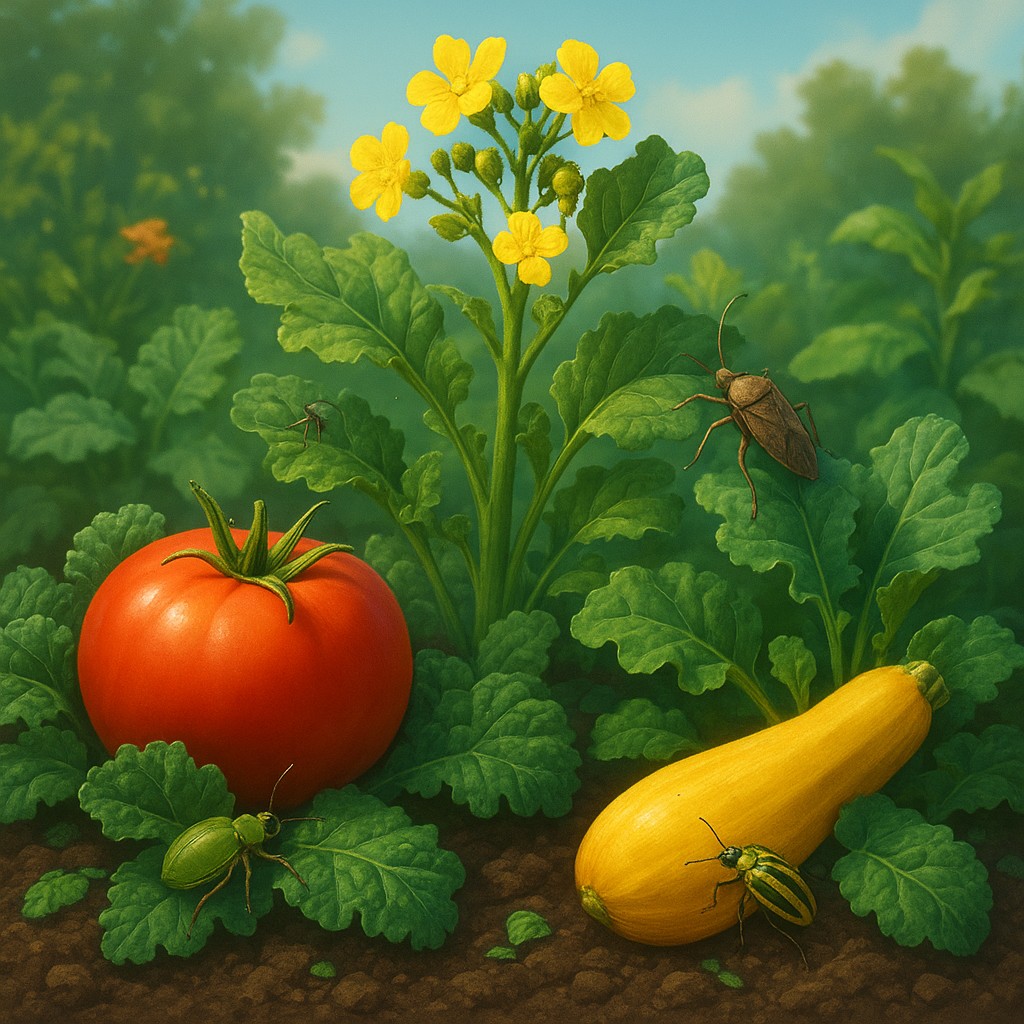
Imagine for a moment that you are a gourmet chef, carefully preparing a five-star meal for a famous critic. You have sourced the finest organic heritage tomatoes, hand-picked the crispest kale, and spent weeks nurturing delicate summer squashes. But as you step into your outdoor kitchen, you realize the guests have already arrived uninvited, and they have terrible manners. Thousands of aphids, cabbage loopers, and squash bugs are devouring your ingredients before they even reach the cutting board. In the traditional gardening world, this is the moment many reach for chemical "heavy weaponry." However, there is a more sophisticated, slightly clever way to handle these unwanted diners: the art of the honeypot, also known as trap cropping.
Instead of fighting a losing battle against every insect that enters your neighborhood, trap cropping relies on the idea of a "distraction salad." It is a biological chess move where you intentionally plant a "sacrificial" species that is far more attractive to a specific pest than your prized vegetables. By understanding what insects like to smell and eat, you can manipulate their movement, luring them away from your main harvest and into a small, controlled area. Think of it as opening a free, all-you-can-eat fast food buffet right next to a high-end steakhouse; if the burger is juicy enough, the crowd will ignore the filet mignon every single time.
The Sensory Science of Fatal Attraction
At its heart, trap cropping relies on the complex sensory world of the insect kingdom. Bugs do not wander aimlessly through your garden hoping to stumble upon a snack; they are guided by specialized chemical receptors that act like biological GPS systems. Plants emit volatile organic compounds (VOCs), which are essentially scent signals that tell an insect exactly what is on the menu. A flea beetle, for instance, can detect the specific sulfurous "kick" of a mustard plant from a long way off. When you plant a trap crop, you are essentially "turning up the volume" on a specific signal to drown out the scent of your main crop.
The success of this strategy depends on a "hierarchy of taste." Insects are specialists by nature. While an aphid might be perfectly happy nibbling on your lettuce, it might absolutely love a nasturtium. If the nasturtium gives off a stronger or more tempting chemical signature, the aphid’s nervous system will instinctively prioritize that plant. This is not a logical choice the insect makes; it is a hard-wired response to the most powerful host-plant signal nearby. By exploiting these cravings, you turn your garden into a carefully designed landscape of lures and diversions.
This biological pull is often so strong that insects will bypass a healthy main crop entirely to reach the trap. For gardeners, this provides a massive tactical advantage. Instead of searching every inch of a large garden for pests, you only need to watch the small patches of trap plants. You have successfully moved from a defensive position, where you react to damage, to an offensive one, where you decide exactly where the damage is allowed to happen. It is the ultimate example of working with nature's appetites rather than against them.
Coordinating the Botanical Ambush
Timing is perhaps the most critical part of a successful trap crop strategy. If your "decoy" plant is too small or hasn’t started producing its peak scent when the pests emerge, they will settle for your main crop because they have to. On the other hand, if the trap crop dies off too early, the pests will simply move to your prized vegetables once the first course is finished. To master this, you must think like a choreographer. You generally want your trap crop to be about two weeks "ahead" of your main crop, ensuring it is established and smelling irresistible the moment the first wave of seasonal pests arrives.
Consider the relationship between the Blue Hubbard squash and the striped cucumber beetle. The Blue Hubbard is like a "siren song" for these insects. It is huge, hardy, and gives off a scent that cucumber beetles find impossible to resist. Professional growers often plant Blue Hubbard squashes along the edges of a field filled with more delicate summer squashes or melons. Because the Blue Hubbard grows faster and more vigorously, it acts as a magnet, drawing the beetles to the edge of the field and keeping the interior safe.
The physical layout of these plants also matters. There are two main ways to do this: "perimeter" and "interspersion." Perimeter trap cropping involves planting a border of the sacrificial crop around the entire garden, creating a wall of distraction. Interspersion involves planting small "islands" of trap crops throughout the garden beds. The choice depends on how the pest moves. For slow-moving insects, clusters work well; for fast fliers, a perimeter fence of scent is often the better deterrent.
A Menu of Deception: Common Pairings
To use this effectively, you need to know which plants act as magnets for specific garden villains. Not all plants are created equal to a hungry bug. Some trap crops work by being tastier, while others work by having a "flashier" chemical profile. Below is a guide to some of the most effective pairings used by ecological gardeners to protect their harvests.
| Main Crop to Protect |
Common Pest Villain |
The Ideal Trap Crop (Sacrificial Plant) |
| Cabbage & Kale |
Diamondback Moth / Cabbage Worm |
Mustard Plants (Spicier and more attractive) |
| Tomatoes & Peppers |
Stink Bugs / Aphids |
Sunflowers (Act as a giant landing pad and nectar source) |
| Summer Squash |
Squash Bugs / Cucumber Beetles |
Blue Hubbard Squash (Extremely high attraction rate) |
| Potatoes |
Colorado Potato Beetle |
Early-season Potatoes or Eggplant |
| Roses & Fruit Trees |
Japanese Beetles |
Geraniums (Can temporarily paralyze the beetles) |
| General Vegetables |
Flea Beetles |
Radishes or Bok Choy (Fast-growing and irresistible) |
While the table above is a great starting point, the "secret sauce" is often variety. Using flowers like nasturtiums is a classic move because they are general magnets, meaning they attract a wide range of pests from aphids to whiteflies. The goal is to create a multi-layered defense system where the pest is always offered something "better" than your actual dinner.
The Exit Strategy: What Happens Next?
This is where many beginners make a major mistake: they plant the trap crop, attract the bugs, and then do nothing. If you leave a trap crop alone, it eventually becomes a "bug nursery." Once the pest population on the trap crop explodes, the extra insects will spill over into your main garden anyway. You haven't solved the problem; you've just delayed it and given the enemy a place to breed. Therefore, trap cropping is not a "plant and forget" method; it is a containment strategy that requires follow-up.
There are generally three ways to handle the pests once they have gathered on your sacrificial plants. The first is "active removal." Since the bugs are all in one spot, you can use a hand-held vacuum, a bucket of soapy water, or a targeted spray of organic pesticide directly on the trap crop. Because you are only spraying the sacrificial plant, you keep your main crop chemical-free and protect the rest of the garden. You are essentially gathering the herd before taking action.
The second method is the "Natural Predator" approach. By concentrating pests in one area, you are putting out a "welcome" sign for helpful insects like ladybugs, lacewings, and predatory wasps. These "good bugs" love finding a high density of prey. In a balanced garden, the trap crop becomes a hunting ground where the predators do the work for you. Finally, some gardeners use "physical removal," where they simply pull up the entire infested trap plant, seal it in a bag, and compost it far away or throw it in the trash, removing the pests from the garden entirely.
Correcting Common Mistakes
A frequent myth is that trap cropping will "invite more bugs into the yard than would have come otherwise." This is a fair concern, but research shows it isn't true. The insects are likely already in your area or flying through; the trap crop simply ensures that when they arrive, they head toward the diversion rather than your food. You aren't necessarily increasing the total number of bugs; you are just managing where they land.
Another misconception is that any "companion plant" is a trap crop. This is not the case. Companion planting is a broad category that includes plants that add nutrients to the soil, plants that repel insects with strong smells (like marigolds), and plants that attract pollinators. A trap crop is a very specific type of companion plant defined by how much pests like it. If you plant something that repels a bug, you are pushing it away; if you plant a trap crop, you are pulling it toward a specific point. Knowing the difference between "push" and "pull" strategies is the mark of an advanced gardener.
Finally, it is worth noting that trap crops can fail if the main crop is under a lot of stress. Plants that are thirsty or lacking nutrients often emit "distress signals" that are very loud to insects. If your main broccoli crop is dying for water, even the best mustard trap crop might not be enough to distract a hungry pest. Biological control works best when your prized plants are healthy, happy, and "quiet" on the chemical front, allowing the trap crop to be the loudest voice in the garden.
Becoming a Garden Architect
The beauty of using trap crops is that it transforms the gardener from a reactive fighter into a proactive architect. It moves you to observe the subtle rhythms of the seasons, the specific cravings of local bugs, and the chemical "conversations" happening between leaves and the air. Instead of seeing every insect as an intruder to be destroyed, you begin to see them as part of a complex system that can be guided with a bit of cleverness and a few sacrificial leaves.
As you move forward, remember that perfection isn't the goal. A few holes in a nasturtium leaf represent a victory, not a failure - it means the system is working exactly as it should. By giving up a small amount of space to create harmony, you aren't just growing food; you are mastering an ancient, sophisticated form of nature-based diplomacy. Let your trap crops stand as tall, green decoys, allowing your main harvest to flourish in their shadow.