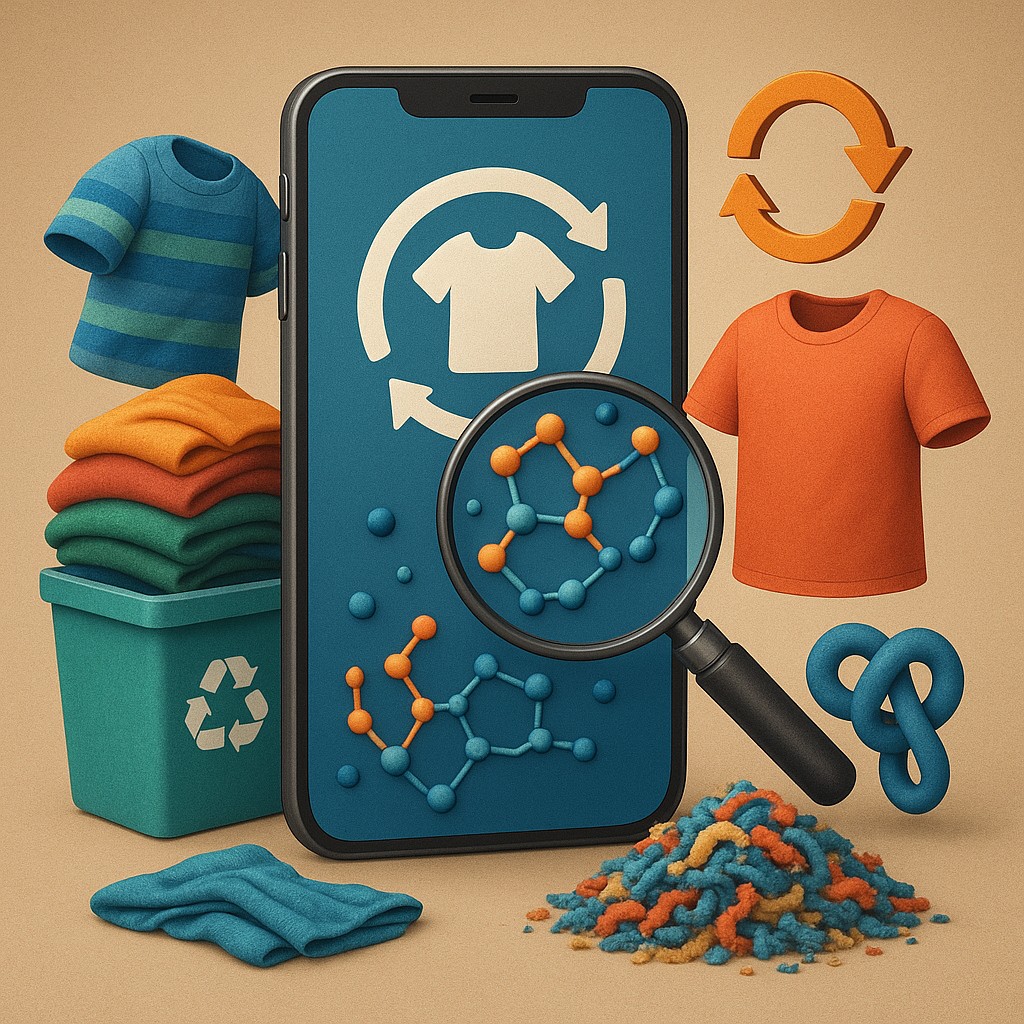
Imagine walking through a crowded second-hand clothing market, surrounded by oceans of polyester blends and cotton tees. To the naked eye, a high-end athletic shirt and a cheap fast-fashion blouse might look much the same after a few years of wear. At a microscopic level, however, they are worlds apart. When these items eventually wear out and head to a recycling bin, they enter a chaotic game of chemical roulette. Currently, most textile recycling is "downcycling." This is where your favorite shirt is shredded into low-grade insulation or carpet padding because we simply do not know what is actually inside the fabric.
The problem lies in the "molecular amnesia" of our clothing supply chain. Once a garment leaves the factory, its chemical history is lost. Was this polyester made from new petroleum or recycled bottles? Does it contain specific flame retardants or dyes that interfere with melting? Because we lack these answers, we mix different grades of plastic together, creating a "Frankenstein" polymer that is structurally weak and brittle. To turn a shirt back into a high-quality shirt, we need more than just a recycling bin; we need a way for the fabric to tell us its own life story.
The Structural Crisis of Recycled Plastic
To understand why your recycled gym shorts might fall apart faster than ones made from new plastic, we have to look at the long, chain-like molecules called polymers. High-quality polyester consists of long, healthy chains that provide strength and flexibility. However, every time plastic is heated and reshaped, those chains get chopped shorter. If you mix "Grade A" plastic with "Grade C" plastic, the resulting material inherits the weaknesses of the lower grade. In the textile industry, this is a nightmare. Even a 1% contamination of the wrong polymer can ruin an entire batch of recycled yarn.
The current sorting process relies heavily on infrared light or, more often, human workers reading poorly printed tags that might be faded or missing. Even when the tag is there, it usually only lists the primary materials, like "60% Cotton, 40% Polyester." It says nothing about the specific chemical additives or the molecular weight of the fibers. This lack of transparency means that high-value materials are often treated as trash. This prevents the industry from reaching a "closed loop," where a garment can be recycled into an identical garment indefinitely.
Identity at the Atomic Level
This is where the concept of the Digital Product Passport (DPP) enters the scene, acting as a permanent, unerasable memory for every fiber in a garment. Rather than relying on a flimsy neck label, engineers are now embedding microscopic tracers directly into the liquid plastic before it is spun into thread. These tracers can be "molecular cocktails" of rare-earth elements or even synthetic DNA sequences that act as a barcode. They are so small that they do not change the feel of the fabric, but they are durable enough to survive washing, drying, and years of heavy use.
When a garment reaches a recycling facility ten years from now, a specialized scanner can read these tracers instantly. The scanner does not just see "polyester"; it retrieves a digital file linked to a blockchain, a secure digital ledger. This file tells the recycler the exact factory where the fiber was born, the specific chemical recipe used, and how many times the material has already been recycled. By knowing the molecular history, the facility can group identical materials together. This ensures that the new yarn produced is just as strong as the original material.
The Architecture of the Digital Passport
A Digital Product Passport is not a single file, but a system of layers that connect the physical world to the digital one. It requires a carrier, a data protocol, and a governance framework. The carrier is the physical link, such as an RFID chip sewn into a seam, a QR code printed with invisible ink, or the molecular tracers mentioned earlier. The data protocol is the language the passport speaks, ensuring that a recycler in Germany can understand the data uploaded by a weaver in India.
| Component |
Function in the Circular Economy |
Real-World Application |
| Data Carrier |
The physical bridge between the object and the cloud. |
Molecular tracers, RFID tags, or QR codes. |
| Material Provenance |
Tracking the origin and purity of the raw fibers. |
Distinguishing between organic cotton and blended fibers. |
| Chemical Inventory |
Listing all dyes, finishes, and processing agents. |
Identifying harmful chemicals that must be removed before melting. |
| Impact Metrics |
Quantifying the carbon and water footprint of the item. |
Providing verifiable "green" data for regulators and consumers. |
| Recycling Instructions |
Guidance on how to take apart and process the item. |
Telling a machine exactly which chemical bath is needed to dissolve a blend. |
This ordered data allows for a level of precision that was previously impossible. For example, some jackets use zippers made of one plastic, buttons made of another, and fabric made of a third. A DPP can include a disassembly map, telling robotic sorting machines exactly where to cut to recover the most valuable parts without contaminating the main fabric. It turns a piece of trash back into a sophisticated industrial raw material.
Moving Beyond Greenwashing with Traceability
For decades, the fashion industry has operated on a "trust me" basis. Brands might claim their products are "eco-friendly" or "made from recycled ocean plastic," but verifying those claims is notoriously difficult once the product is in the store. Digital Product Passports move the needle from marketing claims to measurable facts. Because the data is often stored on a decentralized ledger, it is extremely difficult to forge. A brand cannot claim a shirt is 100% recycled if the molecular tracer reveals it was sourced from a new plastic plant last month.
This shift creates a powerful incentive for brands to design products that are easier to recycle. If a company knows its products will be scanned and evaluated at the end of their life, it is less likely to use complex blends that are impossible to separate. In many regions, particularly the European Union, these passports are transitioning from a good idea to a legal requirement. Legislation is being drafted that will require most textile products to carry a DPP, forcing the global supply chain to adopt a universal language of transparency.
Standardizing a Global Labyrinth
The biggest hurdle for the Digital Product Passport is not the technology, but the cooperation. The textile industry is a sprawling, global labyrinth involving millions of small farmers, giant chemical plants, and thousands of independent sewing shops. For a passport to work, everyone along that chain must agree to record their data in the same way. If a spinning mill in Vietnam uses a different data format than a dye house in Italy, the passport becomes a broken link, and the recycler at the end of the chain is left back at square one.
Furthermore, there are concerns regarding data privacy and intellectual property. High-end outdoor brands often have "secret sauces" for their waterproof coatings or high-performance yarns. They may be hesitant to upload their exact chemical recipes to a digital platform that might be accessible to competitors. Engineers and policy makers are working on "zero-knowledge" systems. These allow a recycler to verify that a material is "Safe to Recycle" without seeing the exact trade-secret formula used to create it. It is a delicate balance between total transparency and protecting the innovation that makes modern clothing so functional.
The Future of the Intelligent Wardrobe
As these digital systems mature, the passport might offer benefits to the consumer long before the garment reaches the recycling bin. Imagine scanning your jacket with your phone and seeing not just the brand name, but a map of where the cotton was grown, the names of the artisans who sewed it, and a set of personalized repair instructions specifically for that garment. The digital passport could even host a "digital twin," a virtual version of the item for use in online spaces. It could also help you prove a high-value item is authentic on the resale market, showing it is a genuine designer piece and not a fake.
We are moving toward a world where the line between physical objects and digital data is permanently blurred. By giving inanimate objects a memory and a voice, we are treating them with a new kind of respect. We no longer view a worn-out shirt as a disposable piece of lint, but as a valuable container of highly engineered molecules waiting for their next assignment. The Digital Product Passport is the key that unlocks this future. It ensures that the energy and resources we pour into our clothes are never truly lost, but are instead kept in a perpetual, high-quality loop that respects both the planet and the people who made them.