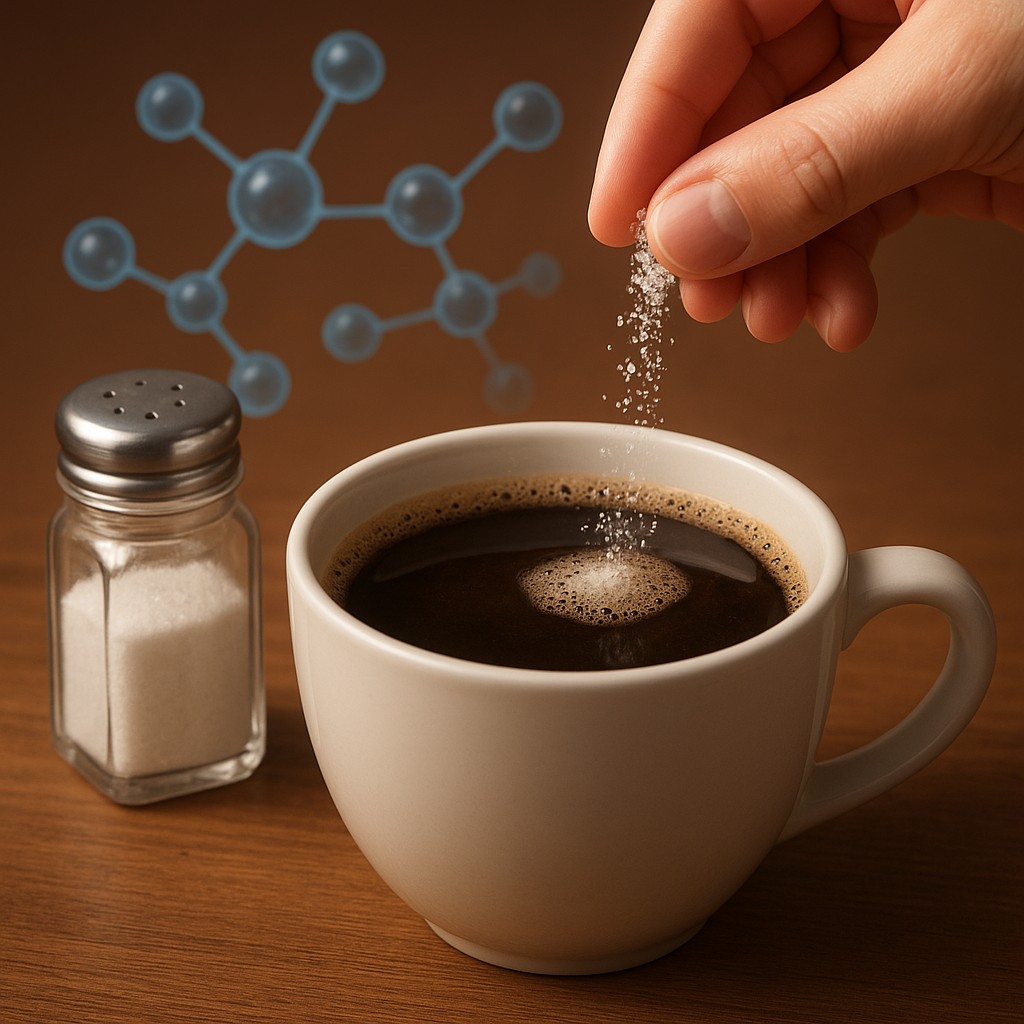
Imagine waking up to find your morning coffee has lost its charm. You’ve brewed a fresh pot, but the beans were over-roasted, or perhaps you let them steep in the French press a minute too long. The result is a cup of liquid charcoal that hits the back of your throat with a harsh, medicinal punch. Usually, your first instinct is to reach for a heavy splash of cream or three spoonfuls of sugar to drown out the bitterness. However, there is a much more elegant, scientific solution sitting right in your salt shaker. It sounds backwards - almost like a kitchen prank - but adding a tiny pinch of salt to your coffee can transform a bitter brew into something surprisingly smooth and sweet.
This trick isn't about making your coffee taste like the ocean, nor is it just covering up a bad flavor with a stronger one. Instead, it is a lesson in biological interference. While we often think of the tongue as a simple landing pad for tastes like "sweet," "salty," and "sour," it is actually a sophisticated sensor array that constantly decides which signals reach the brain. By adding sodium to the mix, you are essentially hacking your nervous system to ignore the bad news while amplifying the good. To understand how this works, we have to look past the steam rising from the mug and dive into the microscopic world of ion channels and chemical gates.
The Gatekeepers of Taste
To understand why salt improves coffee, we first have to look at the biology of bitterness. Your tongue holds thousands of taste buds, each containing specialized receptor cells. Among these, the receptors that detect bitterness, known as T2Rs, are particularly sensitive. From an evolutionary standpoint, this makes perfect sense; many toxic plants and substances in nature are incredibly bitter. Our ancestors survived because their tongues acted as expert alarm systems that shouted "Danger!" the moment something potentially poisonous touched their lips. Coffee contains naturally bitter compounds like caffeine and chlorogenic acid, which trigger these alarms even when the drink is perfectly safe.
When a bitter molecule lands on a T2R receptor, it acts like a key in a lock. This starts a chain reaction of chemical signals that travel through your nerves to tell your brain you are consuming something unpleasant. However, sodium ions are the ultimate "line-cutters" in this biological process. Because salt is highly reactive, its sodium ions tend to bind to these same receptor sites or interfere with how the bitter signals are sent. When sodium is present in small amounts, it physically stops the "bitter" message from being delivered. It acts like a piece of tape over a megaphone: no matter how loud the bitter molecules shout, the brain only hears a whisper.
Separating Flavor from Perception
A common misconception in cooking is that flavor is a permanent quality of the food itself. In reality, flavor is a "hallucination" created by your brain based on data from your mouth and nose. When you drink coffee, your brain processes a profile that includes bitterness, acidity, and a subtle, natural sweetness. Usually, the bitterness of an over-extracted bean is so loud that it drowns out everything else. By using salt to quiet that bitterness, you aren't actually adding sugar, but you are creating the "silence" necessary for your brain to finally notice the sweetness that was already there.
This phenomenon is known as cross-modal suppression. It is a fundamental principle used by professional chefs and food scientists to balance complex dishes. Think of it like a sound mixer in a recording studio. If the bass is too loud, you can’t hear the vocals. You could turn up the vocals (add sugar), or you could simply turn down the bass (add salt). By choosing the latter, you keep the integrity of the original drink without making it sugary or high in calories. It is a surgical strike on flavor rather than a total takeover of sweetness.
The Chemistry of the Coffee Bean
Not all bitterness is the same, and the chemistry inside a coffee bean changes drastically depending on how it is treated. When coffee is lightly roasted, it keeps many organic acids that provide a bright, fruity flavor. However, as the roasting continues, the chemical structure of the bean breaks down. Chlorogenic acids are the primary source of bitterness in light-to-medium roasts. If you push the roast further into "dark" or "Italian" territory, these acids break down into compounds called phenylindanes. These chemicals provide that harsh, lingering bitterness often found in espresso or dark-roasted blends.
The brewing process also plays a critical role. If water stays in contact with coffee grounds for too long, or if the water is too hot, it begins to pull out heavier, harsher compounds that should have been left behind. This turns a balanced cup into a "bitter bomb." Because sodium is so effective at blocking the perception of these specific compounds, it is the perfect antidote for a cup that has been "over-cooked." It acts as a corrective lens, bringing the flavors back into focus.
| Substance |
Primary Taste Group |
Role in Coffee |
Effect of Sodium |
| Caffeine |
Bitter |
Natural stimulant |
Heavily suppressed |
| Chlorogenic Acids |
Bitter/Acidic |
Found in green beans |
Partially suppressed |
| Phenylindanes |
Very Bitter |
Created by dark roasting |
Significantly masked |
| Natural Sugars |
Sweet |
Caramelized during roasting |
Perceived as stronger |
| Organic Acids |
Sour/Bright |
Provides "zip" and fruitiness |
Becomes more balanced |
The Golden Ratio of the Pinch
While the science is solid, the execution requires a light touch. If you add too much salt, you simply end up with salty coffee, which is arguably worse than bitter coffee. The goal is to stay below the "detection threshold." This is the point where there is enough salt to block the bitter receptors, but not enough to fully activate the salty receptors on your tongue. In professional kitchens, chefs often use a saline solution (a dropper bottle of salt water) because it allows for much more precision than a shaky hand with a salt shaker.
For a standard twelve-ounce cup of coffee, you only need a tiny speck of salt - often less than what you would find on a single French fry. If you are brewing a full pot, adding a quarter-teaspoon directly to the dry grounds before brewing works wonders. This ensures the sodium is integrated into the water as it extracts the coffee, leading to a more even effect. This is also a handy trick for when you are at a hotel or an office with notoriously bad, burnt-tasting coffee. A quick trip to the cafeteria for a salt packet can turn a miserable caffeine fix into a pleasant drink.
Beyond the Mug: Salt as a Structural Ingredient
The magic of salt in coffee is just one example of how salt acts as an "enhancer" in the culinary world. We often think of salt as something that just makes things salty, but its primary job in food science is to modify flavor. This is why a pinch of salt is almost always included in recipes for chocolate cake or cookies. Without the salt, the sweetness feels "flat." The salt blocks any stray bitter notes from the cocoa or butter and stimulates the sweet-sensing proteins in our mouth to work more efficiently, making the sugar taste even more intense.
In some cultures, this relationship is a tradition. In parts of Scandinavia, Northern Pennsylvania, and Vietnam, adding salt to coffee is not a "fix" for a bad cup but a standard way of life. Some coastal regions historically used brackish water - a mix of fresh and sea water - to brew their coffee, which led to a regional preference for that smooth profile. These cultures discovered through trial and error what we now know through biology: salt and coffee are natural allies.
Overcoming the "Sugar Only" Habit
There is a psychological hurdle to overcome when you first consider salting your drink. We are taught to think of salt and sugar as opposites. We put sugar in tea and salt on steak, and we rarely let the two meet in our morning routine. This binary thinking misses the reality of how our senses work. By moving away from the idea of "masking" flavors and toward "adjusting" them, we open up more sophisticated ways to enjoy what we eat and drink.
Switching to salt instead of sugar also has genuine health benefits for those trying to cut back on sugar. Many people load their coffee with sugar not because they love the taste of syrup, but because they are trying to hide a bitter roast. If you can neutralize that bitterness with a zero-calorie mineral, you might find that you don't actually need the sugar at all. You get to taste the actual origin of the bean - the notes of chocolate, berry, or nut - without a "bitterness alarm" going off in your head.
Troubleshooting Your Brew
It is important to remember that salt is a tool, not a miracle cure for truly rotten beans. If your coffee tastes like old rubber or has gone sour from sitting on a heating plate for four hours, a pinch of salt can only do so much. This technique works best when you have a decent brew that is just slightly too aggressive, or a dark roast that feels one-dimensional. It is about refinement, not resurrection.
If you find that your coffee tastes dull after adding salt, you likely used too much. Sodium shouldn't just block bitterness; it should also let the acidity shine through. If the coffee feels "heavy" or "flat," you’ve over-salted it, silencing the bright, fruity notes along with the bitter ones. Like any experiment, it requires a bit of practice. Start with a tiny amount, taste the result, and see how your tongue reacts. You will eventually find the "sweet spot" where the bitterness vanishes and the coffee feels vibrant and balanced.
A New Perspective on Your Morning Cup
The next time you are faced with a cup of coffee that looks too dark or smells charred, don't reach for the creamer immediately. Instead, treat your kitchen like a laboratory. By adding that tiny pinch of salt, you are using simple chemistry to silence millions of years of evolutionary warnings. It is a reminder that we aren't just passive consumers; we can actively tune our sensory experiences.
Mastering the use of salt in non-traditional places is more than just a clever trick; it is a sign of a curious mind. When you understand how bitterness works, you see food and drink as a series of chemical interactions waiting to be optimized. So go ahead and try it. The result is a smoother, more satisfying cup that proves sometimes the best way to find sweetness is not by adding more sugar, but by removing the obstacles in its way.