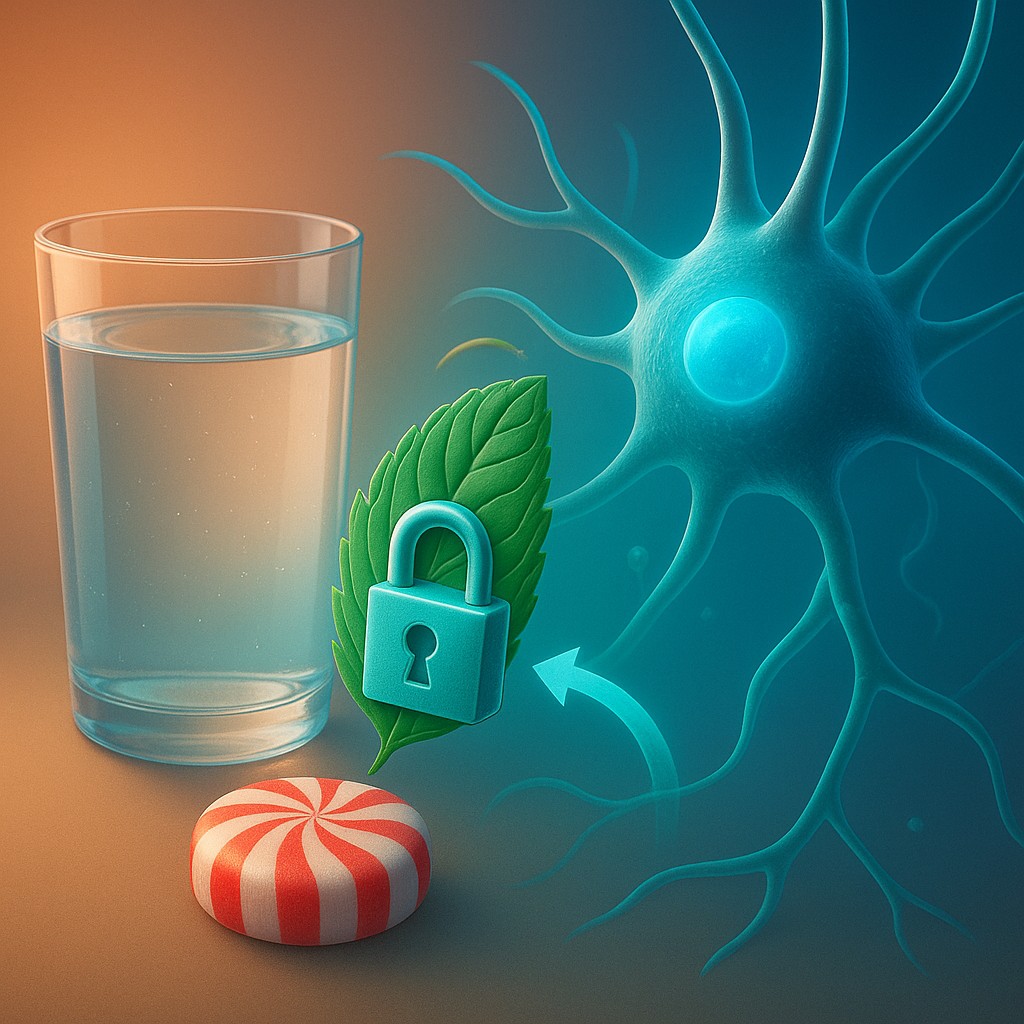
Imagine you are sitting on a sun-drenched porch on a sweltering July afternoon. You reach for a tall glass of water, but before you take a sip, you pop a single peppermint into your mouth. As you crunch down, a familiar, frosty wave sweeps across your tongue. When you finally drink, it doesn't just feel refreshing; it feels as if you have swallowed a liquid glacier. Your mouth is convinced the temperature has plummeted by twenty degrees, yet if you were to stick a thermometer under your tongue, it would show no change at all. You have successfully hacked your own nervous system using nothing but a small green leaf.
This phenomenon is one of the most delightful lies our bodies tell us. It reveals a profound truth about how we perceive the world: our senses are not direct windows into reality, but rather a series of specialized biological sensors that can be easily tricked by the right chemical key. Menthol, the active compound in mint, is a master of this deception. By understanding how this molecule interacts with our nerve endings, we can peek behind the curtain of our sensory architecture to see how our brain builds the sensation of cold from scratch.
The Molecular Lock and the Minty Key
To understand why mint feels cold, we have to look at the specialized hardware embedded in the membranes of your sensory neurons. Your body does not have one single "feeling" sensor; instead, it uses a variety of microscopic proteins called ion channels to detect specific stimuli like pressure, heat, and cold. One of the most important players in this system is a protein called TRPM8. Under normal circumstances, TRPM8 is a gateway that remains mostly closed. However, when the temperature around your nerve endings drops, this protein changes its physical shape, opening a channel that allows calcium and sodium ions to flow into the nerve cell. This flow of ions creates an electrical signal that zips to your brain, which then translates that signal into the conscious thought, "Wow, it’s chilly in here."
Menthol enters the scene as a brilliant chemical impersonator. The menthol molecule is shaped so that it fits perfectly into a specific binding site on the TRPM8 protein. When you eat a mint, these molecules flood your mouth and latch onto those receptors. Because of its unique structure, menthol forces the TRPM8 channel to zip open just as if the temperature had dropped. At room temperature, these receptors are usually quiet, but menthol lowers their activation threshold. It makes them hypersensitive, causing them to fire off cold signals even when your mouth is perfectly warm. Your brain, receiving a frantic stream of electrical pulses from TRPM8, has no way of knowing the signal was triggered by a chemical rather than a breeze. It simply reports the sensation it was programmed to report: cold.
Sensory Synchrony and the Spicy Counterpart
The trickery does not stop with cold. Our bodies use a similar logical framework to detect heat, and just as menthol mimics the cold, other plant compounds can mimic the burn of a fire. Most famously, capsaicin, the compound that gives chili peppers their kick, targets a "brother" receptor to TRPM8 known as TRPV1. While TRPM8 is the cold sensor, TRPV1 is the heat sensor, normally designed to warn you if you are touching something hot enough to damage your tissues. When you eat a spicy habanero, the capsaicin binds to TRPV1 and tricks it into sending a "scorching hot" signal to the brain, even though the pepper itself is at room temperature.
This is why the experience of eating a peppermint is often described as the inverse of eating a chili. Both substances utilize a phenomenon called chemesthesis, which is the ability of chemical compounds to activate receptors associated with other senses like touch or temperature. Interestingly, these sensors are distributed all over your body, not just in your mouth. If you were to rub mint oil or a chili pepper on your arm, you would eventually feel those same sensations of cooling or burning. The mouth is simply more sensitive because the skin is thinner and the density of nerve endings is much higher, allowing the molecules to reach the receptors more quickly.
| Compound |
Target Receptor |
Natural Trigger |
Perceived Sensation |
| Menthol |
TRPM8 |
Temperatures below 25°C (77°F) |
Cold, refreshing, tingling |
| Capsaicin |
TRPV1 |
Temperatures above 43°C (109°F) |
Burning, heat, irritation |
| Allyl Isothiocyanate |
TRPA1 |
Environmental irritants/chemicals |
Sharp, stinging (Wasabi/Mustard) |
| Eucalyptol |
TRPM8 |
Temperatures below 25°C (77°F) |
Mild cooling, airy |
The Threshold Effect and the Second Sip
The most dramatic part of the menthol experience usually happens when you breathe in deeply or take a drink of water after eating a mint. This extra cold sensation occurs because menthol has not just triggered the TRPM8 receptors; it has recalibrated them. Usually, TRPM8 requires a significant drop in temperature to start firing. However, once menthol is bound to the receptor, it acts like a hair-trigger on a scale. It makes the receptor so sensitive that even the slight evaporative cooling of your breath or a drink of water that is only marginally cooler than your body temperature causes the receptors to fire at maximum intensity.
This is a perfect example of sensory amplification. Because the menthol has preemptively primed the nerves, any actual cold stimulus becomes exaggerated. If you drink water at 60 degrees Fahrenheit, your brain might perceive it as being near freezing. This explains why people who chew mint gum often feel a sharp, almost painful ice-burn when they inhale through their mouth. The air hitting the moist surfaces of your throat causes a tiny bit of evaporation, which slightly cools the tissue. Without menthol, you would not even notice this tiny temperature shift. With menthol, your TRPM8 receptors scream "Polar Vortex!" and your brain reacts accordingly.
From Kitchen Chemistry to Clinical Comforts
Understanding the mechanical dance between menthol and TRPM8 is not just a fun fact for dinner parties; it has profound implications for modern medicine. Because menthol can trigger a cooling sensation without actually changing the temperature of the skin, it is a primary ingredient in topical analgesics. When you rub a mentholated cream on a sore muscle, you are not actually icing the muscle, but you are tricking the brain into focusing on the cooling sensation rather than the dull ache of inflammation. This is often referred to as gate control theory, where providing a non-painful sensory input, such as cooling, can effectively close the gate on pain signals reaching the brain.
Researchers are currently looking at ways to isolate these cooling effects to treat chronic pain and even severe itching. Itchiness and pain travel along many of the same neural pathways, and the activation of TRPM8 has been found to have a soothing effect on the neurons that transmit itch. By developing synthetic molecules that are even better at binding to TRPM8 than natural menthol, scientists hope to create powerful, non-addictive treatments for patients with skin conditions or neuropathic pain. It is a beautiful irony of biology: by using a molecule that lies to our brain, we can actually provide very real, honest relief to people who are suffering.
The Evolutionary Logic of Nature's Pranks
You might wonder why plants like mint or chili peppers evolved these specific chemicals in the first place. It is unlikely that the mint plant wants to make your cocktails more refreshing. In the natural world, these compounds usually serve as chemical defense mechanisms. Most insects and mammals find the intense, deceptive cooling of high-concentration menthol or the searing heat of capsaicin to be highly unpleasant. By mimicking a physical threat, such as extreme cold or fire, the plant can deter herbivores without having to develop thorns or expensive toxins. It is a form of psychological warfare performed at the molecular level.
Humans, of course, are the outliers in this biological drama. We are perhaps the only species that actively seeks out these sensory illusions for pleasure. We have learned to enjoy the trickery, incorporating these chemical pranks into our cuisines, candies, and medicines. Every time you enjoy a mint, you are participating in an ancient biological dialogue between a plant and a predator, but you have managed to turn a defensive weapon into a delightful treat.
As you move through your day, remember that your experience of the world is a curated construct. The heat of a summer day, the cold of an ice cube, and the sizzle of a pepper are all electrical signals interpreted by a brain sitting in a dark, silent skull. Menthol serves as a sparkling reminder that our biology is a complex system of triggers and receptors, and that sometimes, a little false signal can lead to a very cool reality. The next time you feel that icy tingle, take a moment to appreciate the microscopic proteins working tirelessly to interpret your environment, even if they cannot always tell the difference between a winter breeze and a sprig of mint.