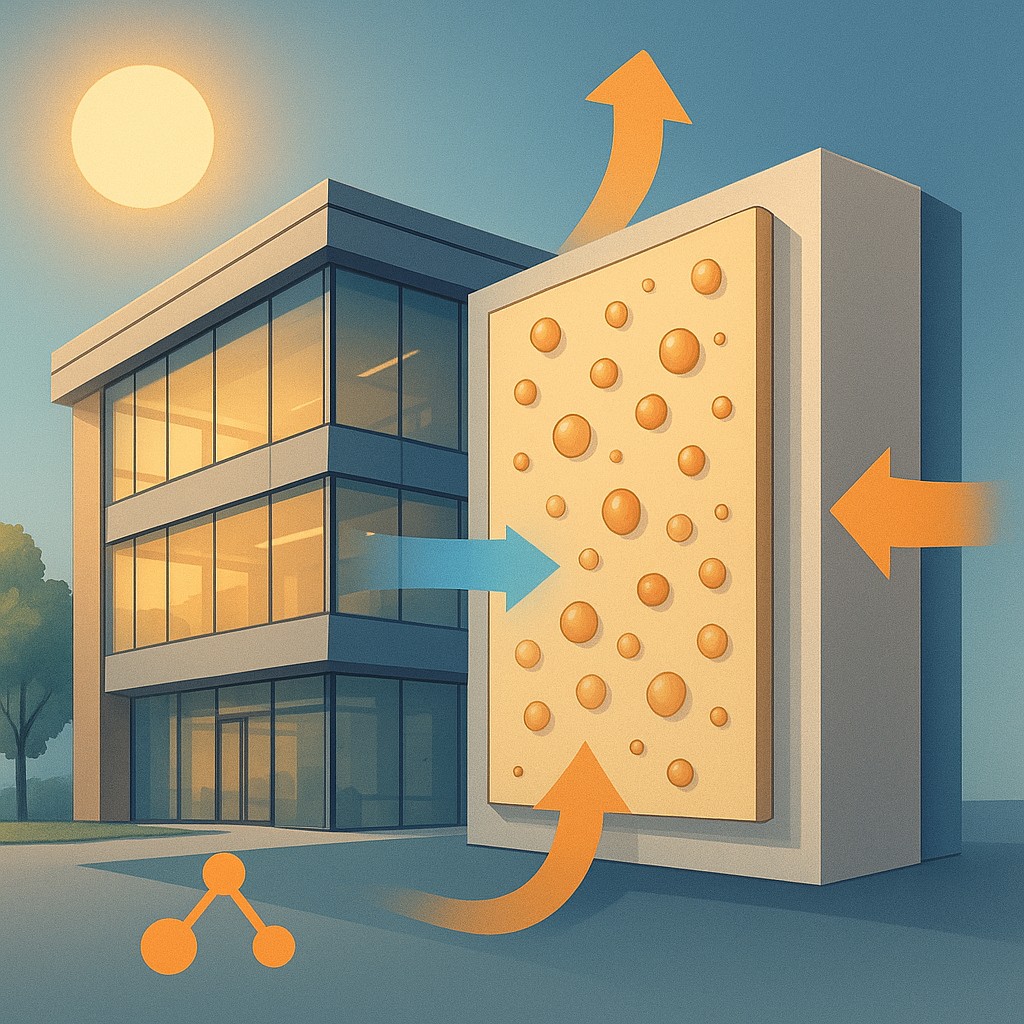
Imagine walking into a sleek, glass-fronted office building on a blistering July afternoon. Normally, you would expect the deafening hum of air conditioning and a blast of frigid, recycled air that makes you reach for a sweater despite the heat outside. Instead, the air feels naturally temperate, as if the building itself were breathing. For decades, we have relied on brute-force mechanical systems to fight the sun, but a quiet revolution is happening inside the walls of modern structures. Construction firms are moving away from active cooling and toward a solution from materials science that feels almost like magic: drywall that remembers the cold from the night before and uses it to combat the noon heat.
This technology relies on phase-change materials, or PCMs. These are substances that store and release vast amounts of energy simply by changing their physical state, such as melting or freezing. While the concept of a "thermal battery" might sound like science fiction, it is actually a high-tech refinement of how humans have built shelters for millennia. By embedding micro-capsules of paraffin wax or salt hydrates into standard building materials, we are turning lightweight drywall into a powerhouse of temperature control. It is a shift from fighting nature with electricity to partnering with physics to create a more stable, comfortable environment.
The Chemistry of a Hidden Battery
To understand how a sheet of drywall can regulate a room, we have to look at the difference between sensible heat and latent heat. Sensible heat is what you feel when you touch a radiator; it is a change in temperature that shows up on a thermometer. Latent heat, however, is the energy absorbed or released during a phase change, like when ice turns to water. When a material melts, it drinks up a massive amount of energy without its actual temperature rising. In a smart building, we use materials designed to melt at exactly the temperature humans find comfortable, usually around 72 to 75 degrees Fahrenheit.
As the sun beats down on a building and the indoor temperature begins to climb, billions of microscopic wax capsules embedded in the wall finish start to melt. These capsules are so tiny they do not affect the look or feel of the drywall. However, as they liquefy, they soak up the heat that would otherwise warm the air in the room. This process keeps the room cool for hours longer than traditional insulation ever could. Then, when the sun sets and the building begins to cool, the wax solidifies again. As it turns back into a solid, it releases that stored heat into the space, preventing a nighttime chill. It is a perfectly balanced cycle of energy exchange that requires no plugs, no wires, and no monthly subscription.
Revitalizing Ancient Wisdom
For thousands of years, humans lived in structures with high "thermal mass," such as adobe huts in the desert or stone cathedrals in Europe. These thick, heavy walls acted as natural regulators, staying cool during the day and warm at night because stone takes a long time to change temperature. Modern construction, however, favors speed and efficiency. We now build with lightweight steel, glass, and thin gypsum board. While these materials are easy to ship and assemble, they have almost no thermal mass. They heat up instantly under the sun and lose warmth the moment the heater clicks off. PCMs effectively "hack" the physics of modern materials to give them the benefits of a three-foot-thick stone wall without the weight or the cost.
By using salt hydrates or paraffin, a half-inch-thick piece of PCM-enhanced drywall can provide the same thermal storage as several inches of concrete or a foot of solid brick. This allows architects to design slim, lightweight buildings that still possess the "thermal inertia" of an ancient fortress. This shift is crucial because our modern obsession with glass towers has created "greenhouses" that require massive amounts of energy to stay habitable. Reintroducing thermal mass through chemistry rather than bulk allows us to keep our aesthetic preferences while drastically reducing our carbon footprint.
Comparing Traditional and Smart Thermal Buffers
When deciding how to manage temperature, engineers look at the trade-offs between different materials. While traditional methods rely on bulk, PCMs rely on the specific chemical properties of the substances hidden within the wall. The following table highlights how these different approaches stack up in a typical construction environment.
| Feature |
Low-Mass Drywall (Standard) |
High-Mass Stone/Concrete |
PCM-Integrated Drywall |
| Weight |
Very Light |
Extremely Heavy |
Light to Moderate |
| Response Type |
Reactive (Needs HVAC) |
Passive (Slow Inertia) |
Passive (Dynamic Buffer) |
| Energy Storage |
Low (Sensible Heat only) |
Moderate (Due to volume) |
Very High (Latent Heat) |
| Installation |
Standard Fasteners |
Specialized Masonry |
Standard Fasteners |
| Thickness Required |
~0.5 inches |
8-12 inches |
~0.5 to 1 inch |
As the table suggests, PCMs offer the best of both worlds. They provide the high energy storage of heavy masonry without requiring the extra structural support that stone or concrete demand. This makes them particularly attractive for renovating older office buildings where adding tons of concrete would be structurally impossible.
Navigating the Challenges of Phase Change
While the prospect of "self-cooling walls" sounds like a perfect solution, there are technical hurdles that keep this from being a universal fix for every climate. The most significant challenge is the "reset" phase. For a PCM wall to work the next day, it must fully solidify overnight. If the nighttime temperature stays above the melting point of the wax, the material remains liquid and cannot absorb any more heat the following morning. This means that in places with "tropical nights" where the temperature never drops, PCMs need help from a building's ventilation system to flush out the heat and reset the chemistry.
The specific materials used also matter. Paraffin wax is popular because it is reliable and does not break down over time, but it is, fundamentally, a fuel. Manufacturers have had to develop sophisticated fire-retardant micro-capsules to ensure these walls do not become a fire hazard. On the other hand, salt hydrates are non-flammable and cheaper, but they can be corrosive to metal studs. They also sometimes struggle to "re-freeze" properly, a problem known as super-cooling. Engineers are constantly tweaking these chemical recipes to ensure the walls remain effective for the 30- or 50-year lifespan of a building.
Flattening the Curve of Energy Demand
The most profound impact of PCM technology is not just personal comfort, but the stabilization of the entire power grid. Most electrical grids experience "peak demand" in the late afternoon when everyone returns home and turns up their air conditioning at once. This forces power plants to run at maximum capacity, which is inefficient and expensive. By using PCM drywall, a building can "shift" its load. Because the walls are absorbing the afternoon heat, the cooling system does not have to work nearly as hard during those peak hours.
Think of it as a tactical delay. The heat is still there, but it is held captive in the molecular bonds of the wall. By the time that heat is released at night, the demand on the grid has dropped and the air is naturally cooler, making it much easier for the building to vent that energy. In some experimental setups, buildings equipped with PCMs have reduced peak cooling loads by as much as 25%. When applied across an entire city, this could eliminate the need for "peaker" power plants, which are often the dirtiest and most expensive units to operate.
The Future of Passive Living
We are moving toward an era where the components of our homes and offices are no longer "dumb" objects. Instead, they are becoming functional participants in our comfort. The drywall of the future is not just a surface to hang pictures on; it is a thermal sponge and a silent guardian of our energy bills. As we continue to refine the temperatures at which these materials activate, we will likely see "tuned" walls designed for specific cities, with different melting points for a home in Phoenix versus an office in Seattle.
Embracing this technology requires us to rethink what it means to be high-tech. We often think of progress as adding more sensors, more apps, and more electricity. However, the true gold standard of engineering is a passive system: a solution that solves a problem through its inherent nature rather than a constant input of power. By looking back at the thermal mass of our ancestors and forward to the molecular engineering of the future, we are building a world that is not only more comfortable but also more resilient. The next time you lean against a cool wall on a hot day, you might just be feeling the silent work of billions of tiny wax crystals saving the planet, one afternoon at a time.