Imagine you have just finished a delicious, greasy slice of pizza or spent the afternoon tuning up a bicycle chain. Your hands are coated in a stubborn layer of oil and grime that seems to defy the very laws of hygiene. You walk to the sink, turn on the faucet, and let the water run over your fingers, but something frustrating happens. Instead of washing the grease away, the water simply beads up and rolls off like rain hitting a freshly waxed car. The oil stays exactly where it is, clinging to your skin with a chemical grip so tight it feels like a permanent part of your body.
This happens because of a fundamental standoff in the world of physics. Water molecules are "polar," meaning they are highly social with their own kind, while oils and fats are "non-polar" and want nothing to do with the watery crowd. Without a middleman, these two substances will never mix. This is where a simple bar of soap enters the story. It is not just a fragrant piece of bathroom decor; it is a sophisticated molecular bridge. Soap works by tricking oil and water into coexisting just long enough to vanish down the drain. By looking at the hidden structure of a soap bubble, we can see a microscopic world where chemistry performs a disappearing act on the stickiest messes.
The Dual Personality of the Soap Molecule
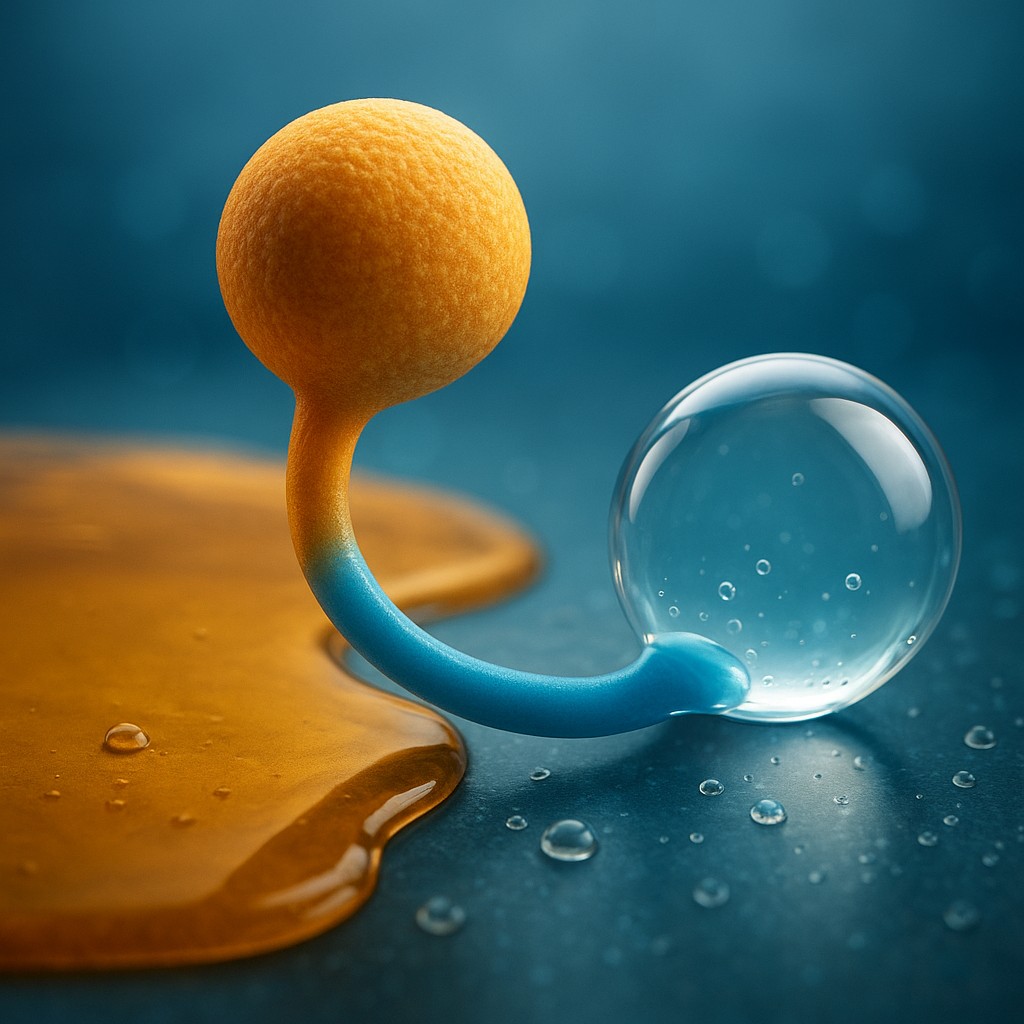
To understand how soap connects grease and water, we have to look at the unique shape of its molecules. Most substances are either "hydrophilic," meaning they love water, or "hydrophobic," meaning they fear it. Soap is a rare and talented exception known as an "amphiphilic" substance. This means it has a split personality. A single soap molecule looks a bit like a tiny tadpole, with a round, sturdy head and a long, wavy tail. These two ends have completely different goals and social circles, which is exactly why soap is so effective.
The head of the soap molecule is the social butterfly. It carries an electric charge that makes it magnetically attracted to water. When soap hits the water, the heads are perfectly happy to mingle and bond. The tail, however, is a long chain of carbon and hydrogen atoms that notoriously avoids water. It is greasy and waxy by nature. If these tails find themselves surrounded by water, they go into a sort of molecular panic, seeking out anything that is not water to cling to. They are perfectly designed to burrow into fats, oils, and the fatty outer shells of various germs.
This double nature allows soap to act as a "surfactant," a term short for surface-active agent. Normally, water has high surface tension; it likes to stick to itself in tight droplets. Soap breaks this tension, allowing the water to spread out and "wet" surfaces more thoroughly. But the real magic happens when those water-fearing tails find their target. They do not just sit on top of the grease; they dive in tail-first. This sets the stage for a clever chemical kidnapping that lifts the dirt right off your skin.
Building a Microscopic Fortress Called the Micelle
When you scrub your hands with soap and water, you provide the physical energy needed for a remarkable feat of engineering. As the soap molecules meet the oil on your skin, the tails immediately bury themselves in the grease to escape the water. Meanwhile, the water-loving heads stay on the outside, bobbing in the water like tiny buoys. As you rub your hands together, you break large patches of oil into smaller and smaller droplets. The soap molecules swarm these droplets until the oil is completely surrounded.
This circular structure is called a "micelle." Think of it as a microscopic fortress or a chemical trap. Inside the center of the sphere, all the oil-loving tails are tucked away, happily nestled into the grease they have captured. The outside of the sphere, however, is covered entirely by water-loving heads. To the surrounding water, the whole package now looks like a friendly, water-soluble object. The water no longer sees a glob of oil; it sees a ball of inviting heads. The oil has been effectively camouflaged within a shell that the water is happy to carry away.
Once these micelles form, the oil is no longer stuck to your skin. It is suspended in the water, trapped inside millions of these tiny soap bubbles. When you rinse your hands, the flowing water grabs the outer shells of the micelles and drags them down the drain, taking the oil and grime with them. Without these spheres, the oil would simply slide around your skin. The micelle is the vehicle that makes the "wash" in handwashing actually work.
Going Deep to Neutralize Germs and Bacteria
Many people think soap is a lethal weapon that kills germs on contact, like a tiny sword or a dose of poison. In reality, the way soap deals with bacteria and viruses is much more mechanical. While some soaps have added antibacterial chemicals, the basic chemistry of soap focuses on physical removal and structural disassembly. Many germs, including some viruses like the one responsible for COVID-19, are held together by an outer layer of fat known as a lipid envelope.
When soap molecules meet these types of viruses, the water-fearing tails do what they do best: they look for a place to hide. They wedge themselves into the fatty shell of the virus. Because the soap molecules are so persistent, they act like a crowbar, prying the viral membrane apart and causing the entire structure to collapse. In this case, the virus is not "killed" in a biological sense; it is simply shredded and rendered inactive. The broken pieces are then swept into micelles and rinsed away just like any other dirt.
For tougher germs that do not have fatty shells, soap still performs its main job of "unsticking" things. Germs often hitch a ride on the natural oils on our skin. By wrapping those oils in micelles and washing them away, soap effectively evicts the germs from their home. They are physically lifted off your body and sent on a one-way trip through the plumbing. This is why tradition and time are so important. It takes about twenty seconds of scrubbing to ensure the soap molecules reach every nook and cranny, build their micelles, and pry the stubborn pathogens away from your fingerprints and cuticles.
Comparing the Tools of Cleanliness
While we often use the terms "soap" and "detergent" for the same things, they are chemically different, even though they both work by forming micelles. Traditional soap is made from natural fats and oils reacted with a strong base (like lye). Detergents are synthetic cleaners developed to work better in "hard water," which contains high levels of minerals like calcium and magnesium. Understanding the differences helps us choose the right tool for the job, whether we are washing our face or scrubbing a scorched lasagna pan.
| Feature |
Traditional Soap |
Synthetic Detergent |
| Origin |
Derived from natural fats and oils |
Made from petroleum or plant oils |
| Hard Water Performance |
Forms "scum" (white chalky film) |
Performs well; does not form scum |
| Environmental Impact |
Breaks down very easily |
Varies; some can linger in nature |
| Skin Sensitivity |
Often gentler on human skin |
Can be harsher or more drying |
| Primary Use |
Hand washing and body bars |
Laundry, dishwashing, and shampoos |
The "scum" mentioned in the table is a chemical reaction where minerals in hard water replace the sodium in the soap, turning it into a solid that won't dissolve. This is why you might find a ring around the bathtub but rarely see one left by liquid dish soap, which is almost always a synthetic detergent. Regardless of the type, both rely on the same principle of the two-sided molecule to bridge the gap between substances that naturally repel one another.
The Importance of Friction and Flow
Soap is a molecular genius, but it cannot find the dirt on its own; it needs your help. This is where the physics of scrubbing meets the chemistry of the micelle. When you work up a lather, you create a high-energy environment that helps soap molecules find their targets faster. Friction helps break thick layers of grease into smaller droplets, providing more surface area for the soap tails to grab. If you simply apply soap and rinse it off immediately, the molecules do not have enough time to finish their construction project.
Water temperature also plays a supporting role, though not for the reasons most people think. Many believe the water needs to be hot to kill germs, but water hot enough to kill bacteria would scald your skin. Instead, warm water is helpful because it melts solid fats (like butter or bacon grease) into a liquid. Liquid oils are much easier for soap molecules to penetrate and break apart. Warmth also speeds up the molecules, making the formation of micelles faster and more efficient.
Finally, the volume of water used during the rinse is the finishing touch. Once the micelles have trapped the oil and germs, they are suspended in a thin layer of lather on your skin. They are "unstuck," but they are still there. The steady stream of clean water is what finally flushes the entire system away. Without a thorough rinse, the micelles might settle back down on your skin as the water dries. The process is a beautiful sequence of chemistry, physics, and movement working in harmony to leave you clean and safe.
The Invisible Magic in Your Bathroom
The next time you reach for a bar of soap, take a moment to appreciate the frantic, invisible activity happening in the palm of your hand. You are leading a massive relocation project, directing millions of tiny molecular tadpoles to build fortresses around microscopic invaders. It is a process that has saved more lives than almost any medical invention in history, yet it relies on a principle as simple as a molecule with two different personalities. From the way a bubble catches the light to the way grease vanishes from a dinner plate, we are seeing the laws of the universe in action.
Armed with this knowledge, you can approach the sink with a new sense of purpose. You are not just rubbing your hands together; you are a master of micelles and a commander of surfactants. Whether you are prepping for a meal or cleaning up after a messy hobby, you are using one of the most elegant tricks in the natural world to keep yourself healthy. So, when the grease seems like it will not budge, just remember: you have a secret weapon that knows exactly how to bridge the divide between oil and water.