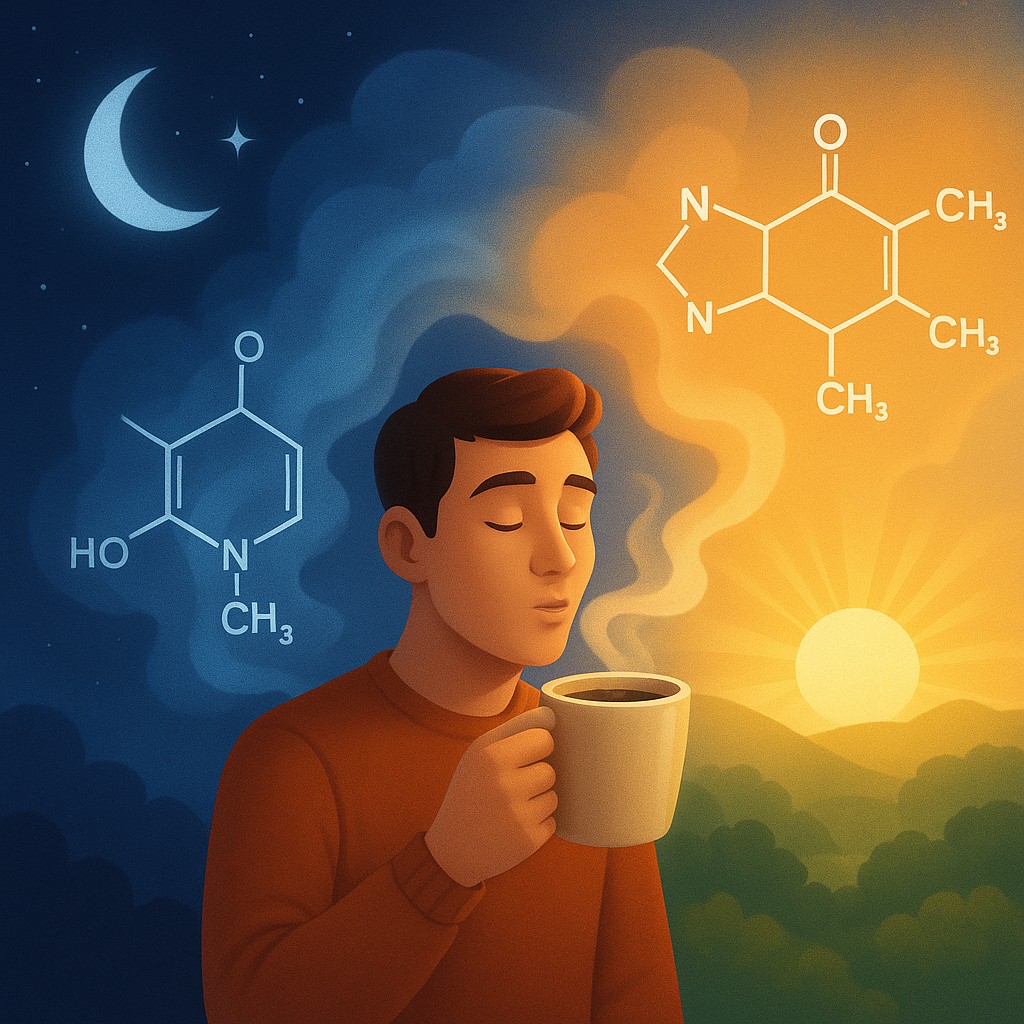
Every morning, millions of people stumble toward their kitchens, driven by a mental fog that demands a caffeine fix. We tend to think of sleep and wakefulness as a simple on-off switch, but the reality is more like a high-stakes chemical ledger. Throughout the day, your brain builds up a molecule called adenosine that tracks how long you have been awake. The longer you stay up, the more adenosine settles into your brain's receptors. This creates "sleep pressure," the heavy sensation that eventually forces your eyes shut. When you wake up, that chemical residue doesn't just vanish; it lingers like a thick morning mist that needs to be burned off before your brain can truly find its rhythm.
While most of us reach for a double espresso to clear the cobwebs, we are actually using a clever pharmacological trick rather than a real biological cleanup. Caffeine is essentially an adenosine squatter. Its molecular structure is so similar to adenosine that it can fit into the same receptors, "parking" in the spot and blocking the sleepiness molecule from doing its job. However, once the caffeine wears off, that original adenosine is still there, often joined by even more that built up while you were caffeinated. This leads to the dreaded mid-afternoon crash. To truly clear the system and find lasting energy, you need to look toward the sky rather than the bottom of a mug.
The Chemistry of Sleep Pressure
To understand why light is the superior fuel, we first have to appreciate the burden of being awake. Adenosine is a byproduct of energy use in the brain. As your neurons use ATP, the primary currency of cellular energy, they leave behind adenosine molecules like exhaust fumes from a car engine. As these "fumes" accumulate, they bind to specific receptors in the brain that slow down activity and prepare the body for rest. By the time sixteen hours have passed, your brain is essentially swimming in a chemical signal screaming for sleep.
During a healthy night of rest, your metabolic processes work to flush this adenosine away, resetting your chemical clock to zero. However, this process is rarely perfect. Many of us wake up with an "adenosine debt," where a significant amount of the previous day's buildup is still clinging to our receptors. This is what we call sleep inertia, that heavy, leaden feeling that makes the snooze button so tempting. Because caffeine only blocks receptors without actually removing the adenosine, the underlying pressure remains, waiting for the caffeine to detach so it can flood back in and make you feel twice as tired as before.
Photons as Biological Janitors
The magic of morning sunlight lies in its ability to act as a master conductor for your internal orchestra. When photons, or light particles, hit your eyes in the morning, they aren't just helping you see; they are sending a high-priority message to a specific part of your brain called the Suprachiasmatic Nucleus (SCN). This tiny region is the metronome of your body, responsible for the circadian rhythm, or your internal 24-hour clock. When the SCN detects a specific frequency of blue light found in early morning sun, it triggers a series of hormonal shifts that caffeine simply cannot replicate.
One of the most immediate effects of this light exposure is the suppression of melatonin, the hormone that makes you feel drowsy. More importantly, it triggers a healthy "cortisol pulse." While we often think of cortisol as a stress hormone to avoid, a sharp spike in the morning is actually essential for metabolic health and mental clarity. This pulse acts as a biological flush, signaling the brain to ramp up its clearance of leftover adenosine and setting a countdown timer for when melatonin should be released again in the evening. By getting light early, you aren't just waking up for now; you are proactively scheduling your sleep for sixteen hours later.
Why Your Office Lamp Isn't Enough
A common mistake is thinking that sitting in a bright room with the lights on is just as good as going outside. From a physics perspective, this couldn't be further from the truth. Light intensity is measured in units called lux, and the human eye is remarkably bad at judging brightness because our pupils adjust to make everything look "normal." An average indoor office might feel bright, but it usually provides only about 200 to 500 lux. Even on a gloomy, overcast day, the light intensity outdoors is often between 5,000 and 10,000 lux. On a clear, sunny morning, that number can soar to 100,000 lux.
The specialized cells in your eyes that regulate your clock, called ipRGCs, require a high threshold of light to activate effectively. These cells are particularly sensitive to the blue light spectrum that is abundant in natural sunlight but often missing or poorly balanced in artificial bulbs. Trying to wake up your brain with indoor lighting is like trying to wash a car with a spray bottle; you might get some dust off, but you won't get a deep clean. To trigger the adenosine clearance and the cortisol spike, you need the sheer volume of light particles that only the sun can provide.
| Feature |
Morning Sunlight |
Caffeine |
Indoor Lighting |
| Primary Action |
Flushes adenosine and sets rhythm |
Blocks adenosine receptors |
Minimal impact on rhythm |
| Duration of Effect |
Lasts all day via hormonal shift |
4-6 hours (half-life) |
Negligible |
| Intensity (Lux) |
10,000 to 100,000+ |
N/A |
300 to 500 |
| Evening Impact |
Helps you fall asleep earlier |
Can delay sleep by several hours |
Can disrupt sleep if used late |
| Metabolic Cost |
Zero (Natural regulation) |
High (Potential for burnout) |
Zero |
The Mechanics of the Blue Light Sensor
It is fascinating to note that the blue-light-sensitive cells in our eyes are not actually involved in "sight" in the traditional sense. These cells do not help you identify colors or shapes; in fact, even some people who are visually blind still have functioning sensors and can maintain a perfect internal clock. These sensors are specifically tuned to the "short wavelength" light that scatters in the atmosphere when the sun is low on the horizon. This is why the specific angle of the sun in the morning is so much more effective than the afternoon sun; it carries the exact frequency needed to tell the brain that the day has officially begun.
When these sensors are activated, they communicate directly with the hypothalamus, the brain's command center, bypassing the visual centers entirely. This direct line of communication allows the body to sync its internal temperature, digestion, and thinking speed with the outside world. If you skip this morning light, your body stays in a state of "biological twilight," where it isn't quite sure if it should be burning fat for energy or storing it, or if it should be focused or resting. This confusion is a primary cause of brain fog and the "tired but wired" sensation many people feel by the end of the day.
Designing a Light-First Routine
If you want to revolutionize your energy levels, the most effective tool is a simple ten to twenty minute walk outside within the first hour of waking up. You do not need to look directly at the sun, which can damage your eyes, but rather just be in the environment where that light is bouncing around. If it is a bright sunny day, ten minutes is usually enough. If it is cloudy, you might need twenty or thirty minutes to get the same amount of light. The goal is to maximize the amount of light reaching your eyes, so avoid wearing sunglasses during this specific morning window if it is safe and comfortable to do so.
This practice also creates a positive loop for your sleep. By getting bright light early, you tell your brain to start the "melatonin timer." Around twelve to fourteen hours after that initial light exposure, your brain will naturally begin to release melatonin, making it much easier to fall asleep at a consistent time. This creates a virtuous cycle: you wake up with less adenosine because you slept better, requiring less effort to "clear the deck" the next morning. It is a fundamental shift from using chemicals to mask fatigue to using physics to manage your biology.
Breaking the Caffeine Cycle
Switching to a light-first approach doesn't mean you have to give up your morning brew entirely, but the timing matters. Experts often recommend waiting ninety minutes to two hours after waking before having your first cup of coffee. This delay allows your natural adenosine clearance (triggered by light) to do the heavy lifting first. If you drink caffeine immediately upon waking, you block the receptors before the adenosine has a chance to clear. This ensures that the "sleep pressure" is still there waiting for you when the coffee wears off at 2:00 PM.
By letting the sunlight do the initial cleaning, the caffeine you do drink later becomes a tool for better performance rather than a crutch for basic survival. You will find that the afternoon slump becomes much less intense because there is simply less leftover adenosine in your system to come crashing back. It is a more sophisticated way to interact with your body’s chemistry, moving away from frantic intervention and toward working in harmony with the natural world.
Embracing the power of the morning sun is about more than just avoiding a headache; it is about reclaiming the vibrant, focused energy that is your biological birthright. We evolved under the sky, and every cell in our bodies is programmed to respond to the shifting colors and intensity of natural light. By stepping outside and letting those light particles hit your eyes, you are performing a ritual that is millions of years old, signaling to your brain that it is time to thrive, to create, and to be fully present in the world.