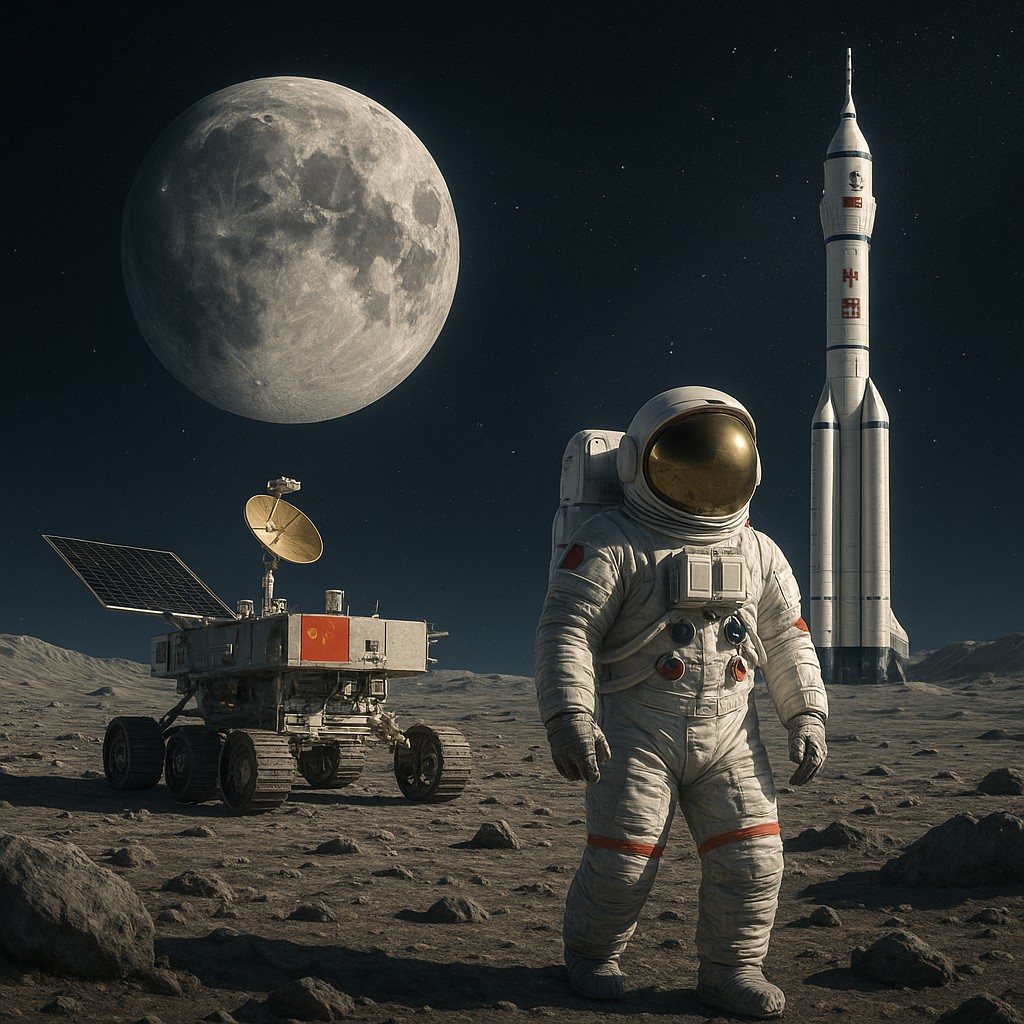
In the middle of the twentieth century, the world stood still as two superpowers raced to plant their flags on the dusty, airless plains of the Moon. It was an era of cold wars and giant leaps, followed by a long period where the Moon felt like a place we had "already visited." But if you look up at the night sky lately, you might notice that the lunar surface is becoming crowded again. This time, the most ambitious guest at the party is China. The China National Space Administration (CNSA) is not just sending robots to take selfies with craters; they are executing a methodical, multi-decade plan to put boots on the ground and eventually build a permanent home there.
What makes China's approach so fascinating is its surgical precision and relentless pace. While other space programs often face shifting budgets or changing political winds, the Chinese program - known as the Chang'e project - moves like a well-oiled machine. They have already accomplished feats no other nation has, such as landing on the mysterious "far side" of the Moon and bringing back fresh lunar rocks for the first time in decades. Understanding this mission is about more than just looking at rockets and fuel; it is about witnessing a historic shift in who leads the exploration of the final frontier.
The Goddess of the Moon and Her Robotic Scouts
To understand where China is going, we have to look at the name they chose for their mission. In Chinese mythology, Chang'e is the Goddess of the Moon who floated to the heavens after drinking an elixir of immortality. Her companion is a jade rabbit, or Yutu. It is a poetic name for a program that has been remarkably practical. The project was designed in three clear stages: orbiting, landing, and returning. Each step served as a building block, proving that they could navigate the vast distance, touch down without crashing, and eventually launch a vehicle from the lunar surface to bring samples back to Earth.
The early missions, Chang'e 1 and 2, were the scouts. They mapped the lunar surface in high definition to find the best places to park. Then came the heavy hitters. Chang'e 3 delivered the first Yutu rover, making China the third country to achieve a soft landing on the Moon. But they did not stop at repeating history. Chang'e 4 did something truly bold: it landed on the far side of the Moon. Because the Moon’s mass blocks direct radio signals to Earth, China first had to launch a relay satellite nicknamed Queqiao (Magpie Bridge) to bounce signals around the corner. This was a logistical masterpiece that proved they could operate in the most difficult environments.
Turning Lunar Dust into Golden Opportunities
The most recent highlight of the program, Chang'e 5, was a masterclass in robotic complexity. It was essentially a miniature, unmanned version of the Apollo missions. It landed, drilled into the surface, scooped up soil, and launched itself back into lunar orbit. There, it docked with a mother ship before screaming back through Earth’s atmosphere to drop its cargo in Inner Mongolia. This mission proved that China had mastered the "orbital ballet" required to bring cargo home. These samples are not just pretty rocks; they are significantly younger than those brought back by American astronauts in the 70s. This means China is rewriting the history books regarding how long the Moon remained volcanically active.
Beyond the science, these missions are testing "in-situ resource utilization." That is a technical way of saying they are learning to "live off the land." If humans want to stay on the Moon for more than a few days, they cannot bring every gallon of water and every tank of oxygen from Earth. It is simply too heavy and expensive. China’s upcoming missions, specifically Chang'e 6, 7, and 8, are designed to hunt for water ice in the dark, permanent shadows of the lunar South Pole. If they find enough ice, they can melt it for water, breathe the oxygen, and use the hydrogen for rocket fuel. It is the celestial equivalent of finding an oasis in a desert.
The Next Giant Leap with New Rockets
To get humans to the Moon, you need a very big "van." Specifically, you need a rocket capable of lifting immense weight and a spacecraft that can keep people alive for weeks. China is currently developing the Long March 10, a massive rocket designed specifically for crewed lunar missions. Unlike the rockets used for space stations near Earth, this one must be powerful enough to break free of Earth’s gravity entirely while carrying a heavy lunar lander and a crew capsule. It is a staggering engineering challenge that China plans to solve by the end of this decade.
The plan for the actual landing is clever and differs slightly from the old Apollo style. Instead of launching everything on one giant rocket, China may use two separate launches. One rocket carries the lunar lander, and the other carries the crew. They meet in orbit around the Moon, dock together, and then the astronauts move into the lander to head down to the surface. This "twin-launch" strategy reduces the risk of having a single point of failure and allows for more flexibility in what they bring along for the ride.
| Mission Phase |
Primary Objective |
Key Technology Tested |
| Chang'e 4 |
Far Side Exploration |
Relay satellite communication and low-frequency radio astronomy. |
| Chang'e 5 |
Sample Return |
Automated docking in orbit and high-speed atmospheric re-entry. |
| Chang'e 6 |
Southern Far Side Samples |
Collecting the first rocks from the Moon's hidden "back door." |
| Chang'e 7 |
Resource Hunting |
Flying detectors to search for water ice in deep, dark craters. |
| Chang'e 8 |
Lunar Construction |
Using 3D printing to build structures from lunar soil (regolith). |
| 2030 Goal |
Human Footprints |
Long March 10 rocket deployment and crewed surface exploration. |
Building a Neighborhood on the Moon
China is not interested in a quick visit and a photo op. Their ultimate goal is the International Lunar Research Station (ILRS). Think of this as a permanent base camp, similar to the research stations in Antarctica, but with a much better view and significantly less air. This is not a solo project; China has invited other nations and international partners to join them, creating a parallel track to NASA’s Artemis program. The ILRS will likely be located near the South Pole, where the peaks of certain craters receive almost constant sunlight for solar power, while the depths of those same craters hide precious ice.
Building this station will be a robotic marvel. There are plans to use 3D-printing bots that can take lunar dust, heat it up, and turn it into solid bricks. This eliminates the need to haul heavy concrete from Earth. Imagine a colony of autonomous robots scurrying around the Moon, building houses and labs before the humans even arrive. This long-term vision shifts the Moon from being a destination to being a "Seventh Continent," a place where humans can actually work, conduct science, and perhaps even use as a jumping-off point for Mars.
Navigating the Myth of a Modern Space Race
When we hear about China’s lunar ambitions, the phrase "Space Race" often pops up in the news. It is easy to view this as a simple competition where the first person to arrive "wins." However, the modern era is more complex than the 1960s. Back then, the goal was to prove which political system was superior. Today, it is about economics, sustainable science, and international influence. There is a common myth that China is trying to "own" the Moon. In reality, international treaties generally prevent any nation from claiming the Moon as territory. Instead, we are seeing a race for "presence." By building the infrastructure, power grids, and communication arrays, China sets the standards for how things are done on the lunar surface.
Another misconception is that China is simply copying what the United States did fifty years ago. While they are building on the foundations of physics established by early pioneers, their technology is vastly different. The computer in a modern Chinese lunar lander has more processing power than every computer on Earth combined in 1969. They are using advanced AI, sophisticated robotics, and new materials that make their missions more efficient and capable of much more complex science than anything seen during the Apollo era. This is not a remake of an old movie; it is a high-tech sequel with a brand-new script.
The Philosophical Impact of the Lunar Journey
As we watch these rockets roar into the sky, it is worth asking what this means for us as a species. For most of human history, the Moon was a dream, a god, or a light to walk by at night. Now, it is becoming a workshop. China’s dedication to this project reminds us that the human spirit is inherently restless and curious. Even though there are many problems to solve here on Earth, projects like the Chang'e missions push the boundaries of what our engineers can imagine and what our scientists can discover. They force us to develop better batteries, more efficient solar panels, and smarter robots - all of which eventually find their way back into our daily lives.
The dream of reaching for the stars is a universal human trait that transcends borders and languages. When the first Chinese taikonaut stands on the lunar surface and looks back at the "blue marble" of Earth, they will feel the same awe that the pioneers before them felt. By expanding our reach to the Moon, we are not just exploring a dead rock; we are ensuring that the story of humanity continues to grow. Whether it is through the lens of a Chinese rover or the boots of an international crew, the Moon remains the perfect mirror, reflecting our greatest ambitions and our endless desire to understand the universe we call home.