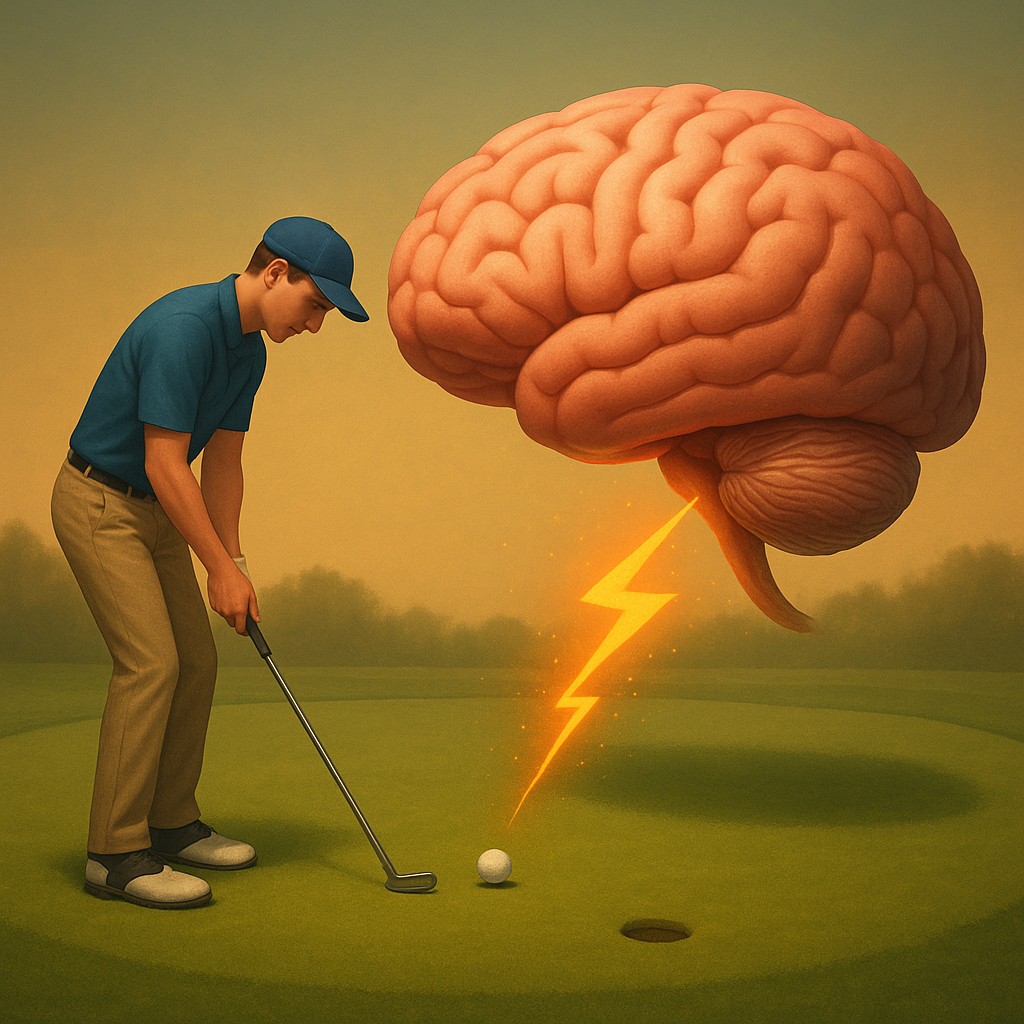
Imagine you are standing on a pristine putting green, focused on sinking a ten-foot putt. You square your shoulders, take a deep breath, and swing with the fluid grace of a pro. The ball veers three inches to the left. Frustrated, you immediately reset and try to mimic the "perfect" form you have seen on TV. You are convinced that if you just repeat that ideal motion enough times, your muscles will eventually memorize it. You likely believe that "perfect practice makes perfect," and that every missed putt is a failure of discipline or focus to be avoided at all costs.
In reality, your brain is actually rooting for those misses. While you are busy scolding yourself for the mistake, a small, fist-sized structure at the base of your skull called the cerebellum is celebrating. It isn't looking for you to be perfect right away; it is looking for data. Every time your ball veers left or stops short, your brain receives a high-voltage signal that acts as a blueprint for correction. This process, known as error-driven learning, suggests that the "messiness" of your practice is not a distraction from mastery, but the very engine that drives it. If you never missed, your brain would never have a reason to change.
The Inner Auditor of Your Nervous System
To understand how we improve at any physical task, from typing on a deck to performing surgery, we have to view the cerebellum as the brain's chief financial officer. Its job is to manage a very specific type of currency: the sensory prediction error. When you decide to move your arm, your motor cortex (the part of the brain that controls movement) sends a command to your muscles, but it also sends a "carbon copy" of that command to the cerebellum. This copy tells the cerebellum exactly what you expect to feel during the movement. You expect to feel the weight of the club, the resistance of the grass, and the click of the ball hitting the cup.
If what you actually feel matches your expectation perfectly, the cerebellum stays relatively quiet. It assumes the current settings are ideal and changes nothing. However, when the ball veers off course, there is a mismatch between what you expected and what actually happened. This mismatch is the sensory prediction error. It acts like a biological alarm bell, signaling to the brain that the internal "map" it uses to control the body is slightly out of sync with reality. The cerebellum then begins a process of "long-term depression," which sounds negative but is actually a sophisticated way of pruning back the weak neural connections that caused the mistake.
This mechanism reveals a profound truth about human biology: our brains are not designed to learn from success; they are designed to learn from the failure to achieve success. When you practice a movement perfectly time after time, you are essentially telling your cerebellum that it has nothing left to do. You are maintaining a skill, not building one. To trigger the rewiring necessary for true improvement, you need to provide the system with a steady stream of "useful" errors that force the brain to recalibrate its predictions.
Why Routine is the Enemy of Growth
Many people fall into the trap of "constant practice," where they perform the exact same drill in the exact same way for hours. While this feels productive because you see immediate, short-term improvement, it is often an illusion. Your brain becomes very good at predicting the specific, narrow details of that single drill, which causes the error signals to dry up. Once the error signal disappears, the "hardware update" in your brain stops. This is why you might look like a pro on the driving range but fall apart the moment you step onto a real course with uneven ground and shifting winds.
To combat this stagnation, elite athletes and musicians often use "varied practice." By intentionally changing the conditions, such as using a slightly heavier ball, standing on a foam pad to challenge their balance, or practicing in a noisy room, they keep the error signal alive. These variations force the cerebellum to constantly re-calculate the movement under different pressures. It prevents the brain from going on autopilot. Instead of learning a single, rigid movement, the brain learns a flexible "rule" for how to move, making the skill more durable and adaptable to the real world.
The difference between these two approaches comes down to how they treat the environment. Constant practice seeks to eliminate variables, while varied practice embraces them as teachers.
| Feature |
Constant Practice |
Varied (Messy) Practice |
| Primary Goal |
Minimizing immediate errors |
Maximizing long-term adaptation |
| Neural Trigger |
Low sensory prediction error |
High sensory prediction error |
| Brain Activity |
Autopilot / High efficiency |
Active recalibration / High effort |
| Skill Type |
Rigid and specific |
Flexible and adaptable |
| Long-term Result |
Quick plateau |
Continuous improvement |
Magnifying the Mistake to Speed Up the Fix
One of the most surprising findings in neuroscience is that if you want to fix a specific mistake, you should sometimes try to make that mistake worse. This technique is known as error augmentation. Imagine you have a habit of leaning too far to the right when you swing a tennis racket. Traditional coaching might tell you to "lean left" to compensate. However, your brain is remarkably good at ignoring small, persistent errors because it gets used to them. It stops seeing the lean as an error and starts seeing it as the "new normal."
If an instructor uses a resistance band to pull you even further to the right, your brain suddenly receives a massive, undeniable error signal. The gap between where you want to be and where you are being pulled becomes so large that the cerebellum cannot ignore it. In response, your nervous system over-corrects with an intensity it would never have used for a small adjustment. When the resistance band is removed, you often find that your body has naturally snapped back into the correct alignment. By magnifying the error, you have provided the brain with better data, allowing it to "see" the problem clearly for the first time.
This suggests that the "sloppiness" of a beginner is actually a high-speed data stream. A beginner’s movements are wild and inconsistent, which generates a massive amount of sensory prediction error. This is why we learn so much faster in the first few weeks of a new hobby than we do years later. To keep progressing as an expert, you have to find ways to re-introduce that level of "informative messiness" into your routine. You have to be willing to look like a beginner again to give your cerebellum the signal it needs to rebuild.
The Myth of Muscle Memory
We often use the term "muscle memory" as if our biceps and quads have their own tiny brains capable of storing information. This is a convenient shorthand, but it is scientifically inaccurate and can lead to poor training habits. Muscles are simply tools; they do exactly what the nervous system tells them to do. The "memory" actually lives in the connection strengths within the cerebellum and the motor cortex. When we talk about sharpening a physical skill, we are really talking about refining a mathematical model inside the head.
When you repeat a movement perfectly, you aren't "burning it into the muscle." You are essentially confirming a hunch. The danger of repetitive, perfect practice is that it creates a very narrow model that only works under those exact conditions. If the temperature changes, if your shoes have a different grip, or if you are slightly more tired than usual, that narrow model breaks down. True mastery is the result of having a robust model that has been tested against thousands of "failures." Every time you slightly overshot a target or lost your balance, you gave your brain a chance to build a safety margin into its model.
Instead of thinking of practice as a way to build a "groove" that you can't fall out of, think of it as a way to map the entire territory, including the cliffs and the swamps. The person who has only ever walked the "perfect path" will get lost the moment they step an inch to the side. The person who has explored the edges, tripped over the roots, and waded through the mud is the one who truly knows the way. Mastery is not the absence of errors; it is the result of processing and correcting so many errors that no new situation can surprise your nervous system.
Embracing the Productive Struggle
If you find yourself feeling frustrated during a practice session because you cannot seem to get it "just right," take a moment to view that frustration as a biological necessity. That feeling of struggle is the physical experience of your cerebellum working overtime to close the gap between your intentions and your actions. The moments where you feel most clumsy are often the moments where your brain is doing its most intense work. When you choose to make a drill slightly harder or more unpredictable, you are choosing to learn faster.
Confidence in a skill shouldn't come from the fact that you haven't made a mistake in an hour; it should come from the fact that you have made every mistake possible and your brain now knows exactly how to recover. This shift in perspective turns every "bad" rep into a valuable data point. It allows you to stop practicing for the sake of the result and start practicing for the sake of growth. By leaning into the mess, intentionally varying your environment, and welcoming errors as instructors, you unlock a more resilient and capable version of yourself. Master the art of being slightly wrong, and you will eventually find yourself being perfectly right when it matters most.