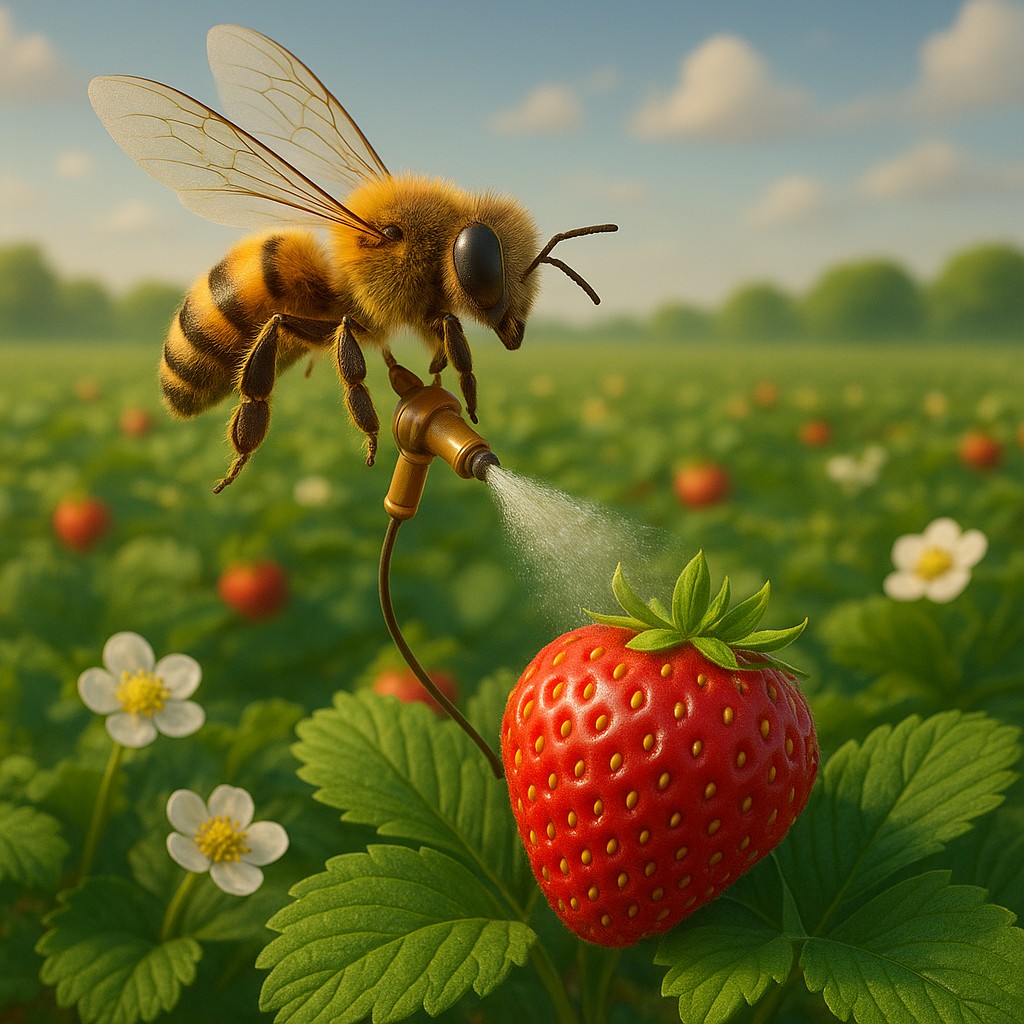
Imagine you are a farmer trying to protect a massive strawberry field from a devastating fungal outbreak. Usually, your best bet would be to start up a heavy tractor or hire a crop-duster to soak the entire field in hundreds of gallons of chemical fungicide. This is a lot like trying to cure one person’s sore throat by spraying a cloud of antibiotics over a whole city. Most of the medicine hits the pavement, rooftops, and trees, while only a tiny fraction actually reaches the patient. In farming, this "spray and pray" method means most of your expensive chemicals end up on the leaves, soak into the dirt, or wash into the local water supply without ever touching the blossoms where the disease starts.
Nature, however, already has a perfect delivery system that has been running for millions of years. This network is made of fuzzy, aerodynamic, and highly motivated workers who are already obsessed with visiting every single flower in your field. By making a clever design tweak to the beehive, we can turn ordinary pollinators into high-precision medical couriers. This process, known as bee vectoring, marks a shift from "broadcasting" chemicals to "precision targeting" with biological defenses. It is a smart solution that turns a natural behavior into a sophisticated delivery network, and it might just change how we think about the relationship between technology and the natural world.
The Bottleneck of Standard Crop Protection
To understand why we need bees to carry our medicine, we first have to look at how inefficient the current system is. Standard agricultural spraying is a mechanical fix for a biological problem. When a tractor moves through a field, it uses high-pressure nozzles to create a cloud of droplets. Since the goal is to protect the fruit, and fruit grows from flowers, the spray needs to land inside the blossom. However, the shape of a plant makes this very difficult. Leaves act like umbrellas, shielding the flowers from the falling mist. Gravity and wind then work together to pull most of the chemicals down to the soil. In many cases, less than five percent of the product actually reaches the target.
This waste creates a new set of problems. Because so much is lost, farmers have to use much more than they should, which raises costs and hurts the environment. Furthermore, many fungal pathogens, like Botrytis (often called "gray mold"), are clever. They don't just land on the fruit; they infect the flower the exact moment it opens. To catch that small window using a tractor, a farmer would have to spray almost every day, which is impossible to afford. This results in a race against time where the farmer is usually one step behind the disease, trying to treat an infection that has already taken hold.
Engineering the Hive as a Launchpad
The genius of bee vectoring lies in a simple piece of equipment installed at the entrance of a managed beehive. Imagine a small plastic tray filled with a specialized, dry, organic powder. This powder contains a concentrated dose of a helpful microbe - a specific strain of fungus that is harmless to humans and bees but deadly to the pests that ruin crops. The tray is designed with a one-way system. When the bees leave for their morning shift, the exit path forces them to walk directly through this powder. It is essentially a tiny, mandatory footbath for every departing worker.
As the bee scurries across the tray, the powder sticks to the tiny hairs on its legs and belly. Since bees are naturally charged with static electricity as they fly, they become magnets for these small particles. By the time the bee takes flight, it is carrying millions of helpful spores. This is a passive delivery system; the bee isn't "trained" to do this, and it doesn't even know it’s working a second job. It is simply following its instinct to find nectar, while the specialized tray ensures that every trip to the "grocery store" also works as a delivery run for the pharmacy.
Precision Placement through Pollination Habits
Once the bee reaches a flower, the magic of biological targeting kicks in. When a bee lands on a blossom, it performs a vigorous "dance" to reach the nectar at the base of the flower. This movement, along with the vibration of its wings, shakes the powder loose from its hairs. The powder falls directly into the center of the flower, which is exactly where the infection would normally start. Unlike a tractor spray that hits the flower from above and often bounces off, the bee delivers the treatment from the inside out, tucking the powder into the folds of the bloom.
This method solves the "timing problem" perfectly. While a farmer might only spray once every ten days, bees visit new blossoms the moment they open. As different parts of the field bloom at different times, the bees automatically track the progress of the crop, providing a constant, rolling layer of protection. This is the ultimate example of "just-in-time" delivery. The farmer no longer needs to guess when the flowers will open; the bees, driven by their own hunger, have a personal interest in finding every new blossom as soon as it appears.
Comparing Mass Spraying vs. Bee Vectoring
To see how much more efficient this is, we can look at how much material is actually used in these two systems. The difference is not just a slight improvement; it is a total transformation.
| Feature |
Standard Tractor Spraying |
Bee Vectoring Technology |
| Volume of Active Ingredient |
Very high (gallons per acre) |
Extremely low (grams per acre) |
| Target Accuracy |
Low (over 90% misses the flower) |
Very high (delivered inside the bloom) |
| Water Requirement |
Thousands of gallons per season |
No water needed |
| Soil Impact |
High runoff into groundwater |
Little to no soil contamination |
| Timing |
Scheduled (often misses the bloom) |
Continuous (matches the bloom) |
| Energy Source |
Fossil fuels (diesel engines) |
Solar/Sugar (biological energy) |
The Microbiological Civil War
You might wonder how a tiny amount of powder can stop a massive fungal infection. The answer is a concept called competitive exclusion. The powders used in bee vectoring are not usually "poisons" like traditional pesticides. Instead, they are biological control agents, such as the fungus Clonostachys rosea. When the bee drops these spores into the flower, they immediately start to grow and take over the space. They are faster and more aggressive than the "bad" fungi that cause rot.
Think of it as a game of musical chairs. When the harmful gray mold spores land on the flower later in the day, they find that all the "seats" are already taken. The helpful fungus has already moved in and eaten all the available food. In some cases, these good microbes even release enzymes that break down the cell walls of the "bad" fungi. Because we are using a living organism to fight another organism, the pest is much less likely to develop resistance. It is much harder to evolve a defense against a neighbor who is eating your food and taking your house than it is to develop a mutation against a specific chemical molecule.
Overcoming Skepticism and Environmental Safety
Whenever humans get involved in a natural cycle, it is healthy to be skeptical. One of the first questions people ask is: "Does this hurt the bees?" Fortunately, because the system was designed around their biology, the answer is a clear no. The powders are made to be non-toxic and organic, and researchers have found that the bees' health, lifespan, and honey production stay normal. In fact, by using bees to deliver the medicine, we can often stop using the heavy chemical sprays that are known to harm pollinators. It is a rare win-win where protecting the crop also means protecting the insects that make the crop possible.
Another concern is that this might "pollute" the honey. However, because the powder is dropped at the flower and the bees are only focused on gathering nectar, the amount of the biological agent that ends up in the hive is tiny. Furthermore, because these agents are often natural microbes already found in the environment, they don't carry the same risks as synthetic chemicals. The goal isn't to create a "franken-bee," but to use the bee as a skilled courier for a map that nature has already drawn.
The Future of Natural Logistics
As we look for ways to grow more food with fewer resources, bee vectoring stands as a model for a new kind of "bio-mimetic" engineering - a field where we copy nature’s designs to solve human problems. It teaches us that the solution to an industrial problem doesn't always require more horsepower or complex chemistry. Sometimes, the solution involves looking at the systems that are already working and finding a way to help them along. By adding a small bit of human ingenuity to the ancient bond between a bee and a flower, we can create a food system that is quieter, cleaner, and much more precise.
This technology reminds us that we don't always have to dominate nature to get what we need. When we treat the environment as a partner rather than an obstacle, we find that the most efficient tools are often already flying through the air around us. The next time you see a bee hovering over a blossom, remember that it might be doing more than just making honey; it might be a tiny doctor, delivering the exact dose of medicine needed to keep the world’s gardens healthy. Success in the future of farming won't be measured by how much we can spray, but by how well we can listen to the rhythm of the hive.