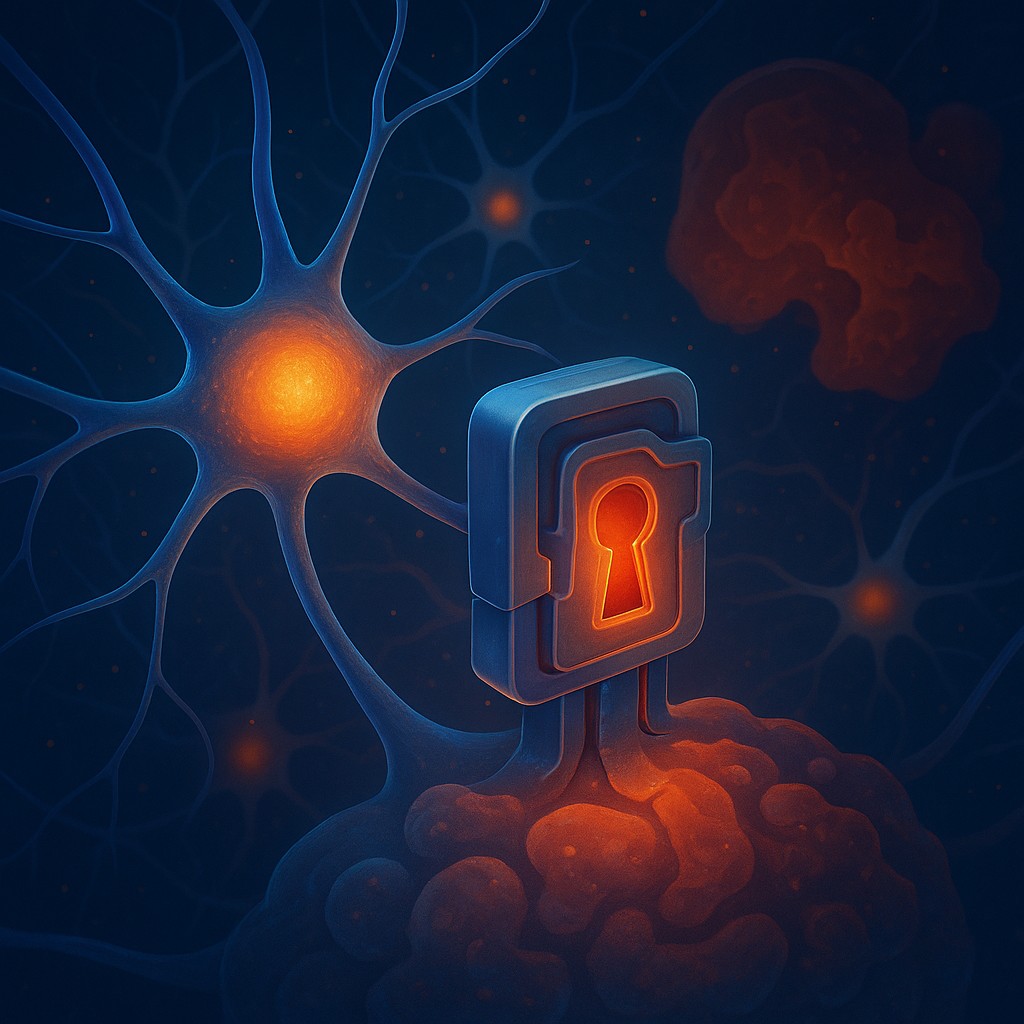
Imagine for a moment that your brain is a bustling, high-tech city. Billions of neurons are constantly chatting, sending messages to keep the lights on and your memories flowing. For decades, scientists studying Alzheimer’s disease have looked at this city and seen piles of metabolic "trash" known as amyloid plaques and tau tangles. They assumed these piles were the primary reason the city was shutting down. However, recent breakthroughs from researchers at Heidelberg University suggest we might have been looking at the wrong culprit. It turns out the neurons aren't just dying because of the neighborhood litter; they are being forced to flip a biological "death switch" that tells them to self-destruct.
This discovery represents a fundamental shift in how we understand brain decay. Instead of focusing solely on the buildup of toxic proteins, scientists have identified a specific protein team that acts like a traitor within the cellular gates. By understanding how this molecular "death complex" forms and, more importantly, how to break it apart, we are entering a new era of medicine. We might finally be able to stop Alzheimer’s in its tracks. It is a story of biological locks, molecular keys, and a tiny connection point that could change the future of brain health for millions of people.
The Secret Architecture of the Neuronal Death Switch
At the heart of every neuron is a receptor called the NMDAR, which is essentially the "ear" of the cell. Under normal circumstances, these receptors listen for chemical signals like glutamate, which help us learn new things and remember where we left our keys. However, when things go wrong in Alzheimer’s, these receptors get overstimulated. This overstimulation usually leads to something called excitotoxicity, where the cell gets so "excited" by incoming signals that it simply burns out and dies. For a long time, we didn't know exactly how that transition from "receiving a signal" to "committing cellular suicide" happened.
The Heidelberg team discovered that the NMDAR receptor doesn't act alone. It forms a deadly partnership with another protein called TRPM4. Think of NMDAR as a door and TRPM4 as a ticking time bomb located just inside the threshold. When these two proteins physically link up, they form what scientists call a "death signaling complex." This union acts as a master switch that triggers a wave of destruction inside the neuron, leading to the loss of synapses (the connections between cells) and the eventual death of the cell itself. Without this specific physical connection, the "death signal" cannot be sent, even if the neighborhood is full of toxic amyloid plaques.
By focusing on the physical interaction between these two proteins, researchers have moved beyond just looking at the symptoms of the disease. They have found the hardware responsible for the damage. This distinction is vital because it explains why many previous Alzheimer's drugs failed. Many of those drugs tried to block the NMDAR receptor entirely to stop the overstimulation. The move backfired because neurons need NMDAR to function properly; if you shut it down completely, you might save the cell, but you also erase its ability to learn or communicate. The new goal is much more surgical: keep the receptor working but stop it from shaking hands with its deadly partner, TRPM4.
Breaking the Deadly Handshake with Molecular Engineering
Once the research team identified the NMDAR/TRPM4 complex as the primary villain, the challenge became finding a way to disrupt it without harming the cell's daily operations. This is where the concept of a "TwinF interface inhibitor" comes into play. If you imagine the connection between NMDAR and TRPM4 as a biological puzzle, the scientists created a tiny molecule, known as FP802, designed to sit right in the middle of that connection. This molecule acts like a piece of tape over a lock, preventing the two proteins from ever clicking together.
In experimental trials using mice with Alzheimer's, the results were remarkable. When the researchers introduced this inhibitor, the "death switch" remained in the off position. Even though the brains of these mice still showed the classic signs of Alzheimer's, such as amyloid plaques, the neurons themselves remained healthy and functional. The cells didn't "bleb" (a type of structural bulging that happens right before a cell dies) and they didn't lose their connections to other neurons. Effectively, the drug acted as a shield that allowed the brain cells to survive in a hostile environment.
What makes this approach particularly exciting is how precise it is. Unlike traditional medications that might flood the entire brain with chemicals, this strategy targets one specific molecular interaction. By preventing the formation of the death complex, the researchers were able to preserve memory and thinking skills in the test subjects. It suggests that even if we cannot yet "cure" the underlying causes of Alzheimer's, we might be able to manage it like a chronic condition, keeping the brain's "infrastructure" intact despite the presence of disease markers.
Comparing Traditional Approaches to the New Breakthrough
To understand why this is such a significant jump forward, it helps to compare the way we used to think about Alzheimer's treatment versus this new, targeted approach. In the past, the strategy was often "scorched earth" (kill the plaques at all costs) or "total blackout" (shut down receptors entirely). The new method is much more like a precision strike that leaves the surrounding city unharmed.
| Feature |
The Classic Amyloid Theory |
The Death Switch Discovery |
| Primary Target |
Amyloid plaques and Tau tangles |
NMDAR/TRPM4 protein complex |
| Mechanism of Action |
Clearing out "trash" from the brain |
Preventing neurons from self-destructing |
| Primary Challenge |
Plaques return; high risk of side effects |
Requires precise molecular targeting (FP802) |
| Cell Connection |
Neurons die from external toxicity |
Neurons die from an internal signal switch |
| Impact on Health |
Often too late once symptoms appear |
Protects healthy neurons even in "sick" brains |
| Safety Profile |
Can cause brain swelling or bleeding |
Does not interfere with normal brain signaling |
As shown in the table above, the focus has shifted from the environment around the cell to the machinery inside the cell. While removing plaques is still a valuable goal, protecting the neurons from the "death signal" provides a much more robust defense against the actual loss of memory and personality that defines the disease. It turns the treatment from a janitorial task into a protective engineering feat.
Why Cognitive Preservation Changes Everything
For the average person, the most terrifying thing about Alzheimer's isn't the presence of plaques in the brain; it is the loss of the self. We define ourselves by our memories, our ability to recognize loved ones, and our capacity to navigate the world. In the Heidelberg study, the use of the FP802 inhibitor didn't just look good under a microscope; it translated to real-world behavioral benefits. The subjects in the study actually performed better on memory tests and showed a level of mental health that matched healthy subjects.
This suggests that the "death switch" is the direct bridge between the biology of the disease and the symptoms we see in humans. By blocking this bridge, we might be able to prevent the transition from "having the disease" to "suffering from the disease." This is a crucial distinction in modern medicine. If we can keep neurons alive and talking to each other, a person could technically have the markers of Alzheimer's for decades without ever losing their ability to lead a normal, fulfilling life. It is the difference between a city with some litter on the streets and a city that has been completely abandoned.
Furthermore, this discovery has implications beyond just Alzheimer's. The NMDAR/TRPM4 death complex is also thought to play a role in other conditions where neurons die due to overstimulation, such as strokes or traumatic brain injuries. This means that a drug like FP802, or its future versions, could potentially be used in emergency rooms to protect the brain immediately after a person suffers a stroke. The "death switch" seems to be a universal trigger for neuron loss, making its discovery a major breakthrough for the entire field of neurology.
Debunking the Myths of the Inevitable Decline
One of the most persistent myths about Alzheimer's is that once the process starts, there is absolutely nothing that can be done to stop the brain from shrinking. This sense of inevitability has cast a shadow over research for decades. However, the discovery of the NMDAR/TRPM4 complex proves that brain decay is a programmed event, not just a random collapse. Because it is programmed, it can be hacked. We used to think the brain was like a house of cards that fell over when the wind blew too hard; now we realize the house has a demolition button, and we can simply put a protective cover over that button.
Another common misconception is that "brain plaques" are the only things that matter. We now know that many elderly people have brains full of amyloid plaques but never show signs of dementia. Why? The Heidelberg research suggests that in these "resilient" individuals, the death switch might not be getting flipped as easily. Perhaps their biology naturally blocks the NMDAR/TRPM4 connection, or they have other protective factors. This research gives us a scientific framework to explain why some people stay sharp until their 100th birthday despite their brain chemistry.
Finally, there is the myth that any drug powerful enough to stop Alzheimer's would also have to be powerful enough to change our personalities or dull our senses. Because the FP802 inhibitor only targets the specific meeting point of the death complex, it doesn't interfere with the normal signaling of the NMDAR receptor. This means the brain’s "music" continues to play uninterrupted, while only the "discordant notes" of the death signal are filtered out. It is a highly sophisticated approach that honors the complexity of the human mind rather than trying to overpower it.
The Path Toward a Future Without Memory Loss
The journey from a laboratory discovery to a pharmacy shelf is often long, but the identification of the NMDAR/TRPM4 complex provides one of the clearest roadmaps we have ever had. While we must remain cautious and wait for human clinical trials to confirm these results, the underlying science is sound and incredibly promising. We are moving away from a time of "best guesses" and into a time of molecular precision. The ability to protect the structural integrity of a neuron despite the presence of disease markers is a game changer that could redefine aging for the next generation.
As we look forward, the focus will be on refining these inhibitors to ensure they can easily cross the blood-brain barrier and remain effective over long periods. The dream is to develop a preventative treatment that someone could take as they age, much like how people take statins to protect their hearts. By proactively keeping the neuronal "death switch" in the off position, we may eventually reach a point where Alzheimer’s is no longer a terminal diagnosis, but a manageable condition that never gets the chance to steal who we are. The city of the mind is worth protecting, and we finally have the blueprints to keep the lights on for good.