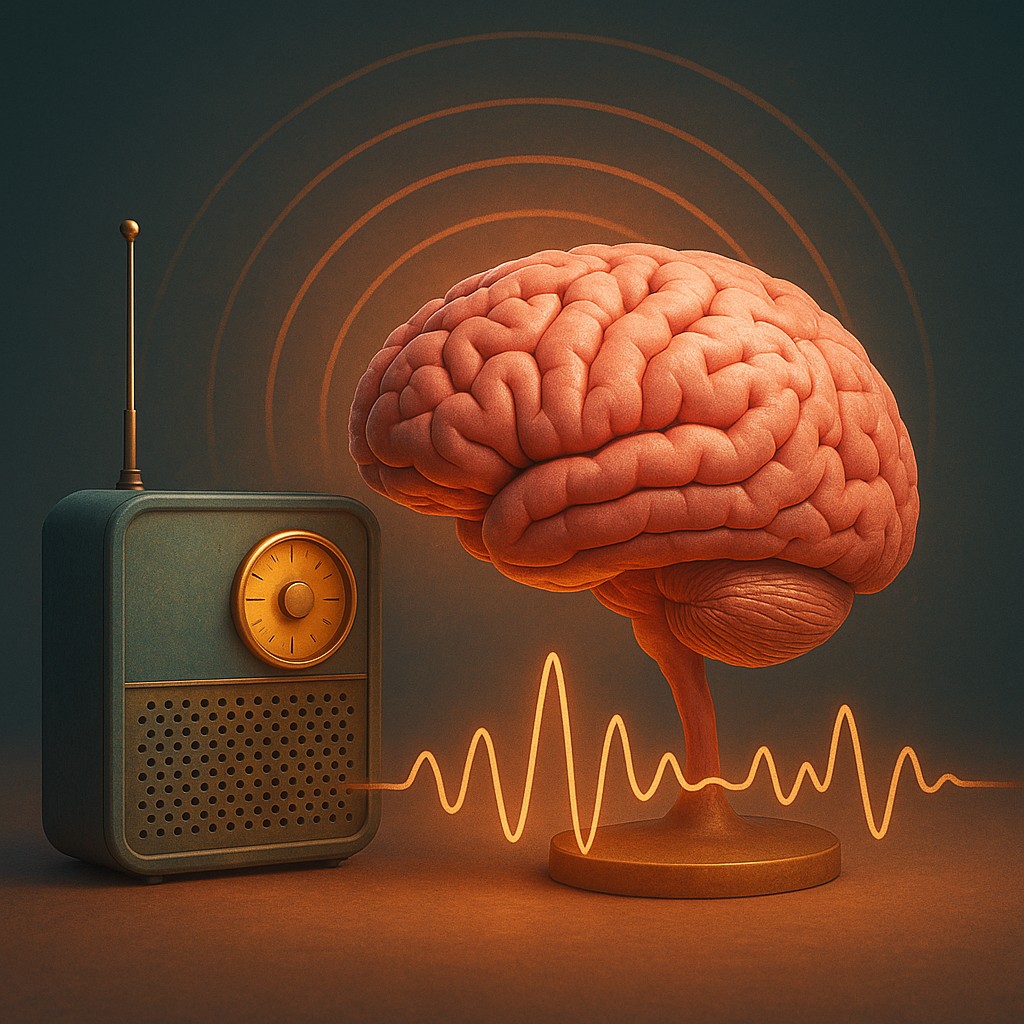
Imagine for a moment that your brain isn't the composer of your life’s symphony, but the radio set picking up the broadcast. For decades, the standard scientific story has been that the three-pound lump of wet tissue between our ears is a biological computer. We are told that, through a magic trick of complexity, this organ creates the feeling of being "you." This materialist view suggests that when neurons stop firing, the music stops forever because the brain was the source.
However, a growing number of thinkers, led by neuroscientist and theoretical physicist Àlex Gómez-Marín, are asking if we have spent the last four hundred years looking at the problem backward. If a radio breaks, the music stops playing in the room, but that doesn't mean the radio station has vanished. It simply means the receiver is broken.
This shift in perspective is more than a philosophical parlor trick; it is a fundamental challenge to the foundations of modern science. Gómez-Marín suggests that our current "Science 1.0" is built on a limiting set of rules established during the Renaissance. By revisiting the moment we decided to separate the "objective" world of matter from the "subjective" world of the mind, we can see why we are stuck in what philosopher David Chalmers called the "Hard Problem of Consciousness" - the mystery of how physical matter gives rise to felt experience. To move forward, we may need a "Science 2.0" brave enough to look at anomalies, terminal lucidity, and near-death phenomena not as glitches, but as the very clues we need to understand reality.
The Ghost in the Measuring Tape
To understand why we think the way we do, we have to travel back to the early 17th century and visit the workshop of Galileo Galilei. Before Galileo, the world was a unified place where colors, smells, and feelings were just as real as rocks and trees. But Galileo made a strategic decision that changed history. He decided that science should only concern itself with "primary qualities" - things that can be measured, counted, and weighed, such as size, shape, and motion.
Things like the sweetness of a pineapple or the moving beauty of a sunset were labeled "secondary qualities." These were relegated to the realm of the mind, deemed subjective, and essentially kicked out of the laboratory.
This move was incredibly successful. By focusing only on what fits into an equation, we built steam engines, split the atom, and put smartphones in every pocket. However, Gómez-Marín argues this success came at a steep price. By defining science as the study of the measurable, we effectively defined consciousness out of existence. We created a "science of objects" and then spent centuries wondering why we couldn't find the "subject" inside the machinery. Our current crisis in consciousness studies stems from the fact that we are trying to use a toolkit designed to ignore inner experience to explain what inner experience is. It is like using a ruler to measure the flavor of a soup and then concluding that flavor doesn't exist because the ruler didn't find any inches.
From Production to Permission
If the brain doesn't produce consciousness, what is it doing? Gómez-Marín leans into a theory championed by thinkers like William James and Henri Bergson: the "Filter" or "Permissive" hypothesis. In this model, consciousness is a fundamental property of the universe, much like gravity. The brain’s job is not to create consciousness from scratch, but to "step it down," filter it, and channel it into a format useful for survival. If we experienced everything all at once, we would be too overwhelmed to find food or avoid predators. The brain acts as a reducing valve, narrowing the vastness of a universal mind into a tiny, focused stream of "here and now" data.
This perspective flips the script on brain damage. In the standard model, if a part of the brain is damaged and a person loses a memory, it proves the brain produced that memory. In the filter model, damaging the filter simply changes what comes through. Sometimes, a "crack" in the filter might actually allow more information in, rather than less. This explains why certain types of brain inhibition - such as those caused by meditation, deep prayer, or even psychedelic substances - can lead to "mystical" experiences where a person feels more awake and aware than ever before. It isn't that the brain is doing more work; it's that the brain has stopped getting in the way.
Anomalies and the Frontiers of Evidence
Science usually progresses by ignoring "weird stuff" until it becomes too loud to ignore. Gómez-Marín points to several phenomena that the current materialist framework finds embarrassing but that he believes deserve rigorous study. One of the most striking is "terminal lucidity," where patients with advanced Alzheimer’s or severe brain damage suddenly become completely clear and present shortly before death. If the brain is the producer of the mind and the "hard drive" has been destroyed by disease, this should be impossible. However, if the brain is a filter that "thins out" as death approaches, terminal lucidity starts to make a strange kind of sense.
Then there are Near-Death Experiences (NDEs), something Gómez-Marín has experienced himself. During these events, people often report hyper-real consciousness and vivid perceptions during periods when clinical instruments show their brains have little to no activity. Instead of dismissing these as hallucinations, Gómez-Marín suggests we take the testimony seriously. If thousands of people return from the brink of death reporting that their consciousness felt expanded rather than extinguished when their "radio" was turned off, we have a scientific duty to investigate whether the signal exists independently of the device.
| Concept |
The Production Model (Science 1.0) |
The Filter Model (Science 2.0) |
| Origin of Mind |
Created by firing neurons in the brain. |
Exists fundamentally; the brain receives it. |
| Role of the Brain |
A generator or biological computer. |
A filter, receiver, or "reducing valve." |
| Brain Damage |
Destroys parts of the mind forever. |
Impairs the expression or limits the "signal." |
| Altered States |
Glitches or malfunctions in the wiring. |
A thinning of the filter, allowing more in. |
| Ultimate Reality |
Matter is primary; mind is a byproduct. |
Mind/Consciousness is primary or equal. |
Toward a Science 2.0
So, what does it look like to practice "Science 2.0"? For Gómez-Marín, it doesn't mean throwing away the scientific method or embracing superstition. On the contrary, it requires more rigor, not less. It involves expanding our definition of "data" to include first-person experience as a primary source of information. It means being brave enough to study the "fringes" without the fear of being labeled a heretic. A "Science 2.0" would observe the world not as a collection of dead objects, but as a process where the observer and the observed are fundamentally linked.
This approach requires us to accept that some things might be "irreducible," meaning they cannot be broken down into simpler parts. Just as physicists eventually had to accept they couldn't explain light using only the laws of mechanics, neuroscientists may have to accept they cannot explain "feeling like something" using only molecular biology. This isn't a defeat for science; it is an expansion. By moving away from the idea that we are just "brain-bound," we might find that we are part of something much larger and more interconnected than we imagined.
The Courage to See Beyond
The journey from a brain-centric to a consciousness-centric worldview is not just an academic exercise. It changes how we view ourselves, how we treat the dying, and how we understand our place in the universe. If you are not a biological accident trapped in a physical body, but a local expression of a vast, conscious universe, your life takes on a different kind of weight. It suggests that our curiosity, love, and awe are not just chemical reactions, but genuine windows into the fabric of reality itself.
Adopting this perspective requires intellectual humility. It asks us to admit that while we are very good at measuring "how" the world works, we are still in the dark about "what" it is and "why" it exists. By following the lead of thinkers like Àlex Gómez-Marín, we can begin to bridge the gap between our scientific skills and our lived experience. We can stop trying to explain away our humanity and start using reason to explore the full depth of what it means to be alive. The next great frontier isn't outer space; it's the very thing that is reading these words right now.
As you go about your day, consider the possibility that your mind is not a prisoner of your skull. Consider that every thought and every moment of clarity is a peek behind the curtain of a much larger reality. We have spent centuries looking at the stars through a telescope; perhaps it is time we turned that curiosity inward with the same discipline and wonder. If we have the courage to loosen our grip on old rules, we might find that the universe is far more welcoming, and far more conscious, than we ever suspected. The "music" has been playing all along; we just needed to realize we were more than the radio.