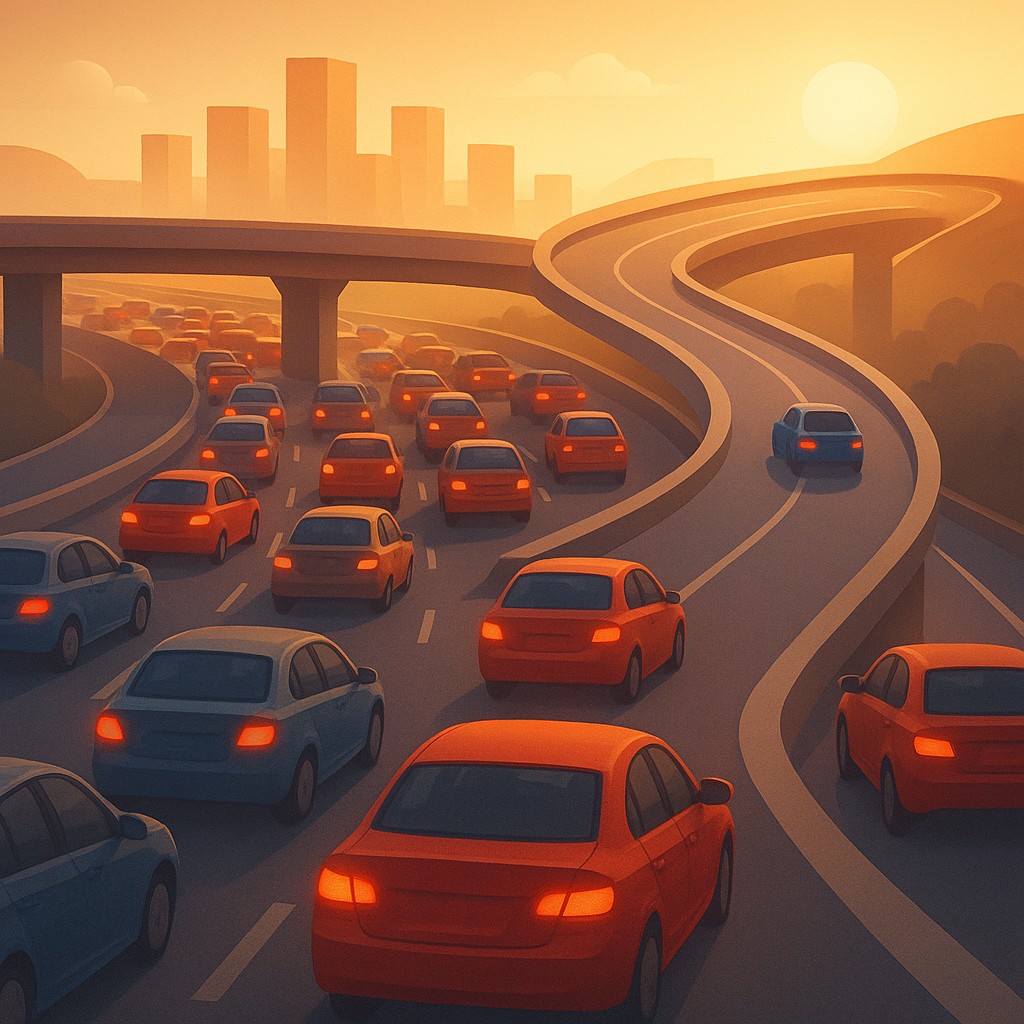
Imagine you are sitting in your car, feeling that all-too-familiar frustration as your morning commute grinds to a halt. You stare at the sea of red brake lights and think that if the city would just build one more shortcut between this highway and the downtown bridge, your problems would vanish. It seems like a simple matter of plumbing: if a pipe is too small for the volume of water, you add a second pipe to drop the pressure. In your mind, roads are just pipes for cars, and more capacity must lead to a faster flow.
However, transport networks are not filled with mindless water molecules. They are filled with people making decisions to maximize their own time. This human element introduces a strange mathematical quirk known as the Braess Paradox. Named after German mathematician Dietrich Braess, this principle suggests that adding a new road to a crowded network can actually increase travel time for every single person using the system. It is a counter-intuitive blow to common sense, proving that in complex systems, more infrastructure often leads to more of a mess.
The Selfish Search for the Perfect Shortcut
To understand why a new road can make things worse, we have to look at how drivers choose their routes. Most people do not wake up and consult a city-wide map to see how their travel choices affect the greater good. Instead, we use apps like Google Maps or Waze to find the absolute fastest path for ourselves. In game theory, this leads to a "Nash Equilibrium." This is a state where no individual driver can save time by switching routes, assuming everyone else keeps doing exactly what they are doing.
The problem is that a Nash Equilibrium is rarely the most efficient state for the group. When a new shortcut opens, it looks incredibly attractive to every driver at the same time. As everyone swerves toward this new path, the road quickly hits its limit, creating a bottleneck that never existed before. Because this shortcut links two previously separate routes, it allows traffic to "bleed" from one crowded area into another, eventually slowing down the entire grid. The shortcut becomes a trap that everyone feels forced to take because avoiding it would be even slower, yet taking it makes the whole trip longer than it was before the road was built.
Mapping the Math of a Traffic Trap
Let us look at a classic example of this paradox. Imagine a city where drivers travel from Point A to Point D using two main routes. One goes through Point B, and the other through Point C. In the original layout, the paths from A to B and C to D are wide highways where the trip always takes 45 minutes, no matter how many cars are there. However, the paths from B to D and A to C are narrow local roads where travel time depends on traffic. If 4,000 cars use them, the trip takes 40 minutes. If only 2,000 use them, it takes 20.
Initially, drivers split evenly between the two paths. Everyone's total travel time settles at 65 minutes. Now, imagine the city builds a super-fast bridge connecting B and C that takes zero minutes to cross. Every driver thinks, "I can take the short local road to B, zip across the bridge to C, and then take the short road to D!" Suddenly, all 4,000 cars cram onto the same two local road segments. The time on those stretches balloons to 40 minutes each. The result? A total travel time of 80 minutes. The shortcut just cost everyone an extra 15 minutes.
| Feature |
Without the New Shortcut |
With the New Shortcut |
| Route Choice |
Drivers split between two balanced paths |
Everyone crowds the new "fast" path |
| System Status |
Stable and moderately efficient |
Congested Nash Equilibrium |
| Individual Motive |
Follow the established flow |
Switch roads to save personal time |
| Group Outcome |
65-minute average travel time |
80-minute average travel time |
| The Fix |
Maintain existing roads |
Close the new road to restore flow |
Why More Asphalt Rarely Means More Speed
This paradox helps explain "induced demand," though they are slightly different concepts. Induced demand suggests that building more roads simply encourages more people to drive, eventually filling the new space. The Braess Paradox is more subtle: it suggests that even if the number of drivers stays exactly the same, the mere existence of a new path can cripple the network. This happens because the new road disrupts the "price" of travel, which, in this case, is time. When the time cost of a specific route drops slightly, it attracts too many "buyers," leading to a market crash in the form of a massive traffic jam.
Engineers have seen this play out in the real world. In 1990, New York City closed 42nd Street, a major crosstown artery, for Earth Day. The city expected a total meltdown of the Manhattan grid. Instead, traffic actually moved faster. Without the 42nd Street shortcut tempting drivers to cut across town, traffic stayed on more efficient outer routes, and the predicted chaos never happened. Similar results occurred in Seoul, South Korea, when a massive elevated highway was torn down to create a public park. To the shock of many, travel times in the surrounding areas improved because drivers were forced into a more efficient distribution across the city.
The Interconnectedness of Crowded Networks
It is important to note that the Braess Paradox does not apply to every road project. If you build a road through a deserted forest where only three cars pass per day, you will not trigger a paradox. The system must be "highly interdependent," meaning the roads are closely linked and already near their maximum capacity. This makes the paradox a specific problem of the modern city. In a rural setting, adding a road is almost always a benefit because the individual parts of the network are not fighting for the same limited seconds of space. But in a dense urban environment, every street is a variable in a massive, living equation.
This principle extends beyond asphalt and tires. Computer scientists see the Braess Paradox in telecommunications. If you add a high-speed fiber optic link between two servers, you might think you are speeding up the internet. But if every packet of data is programmed to take the fastest possible route, the new link might become so overwhelmed that it slows down data transfers across the globe. Biologists have even seen similar patterns in power grids and energy flow. The lesson is universal: in a crowded system, giving individuals more options can lead to worse results if those individuals only look out for themselves.
Designing Cities for Collective Success
Modern urban planners are beginning to embrace the "less is more" philosophy. They use mathematical models to identify roads prone to this paradox. Sometimes, the most effective way to fix traffic is not to pick up a shovel and add a lane, but to put up a "Do Not Enter" sign. By strategically removing certain connections or turning two-way streets into one-way streets, planners can force traffic into a pattern that is better for everyone. This is a move away from brute-force engineering and toward "systemic choreography," where the goal is to guide human behavior rather than just providing more space for it.
The next time you hear about a city closing a major downtown street to create a pedestrian plaza, do not assume it is just a trendy or "green" choice. The planners might be performing a surgical strike on a Braess Paradox. By removing a shortcut that lured too many drivers into a bottleneck, they are actually giving the city its speed back. It serves as a reminder that in a world of complex connections, our individual search for the quickest path often blinds us to the flow of the entire journey.