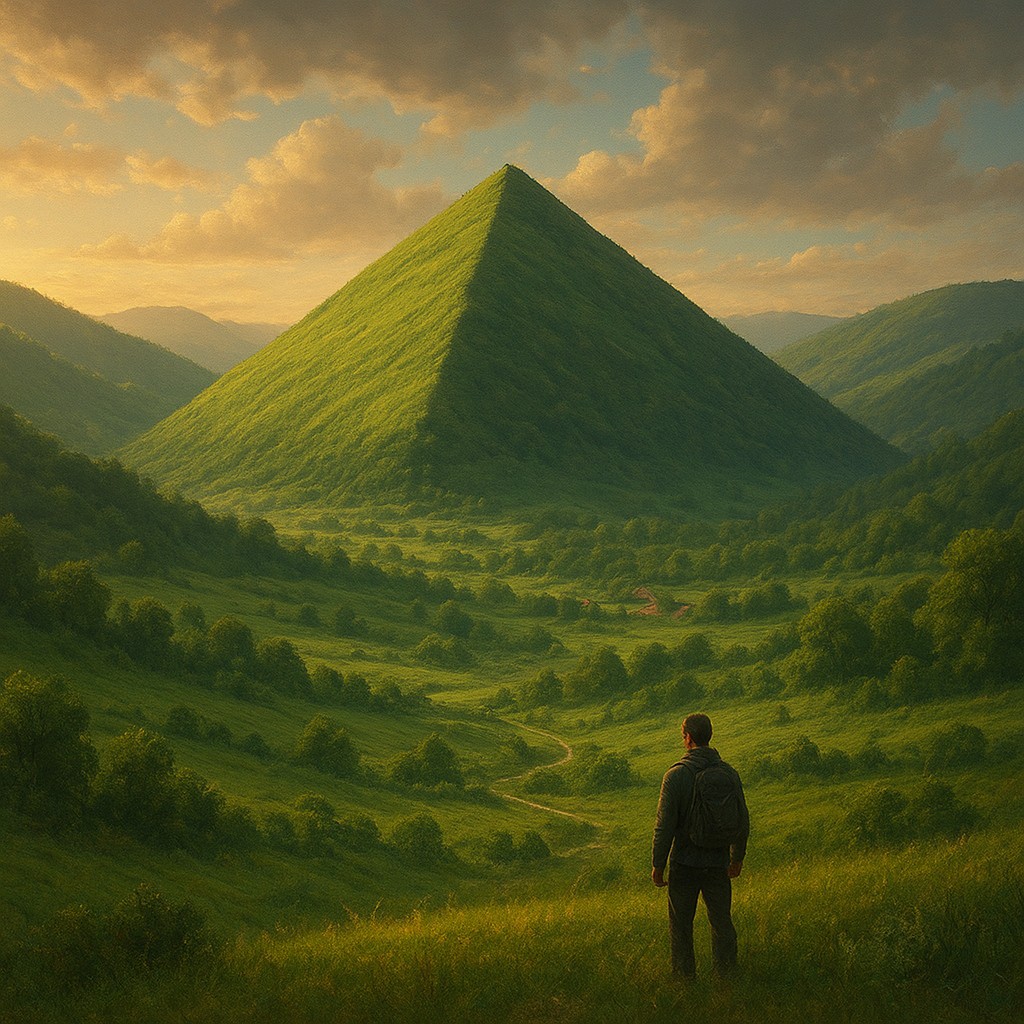
We love stories that challenge what we thought we knew. A quiet valley, a hill that looks a little too much like a pyramid, and suddenly the collective imagination lights up: what if Europe hides a "Pyramid of the Sun" older than those in Egypt? That is exactly what happened in Visoko, Bosnia and Herzegovina, where a formation called the Visočica hill became, for some people, a revolutionary archaeological wonder.
But there is a world of difference between an intriguing shape and a man-made pyramid: scientific methods, documented digs, reliable dating, consistent cultural traces, and above all, a consensus built slowly. The "Bosnian pyramids" story is fascinating not only because of the question itself (pyramid or not?), but because it shows how science moves forward, how myths form, and how our brains love to spot patterns even when nature makes them on its own.
The Visočica "Pyramid of the Sun": what supporters claim
The modern story begins in the mid-2000s with Semir Osmanagić, a Bosnian-American entrepreneur who promoted the idea that several hills around Visoko were artificial pyramids. The most famous one is nicknamed the "Pyramid of the Sun" because it would be the largest and unusually well aligned. In this account, the hill is not just a hill but a structure covered by vegetation and sediment, like a forgotten monument.
Supporters point to a few recurring "clues": very regular geometry (triangular faces), alignment close to the cardinal directions, "slabs" that look like paving stones, and a network of tunnels (often called Ravne) that they say links to the pyramid complex. They also sometimes give spectacularly ancient dates in public statements, which adds a sense of dramatic discovery.
What makes this story compelling is that these arguments speak to our intuition. A sharp, symmetrical shape, a blocky look, underground passages - it looks like a "pyramid" case ready to be filed. The problem is that intuition is a great starting point, but a poor final judge.
How archaeology and geology see it: why most researchers do not call it a pyramid
Among archaeologists and geologists, the dominant view is clear: the "Pyramid of the Sun" is not recognized as a human-built pyramid. Visočica hill is seen as a natural formation, shaped by local geology and erosion, with layers of sedimentary rock that can create flat surfaces or fractures that mimic alignments.
In archaeology, you prove a large monument by a consistent set of signs: traces of quarrying and stonecutting, a stratigraphic pattern in the layers, tools and construction debris, planned internal structures, cultural context (habitation, pottery, burials, inscriptions), and reproducible dates. For Visoko, critics point to the lack of convincing evidence for a massive human construction. They also warn that poorly targeted digs can damage genuine, later archaeological sites, including medieval remains that do exist in the area.
Geology matters here. Layered rocks can break into slabs and look like "paving." Hills can show regular slopes, especially when layers were laid down and eroded repeatedly. In short, nature can be an impressive architect without needing prehistoric building teams.
A key point: a "pyramidal" shape is not enough
Many landforms worldwide can suggest a pyramid. The human brain is great at spotting patterns - useful for survival, less useful for staying calm in front of a neatly shaped hill. A geometric shape is only a visual clue, not proof. Science looks for converging evidence, not just a silhouette.
To recognize a pyramid as a human work, we expect things that are hard to explain naturally: quarried blocks with tool marks, joints, clearly planned internal architecture, evidence of organized earthwork, and above all an archaeological context that tells the same story. Big recognized sites rest on this convergence, not on a single dramatic claim.
The Ravne tunnels: fascinating, but not the final proof many imagine
The Ravne tunnels are often presented as the most mysterious part of the case. Visitors go there, volunteers work on them, and the "adventure archaeology" vibe is real. People sometimes describe an ancient network tied to the pyramid, and some even claim special "energetic" properties - a common theme at controversial sites.
What we know more carefully is that underground passages exist and that modern work has explored and widened them. But linking these tunnels to a very ancient artificial pyramid requires strong evidence: clear dating of digging phases, analysis of spoil material, identification of mining techniques, and a tie to documented human occupation. Specialists remain cautious because jumping from "tunnels" to "pyramid" is a hasty conclusion.
It also helps to separate two things: an underground site can be old without being prehistoric, and it can be man-made without relating to a pyramid monument. Mines, quarries, refuges, cellars, and galleries are common through history and served many functions. The world is interesting enough without adding a grand structure everywhere.
How science checks (or rejects) a pyramid: the tools that matter
To understand this debate, look at the toolkit of earth sciences and archaeology. Serious methods do not rely on a viral video or a "revelation," but on repeatable measurements, protocols, and open data. It is less cinematic, but far more reliable.
Here are key approaches and what they can settle:
- Stratigraphy: reading soil layers like a historical layer cake. Human construction usually disturbs layers, with fills and work surfaces.
- Petrography and structural geology: analyzing rocks and their fractures. "Slabs" can be natural if they follow bedding planes.
- Dating (radiocarbon, luminescence, etc.): dating organic matter or sediments linked to human activity. Dates need context; a single date does not prove a pyramid.
- Building archaeology: looking for cutting marks, assembly techniques, transport evidence, and a coherent architectural plan.
- Documentation and publication: less glamorous, but decisive. A result becomes solid when it is published with methods, data, and peer review.
Summary table: frequent claims and a cautious reading
| Argument often put forward |
Possible interpretation |
What strong evidence would require |
| Pyramidal shape of the hill |
Natural relief with regular slopes |
Traces of construction, internal architecture, organized construction work |
| "Slabs" or "concrete" |
Stratification, natural fractures, conglomerates |
Analyses showing manufacture, binders, production sequence, construction context |
| Orientation toward north |
Coincidence or selection bias |
Rigorous measurements, comparison with nearby hills, statistical tests |
| Ravne tunnels |
Natural or man-made galleries from different periods |
Dating of digging phases, tools, spoil material, direct link to a construction |
| Very ancient dates announced |
Dating an element is not dating a pyramid |
Multiple, contextualized dates tied to a construction event |
This table sums up a simple idea: many clues can be "compatible" with a pyramid while also fitting ordinary explanations. Science looks for what is hard to explain another way.
Common myths and confusions: why the story sometimes runs away
Several misunderstandings repeat in this case. Clearing them helps keep an open mind without swallowing the whole menu.
First, there is the idea that "if visitors flock there, it must be true." Tourism is not proof. It shows the story is captivating, which matters, but it is not scientific validation. Second, people sometimes confuse "controversy" with "science in disagreement." A media controversy can exist even when a broad scientific consensus forms, because novelty and mystery sell better than careful method.
Another frequent claim is "archaeologists resist because it would change history." That accusation crops up in alternative narratives. In practice, a major discovery is every scientist's dream, provided it is well supported. Scientists love overturning assumptions, but they love solid evidence even more, because they will live with their conclusions for decades.
Finally, a psychological trap is clear: once you "see" a pyramid, you see pyramids everywhere. You pick the confirming clues and ignore the ones that contradict your idea. This does not make people "stupid," it makes them human. The good news is you can learn to spot this bias and correct it.
What we can say with confidence today
To summarize the state of knowledge responsibly: the Visoko region is rich in history, with medieval remains and complex landscapes. There are structures and tunnels that attract curiosity and visitors, and the place has real cultural importance today. And yes, Visočica hill has a shape that invites imagination.
But no, the Bosnian "Pyramid of the Sun" is not recognized by most archaeologists and geologists as a pyramid built by an ancient civilization. The evidence normally required to establish such a construction has not been presented convincingly in the standard scientific framework, and many claimed elements are more simply explained by natural processes.
The healthiest way to hold these two facts together is this: the site is interesting, but the "ancient pyramid" interpretation remains an unproven hypothesis and is widely rejected by the academic consensus. You are entitled to be intrigued, and you are also entitled to demand evidence that matches an extraordinary claim.
What the story teaches beyond the pyramid itself
The "Bosnian pyramids" saga is a great crash course in critical thinking. It teaches us to tell an exciting question ("what if...?") from a solid conclusion ("we know that..."). It reminds us that science does not kill dreams, but it prevents dreams from masquerading as facts.
If you want to explore the topic with a sharp mind, keep three simple habits. Look for varied sources, favor independent publications and analyses, and always ask how a conclusion was tested. Above all, keep the curiosity that makes you look up at a strange hill, while keeping your feet on the ground of evidence. That is where real discoveries live, the ones that hold up even when the camera is turned off.