Imagine you are standing at the edge of a stage, about to give the most important presentation of your life. Your palms are damp, your heart drums a frantic rhythm against your ribs, and your breath has moved high into your chest, coming in short, jagged sips. This is your survival brain in action, convinced the audience is actually a pack of hungry wolves. You have likely been told a thousand times to "just take a deep breath," advice that often feels as helpful as being told to "just be happy" when you are miserable. It sounds like a hollow cliché, a total oversimplification of the adrenaline and cortisol surging through your veins.
However, beneath that cliché lies a masterpiece of biological engineering. Most of us go through life "chest breathing," using the small muscles in the neck and upper torso to pull air into the lungs. This shallow pattern actually feeds the stress response, keeping the body in a state of constant, low-grade emergency. But by shifting the mechanics of your inhalation just a few inches lower, you can flip an actual toggle switch for your nervous system. This isn't about mystical energy or positive thinking; it is a mechanical override that uses your body's own architecture to force your brain into a state of calm.
The Wandering Nerve and the Biological Brake Pedal
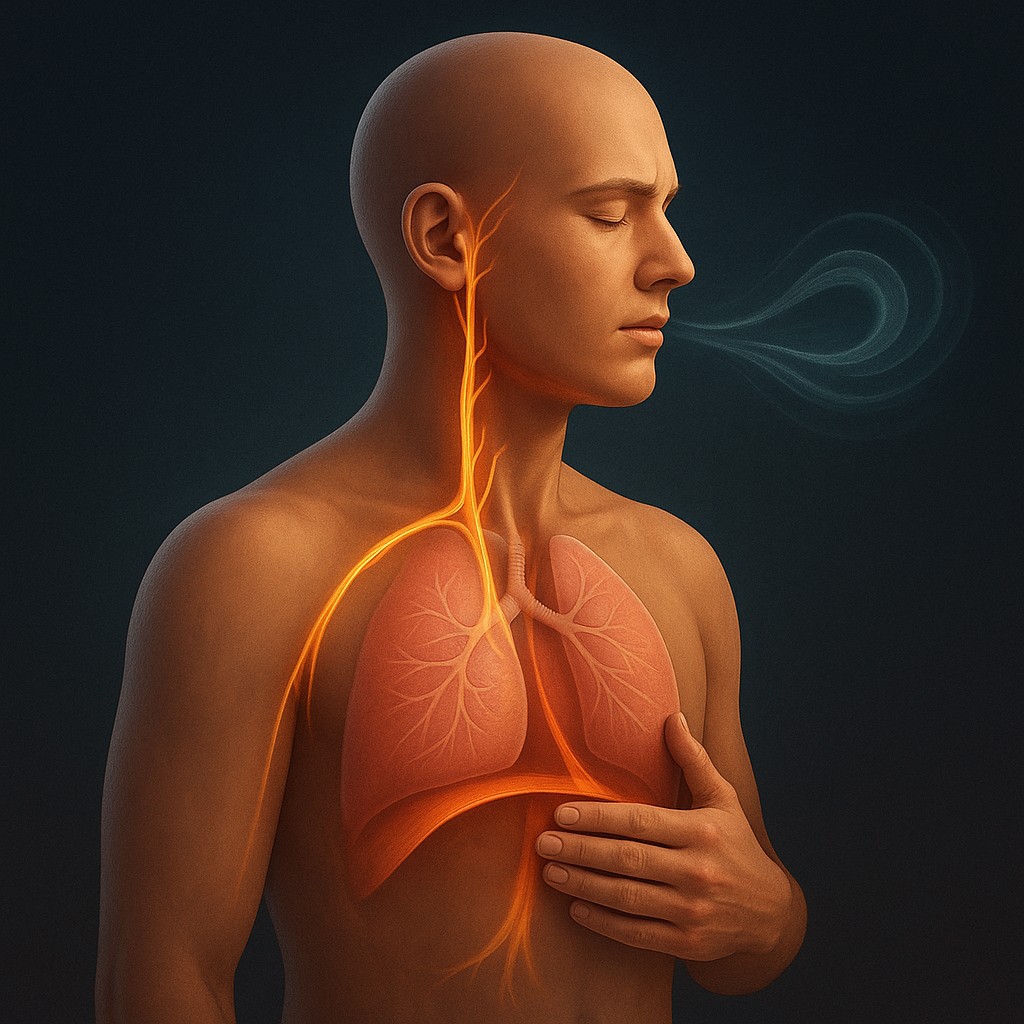
To understand how a breath can change your mood, you first have to meet the vagus nerve. The name comes from the Latin word for "wandering," which is fitting because this massive nerve starts in the brainstem and snakes its way down through the neck, chest, and abdomen, touching almost every major organ along the way. It is the main highway of the parasympathetic nervous system, the part of your biology responsible for the "rest and digest" state. While the sympathetic nervous system acts like an accelerator, revving you up for action, the vagus nerve acts like a brake pedal, slowing things down once the danger has passed.
The beauty of the vagus nerve is that it is a two-way street. While the brain can send signals down the nerve to the body, about 80 percent of the fibers in the vagus nerve are sensory. This means they carry information from the body back up to the brain. This creates a fascinating opportunity for "bottom-up" regulation. When you change the physical state of your body, you change the report being sent to headquarters. By physically stimulating the vagus nerve, you are essentially sending a telegram to your brain that says, "The wolves have left the building; you can turn off the alarm now."
The Piston in Your Ribcage
The star of this process is the diaphragm, a large, dome-shaped muscle at the base of the lungs. Most people think of the lungs as balloons that inflate themselves, but they are actually passive organs. They rely on the diaphragm to move. When you take a shallow chest breath, your diaphragm barely moves, and you rely on "helper" muscles in your shoulders and neck to lift the ribcage. This is inefficient and signals to the brain that you are under duress. After all, when do humans breathe rapidly and shallowly? Usually when they are running for their lives.
When you use diaphragmatic breathing, you allow the diaphragm to drop down toward the belly. This creates a vacuum that pulls air deep into the lower lungs, where the body exchanges oxygen most efficiently. As the diaphragm moves down, it physically pushes against the internal organs, which is why your belly expands. Crucially, the vagus nerve passes directly through the diaphragm via a small opening called the esophageal hiatus. As the diaphragm moves deeply and rhythmically, it provides a gentle, repetitive massage to the vagus nerve, acting as a manual trigger for relaxation.
Mapping the Shift from Panic to Peace
Moving from a "fight or flight" state to "rest and digest" involves several clear physical changes. When you engage the diaphragm and trigger the vagal response, your body undergoes a full system reset. This isn't just a feeling; it is a measurable shift in your internal chemistry and heart rhythm. By looking at these markers, we can see why this technique is used by everyone from professional athletes to elite soldiers who need to stay "tactically calm" under pressure.
| Body System |
Stress Response (Sympathetic) |
Relaxation Response (Parasympathetic) |
| Heart Rate |
Increases to pump blood to the limbs |
Slows down as the vagal "brake" is applied |
| Cortisol Levels |
Spikes to provide a quick energy burst |
Gradually drops as the threat passes |
| Breathing Pattern |
Shallow, rapid, and centered in the chest |
Deep, slow, and centered in the belly |
| Digestion |
Paused or slowed to save energy |
Resumes normal "rest and digest" activity |
| Blood Pressure |
Vessels tighten, raising pressure |
Vessels relax, improving circulation |
| Mental Focus |
Narrow "tunnel vision" on the threat |
Broad, creative, and analytical |
The Art of Expansion, Not the Huff
One of the most common mistakes people make when trying to use breathing to calm down is "over-breathing." In an effort to take a "deep" breath, they often inhale sharply, puffing out their chest and tensing their shoulders. This actually mimics an asthma attack or a gasp of terror, which can spike your heart rate and make you feel more anxious. The goal is not force, but volume and smoothness. You aren't trying to suck the air out of the room; you are trying to expand your internal space to make room for it.
To do this correctly, imagine your torso is a pitcher being filled with water. The water fills the bottom first, then rises to the top. When you inhale, your lower belly should move out first, followed by the lower ribs expanding sideways. Only at the very end should you feel a slight lift in the chest. The exhale is just as important as the inhale. A long, slow exhale actually provides even more vagal stimulation than the inhale does. Try to make your exhale twice as long as your inhale; this tells the nervous system there is no urgent need to save oxygen for a fight.
Correcting the Myths of Proper Breathing
There is a common myth that the goal of deep breathing is to get as much oxygen as possible. Paradoxically, over-breathing can actually reduce the amount of oxygen that reaches your brain. This happens because of a biological rule called the Bohr Effect: your blood needs a certain level of carbon dioxide to "release" oxygen so it can enter your tissues. If you huff and puff, you blow off too much carbon dioxide, causing your blood vessels to tighten and leaving you feeling lightheaded. This is why "calm" breathing is slow and steady rather than frantic.
Another myth is that you need a quiet meditation room or a yoga mat to do this. The beauty of diaphragmatic breathing is that it is invisible. You can stimulate your vagus nerve while sitting in traffic, standing in a grocery line, or listening to a difficult boss during a meeting. No one knows you are doing it. Unlike many other stress management tools, it requires no equipment, no apps, and no help. It is a biological "hack" you carry with you at all times, tucked right behind your ribs.
Building a Resilient Nervous System
While diaphragmatic breathing is effective in the heat of the moment, its real power comes from practice. Think of it like a muscle. If you only try to lift a heavy weight once a year, you won't be very good at it. Similarly, if you only try to breathe deeply during a full-blown panic attack, your body might struggle to coordinate the movement. By practicing for just five minutes a day, you "tone" the vagus nerve, improving your heart rate variability (HRV), which is a key sign of how well your body bounces back from stress.
Over time, this practice lowers your nervous system's "baseline." You become less reactive to small annoyances, and your recovery time after a major stressor becomes much shorter. You are essentially training your brain to trust your body. By regularly hitting that vagal brake pedal, you teach the amygdala, the brain's emotional smoke detector, that it doesn't need to scream at every puff of smoke. This builds a buffer of resilience that allows you to naviagte a high-pressure world with a sense of control.
You possess incredible technology within your own body, a physical bridge that connects your conscious mind to your unconscious vital functions. When the world feels overwhelming and your biology tries to hijack your peace, remember that you are not a helpless passenger. You have the manual controls. By simply dropping your breath, expanding your belly, and gently pressing on that wandering nerve, you can steer yourself back to calm. Use this power not just for emergencies, but as a daily invitation to live with a steady and resilient heart.