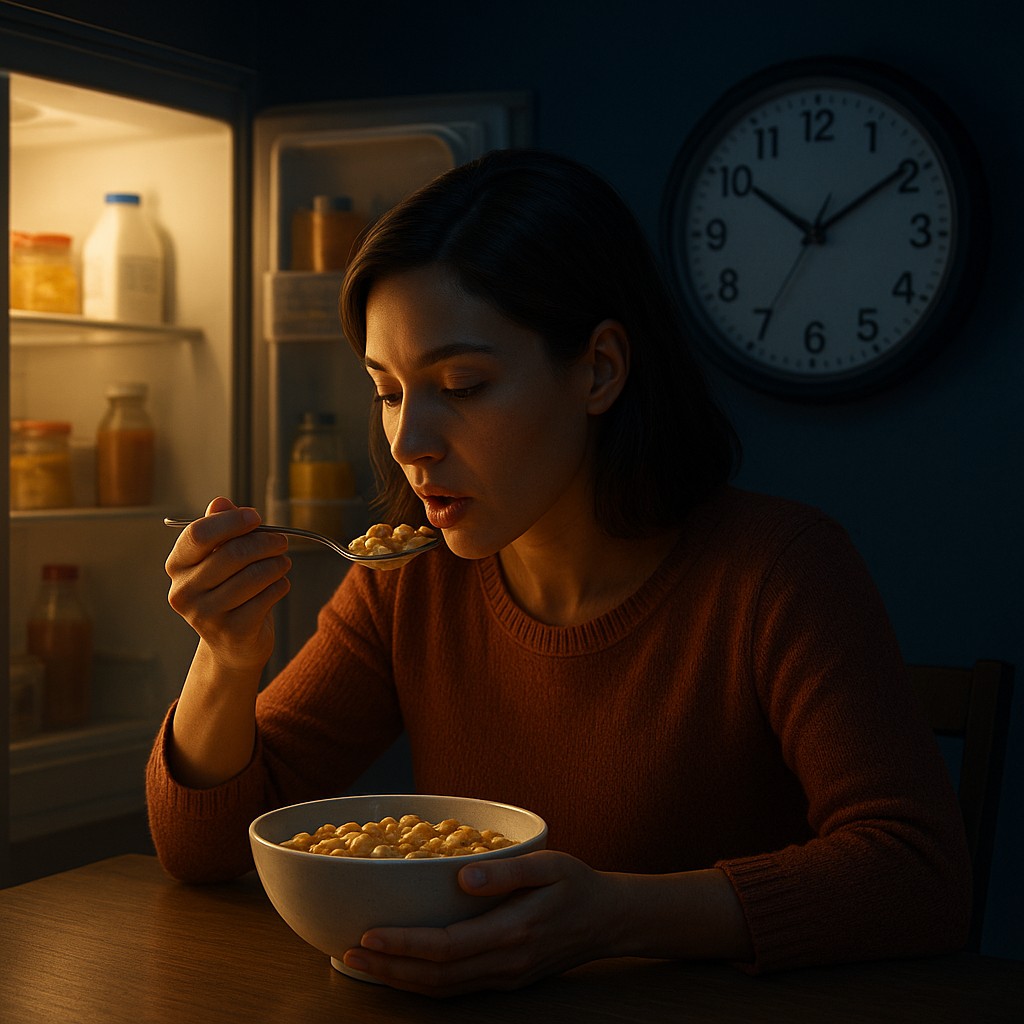
For many of us, a midnight snack is a beloved ritual. Whether it is a bowl of cereal by the glow of the fridge or a cold slice of pizza while scrolling through social media, raiding the kitchen late at night feels like a harmless treat. However, new research into meal timing suggests our bodies are much less excited about these late-night calories than our taste buds are. The growing field of chrononutrition, or the study of how timing affects nutrition, suggests that it isn't just what we eat, but when we eat that determines how we process energy, manage blood sugar, and maintain a healthy weight.
The idea of Time-Restricted Eating (TRE) has moved from the world of extreme health hackers into mainstream science. Unlike traditional diets that focus on counting calories or cutting out specific food groups, TRE is simple: you eat whatever you like, but only during a set window of time. While this may sound like an excuse to overindulge, a massive review of studies published in the journal BMJ Medicine suggests the clock might be your most powerful health tool. By looking at dozens of clinical trials involving thousands of people, researchers are decoding the hidden link between our internal biological clocks and the kitchen pantry.
The Body as a Precise Engine
To understand why meal timing matters, we have to look at circadian rhythms. Evolution did not design humans to process food 24 hours a day. Instead, our biology is tuned to the cycle of light and dark. During the day, our systems are primed to spend energy, use insulin effectively, and absorb nutrients. As the sun sets, our bodies switch into a "repair and maintenance" mode. When we eat late at night, we are essentially trying to run a heavy industrial process in a factory where the lights have been dimmed and the technicians have gone home for the night.
This clash creates "metabolic friction." When we eat during our biological night, our bodies are less efficient at clearing sugar from the blood and more likely to store that energy as fat. The research in BMJ Medicine highlights that Time-Restricted Eating acts as a reset button for these rhythms. By limiting when we eat, we give our bodies a predictable period of fasting. This allows insulin levels to stay low long enough to trigger fat burning and a cellular cleanup process called autophagy, where the body recycles its own damaged parts.
Finding the Best Window for Eating
One of the most interesting findings from the analysis of 41 different trials is that not all eating windows are the same. The study compares "Early TRE," where the eating window starts and ends earlier (like 8:00 AM to 4:00 PM), with "Late TRE," where the window shifts toward the evening (perhaps noon to 8:00 PM). While any form of restriction worked better than eating all day long, the "early birds" saw significantly better health results. Early TRE was especially effective for losing weight, lowering BMI, and controlling blood sugar.
The reason for this "morning advantage" likely comes down to our natural insulin peaks. Most people are best at processing carbohydrates in the morning and early afternoon. As the day goes on, our ability to manage glucose (blood sugar) slowly drops. By eating most of our calories in the first half of the day and closing the kitchen by late afternoon, we match our food intake with our highest metabolic capacity. This ensures the food we eat is used for immediate fuel rather than being tucked away as body fat.
Comparing Health Strategies
The data shows that how long you fast and when you start your window both play a role in your health. Researchers used a "network meta-analysis," a method that compares multiple treatments at once, to look at 12-hour, 10-hour, and 8-hour windows. Generally, as the eating window gets smaller, the health benefits increase. However, there is a point where it becomes too difficult for the average person to maintain. Finding a "sweet spot" is the key to making this a lifestyle rather than a short-term experiment.
| Strategy Type |
Typical Window |
Main Benefits |
Ease of Use |
| Early TRE |
8:00 AM - 4:00 PM |
Significant weight loss, better blood sugar |
Moderate (harder for social life) |
| Mid-Day TRE |
10:00 AM - 6:00 PM |
Balanced weight, steady daily energy |
High (fits most jobs) |
| Late TRE |
1:00 PM - 9:00 PM |
Modest weight loss, stops night snacking |
High (good for social dinners) |
| Standard Diet |
7:00 AM - 10:00 PM |
Baseline health (depends on food quality) |
Very High (the default) |
The table above shows that while any TRE is better than grazing all day, Early TRE has a slight edge in medical markers. However, the best window is the one you can actually stick to. If an early window makes you feel cut off from your family at dinner, it might not be the best choice for your mental health, even if it is better for your insulin. Science suggests that staying consistent is the most important factor for long-term results.
Myths of Muscle Loss and Starvation
A common worry for people starting TRE is the fear of losing muscle or having their metabolism "crash." The BMJ study helps prove these are just myths. When researchers looked at body composition, they found that while people lost weight, they mostly lost fat. In fact, when combined with exercise, TRE can help keep muscle while stripping away body fat. This happens because fasting boosts human growth hormone (HGH), which helps protect our muscles.
Another misconception is that the body enters "starvation mode" if it doesn't get food every few hours. In reality, our ancestors survived for thousands of years by switching between eating and fasting. The human body is great at switching fuel sources. Once the sugar from your last meal is gone, your liver starts converting stored fat into ketones for energy. This "metabolic flexibility" is like a hybrid car switching from gas to electricity. Rather than slowing you down, this switch often leads to clearer thinking and more stable energy levels.
Steps to Master Your Metabolic Clock
Switching to Time-Restricted Eating doesn't require clearing out your pantry, but it does require a plan. You don't need to jump straight into a tiny four-hour eating window to see results. Most successful studies used an eight or ten-hour window. A good way to start is by cutting out post-dinner snacks and pushing breakfast back by an hour or two. This slow change lets your hunger hormones, like ghrelin, adjust without causing "hangry" outbursts.
Hydration is the secret to success. During fasting hours, it is vital to drink plenty of water, black coffee, or plain tea. These drinks help quiet hunger signals and keep your metabolism running without breaking your fast. It is also important to remember that food quality still matters. While timing provides a great safety net, eating whole foods, protein, and fiber will multiply your results. Think of timing as the foundation of your house and food quality as the bricks and mortar.
A Long-Term Vision for Health
The beauty of Time-Restricted Eating is that it is a free, accessible way to tackle major health issues like obesity and type 2 diabetes. By understanding that our bodies are sensitive to the clock, we can move away from harsh dieting and toward a more natural way of living. This isn't about punishment; it is about alignment. When we respect our biological boundaries, our bodies reward us with more energy, better focus, and a longer life.
As you look forward to your next meal, consider not just what is on your plate, but where the sun is in the sky. Eating an earlier dinner or skipping the midnight snack isn't just a "diet tip" anymore; it is a proven strategy to help your body run at its best. You have a real chance to work with your body instead of against it. By saving the night for rest and the day for fuel, you are setting the stage for a healthier future. The power to change your health is quite literally in your hands, dictated by the face of the clock.