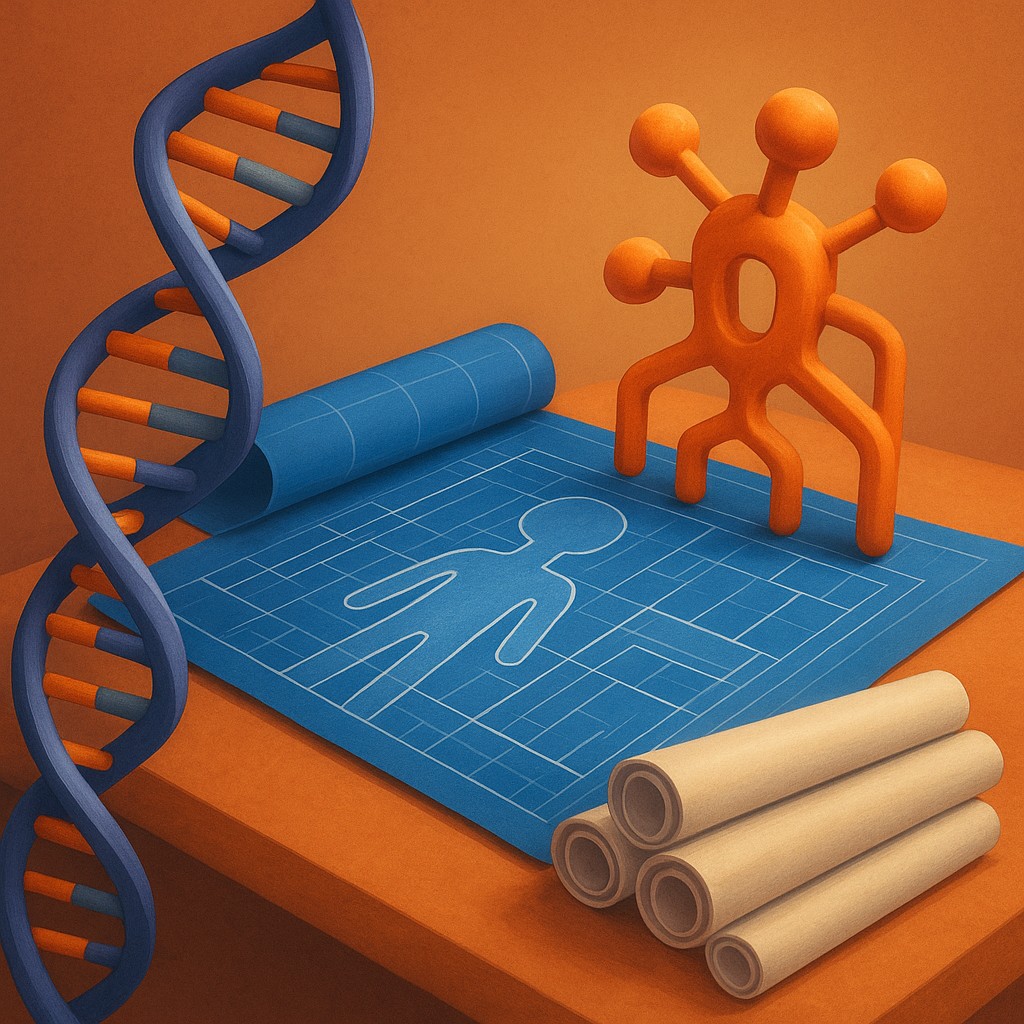
Imagine for a moment that you are a construction worker at a massive building site. You have been handed a stack of blueprints thousands of pages long, but there is a catch: every single worker on the site, from the plumber to the electrician to the landscaper, is holding the exact same set of drawings. There are no specialized instructions for different teams. In this scenario, how does the plumber know to install pipes in the bathroom rather than burying them in the front lawn? How does the electrician know that the wires belong inside the walls instead of dangling from the chimney? Without a head coordinator to tell each worker which page to read based on where they are standing, the result would be a chaotic pile of mismatched materials.
This is the exact challenge a developing embryo faces. Every single cell in your body, whether it is a neuron in your brain or a muscle cell in your toe, contains the same identical DNA. Your genetic code is the blueprint, but it does not come with a different "instruction manual" for each body part. Instead, your body relies on a specialized group of genes called Hox genes to act as the site foreman. These genes carry the master plan for the body's layout, ensuring that your arms grow from your shoulders and your legs grow from your hips. Without them, your body would have all the right "building materials" but no sense of where to put them, leading to a biological architectural disaster.
The Molecular GPS of Life
To understand how a single fertilized egg transforms into a complex organism with a top, a bottom, a front, and a back, we have to look at the concept of positional information. Early in development, an embryo is essentially a uniform ball of cells. As it begins to stretch out, it needs to establish a coordinate system. Hox genes provide this system by acting like a molecular GPS. They do not build your organs themselves, but they provide the "ZIP code" that tells other genes what to do in a specific location. If the Hox gene for the chest area is active, it signals the surrounding cells to start forming ribs and heart tissue. If the "lower back" Hox gene is active, those same types of cells receive signals to form spinal bones instead.
What makes Hox genes truly remarkable is how they are physically organized. In a rare instance of biological neatness, these genes are often arranged on the chromosome in the same order as the body parts they control. Scientists call this "colinearity." The genes at the beginning of the DNA cluster control the development of the head, the genes in the middle control the torso, and the genes at the end control the tail or lower limbs. It is as if nature decided that the best way to keep track of a body map was to print it out as a linear checklist directly on the DNA strand. This strategy has been so successful that it has remained unchanged for hundreds of millions of years of evolution.
The Master Architects and Their Tools
A common misunderstanding in genetics is the idea that every gene produces a physical structure, like a brick making a wall. Hox genes, however, belong to a class of proteins called transcription factors. Rather than being the bricks, they are the foremen who have the power to hire or fire entire teams of workers. When a Hox gene is switched on, it produces a protein that binds to hundreds of other genes, either turning them on or switching them off. This creates a massive genetic waterfall, or a "regulatory cascade." One single Hox gene decision can trigger thousands of other genes responsible for making bone, muscle, and skin in a very specific shape.
Because Hox genes sit at the very top of this hierarchy, a small change in a Hox gene can have a massive, visible impact on an organism. They are the "master switches" of the body plan. Scientists often distinguish between structural genes (which make the proteins for your hair, eyes, and muscles) and regulatory genes like Hox genes. You can think of structural genes as the individual keys on a piano, while Hox genes are the sheet music that tells the pianist which keys to press and in what order. The music of a human being is very different from the music of a starfish, yet they often use many of the same keys to get the job done.
When the Map Goes Wrong: Lessons from the Fruit Fly
The power of Hox genes was first famously demonstrated in the early 20th century through experiments with Drosophila melanogaster, the common fruit fly. Because flies grow quickly and have easily visible body parts, they are the perfect subject for genetic study. Researchers discovered that by mutating specific Hox genes, they could create what looked like science fiction monsters. In one famous mutation called Antennapedia, the Hox gene that normally tells the fly to grow legs in its midsection is accidentally activated in the fly's head.
The result is as striking as it is bizarre: the fly grows a perfectly formed, fully functional pair of legs where its antennae should be. This experiment proved two vital points. First, it showed that Hox genes are "instructive." The presence of that specific Hox protein was the only signal the head cells needed to abandon their plan to become antennae and build legs instead. Second, it proved that the "blueprint" for a leg was already present in the cells of the head; it just usually stays tucked away in a locked drawer. When the Hox gene unlocked that drawer, the head cells followed the leg instructions perfectly, demonstrating that biological complexity is all about placement and timing.
Comparing the Genetic Foreman Across Species
One of the most humbling discoveries in modern biology is that Hox genes are nearly universal across the animal kingdom. Whether you are looking at a fruit fly, a mouse, a shark, or a human, the Hox genes are shockingly similar. This shared "genetic toolkit" suggests that evolution invented this basic way of mapping out a body once, and it was so effective that it was never replaced. While a human has more sets of Hox genes than a fly (we have four clusters, while they have one), the individual genes perform almost identical roles in defining the head-to-tail axis.
| Feature |
Fruit Fly (Invertebrate) |
Human (Vertebrate) |
| Number of Hox Clusters |
1 Cluster |
4 Clusters (A, B, C, D) |
| Arrangement |
Linear (Head-to-Tail) |
Linear (Head-to-Tail) |
| Primary Function |
Defines segment identity |
Defines segment and bone identity |
| Mutation Effect |
Parts in wrong places (Leg-heads) |
Skeletal and limb deformities |
| Evolutionary Origin |
Shared ancestor (~600 million years ago) |
Shared ancestor (~600 million years ago) |
This table shows that while humans are much more complex than insects, our underlying "operating system" is built on the same foundation. Evolution did not start from scratch when it moved from worms to mammals; it simply took the existing Hox gene map and copied and pasted it several times. This backup system allowed for more complex bodies, as the extra copies of the genes could evolve to handle new, specialized tasks, like building a thumb or a complex inner ear, while the original copies kept the basic body frame intact.
The Difference Between Location and Construction
It is vital to keep one distinction clear: Hox genes define the identity of a region, not the details of the organs themselves. A Hox gene is like a sign on a door that says "Kitchen." It does not tell you where the forks are, how to turn on the stove, or what color the tiles should be; it simply identifies the room. Once the "Kitchen" sign is up, other specialized genes (the sub-foremen) take over to handle the specifics of making a stove or a sink.
This is why, in the leg-headed fly experiment, the fly did not grow a weird leg-antenna hybrid. It grew a distinct, recognizable leg. The Hox gene provided the "Location: Thorax" signal to the head cells, and the head cells responded by running the entire "Make a Leg" program. This modular design is what allows for the incredible diversity of life on Earth. By simply shifting where a Hox gene is active, or for how long it stays on, evolution can extend a giraffe's neck, shorten a whale's neck, or turn a reptile's scales into a bird's feathers.
The Choreography of Timing and Placement
Behind the scenes of this molecular map is a strict sense of timing. Hox genes do not all turn on at once. They activate in a specific wave that moves from the head toward the tail as the embryo grows. This timed activation ensures that the body is built in the correct order. If the "tail" genes turned on at the same time as the "head" genes, the embryo might end up as a confused ball of competing signals, unable to decide which end is which.
This timing is regulated by how the DNA is packed within the cell. Initially, the Hox genes are wound tightly around proteins called histones, like thread on a spool, which keeps them turned off. As development progresses, the cell begins to unwind the DNA from one end of the cluster. The genes at the beginning are released first (the head), followed progressively by the ones behind them. This physical unwinding of the genetic "scroll" ensures that the body plan unfolds in the correct sequence, in both space and time.
Misconceptions About the Genetic Blueprint
One of the biggest myths about genetics is that there is a "gene for a hand" or a "gene for an eye." In reality, almost no complex body part is the result of a single gene. A hand requires the coordinated effort of thousands of genes working in sync. The Hox genes are unique because they sit at the center of these efforts. They are the decision makers that commit a group of cells to a specific path.
Another common misconception is that Hox genes are only active while an embryo is developing. While their most dramatic work happens in the womb or the egg, we are learning that Hox genes continue to play roles in adults. They help maintain the identity of certain tissues and may even help the body repair itself after an injury. In some cases, when Hox genes are accidentally reactivated the wrong way in adults, it can lead to problems like cancer, as cells "forget" what they are supposed to be and begin to grow uncontrollably.
The Future of Bio-Engineering and Medicine
Understanding the Hox code opens the door to incredible possibilities in regenerative medicine. If we know the exact signals that tell a body to build a specific part, we could theoretically use those signals to help heal complex injuries. Imagine being able to tell cells in a damaged spinal cord to re-read the growth instructions that were active during development. By mastering the language of Hox genes, scientists hope to eventually guide stem cells to grow specific organs or tissues for transplants with perfect accuracy.
Furthermore, studying these genes allows us to trace the history of life with amazing precision. By comparing the Hox clusters of different species, we can see exactly how new body plans emerged. We can see the moments in history where a gene was duplicated, allowing a fin to eventually become a limb, or a simple rib cage to transform into specialized armor. We are not just looking at DNA; we are looking at the logic that allows life to take shape.
As you move through your day, consider the silent, invisible logic operating within you. Every time you reach for a cup or take a step, you are using limbs that were placed with mathematical precision by a set of genes passed down through countless generations. You are a masterpiece of biological architecture, designed by a system so reliable that it can build everything from a fruit fly to a philosopher using the same basic set of instructions. The story of Hox genes is a reminder that we are not just a collection of parts, but a perfectly timed and beautifully mapped symphony of chemistry and history. Understaning that your body has its own internal GPS should give you a new sense of wonder for the complexity of the life you carry within every cell.