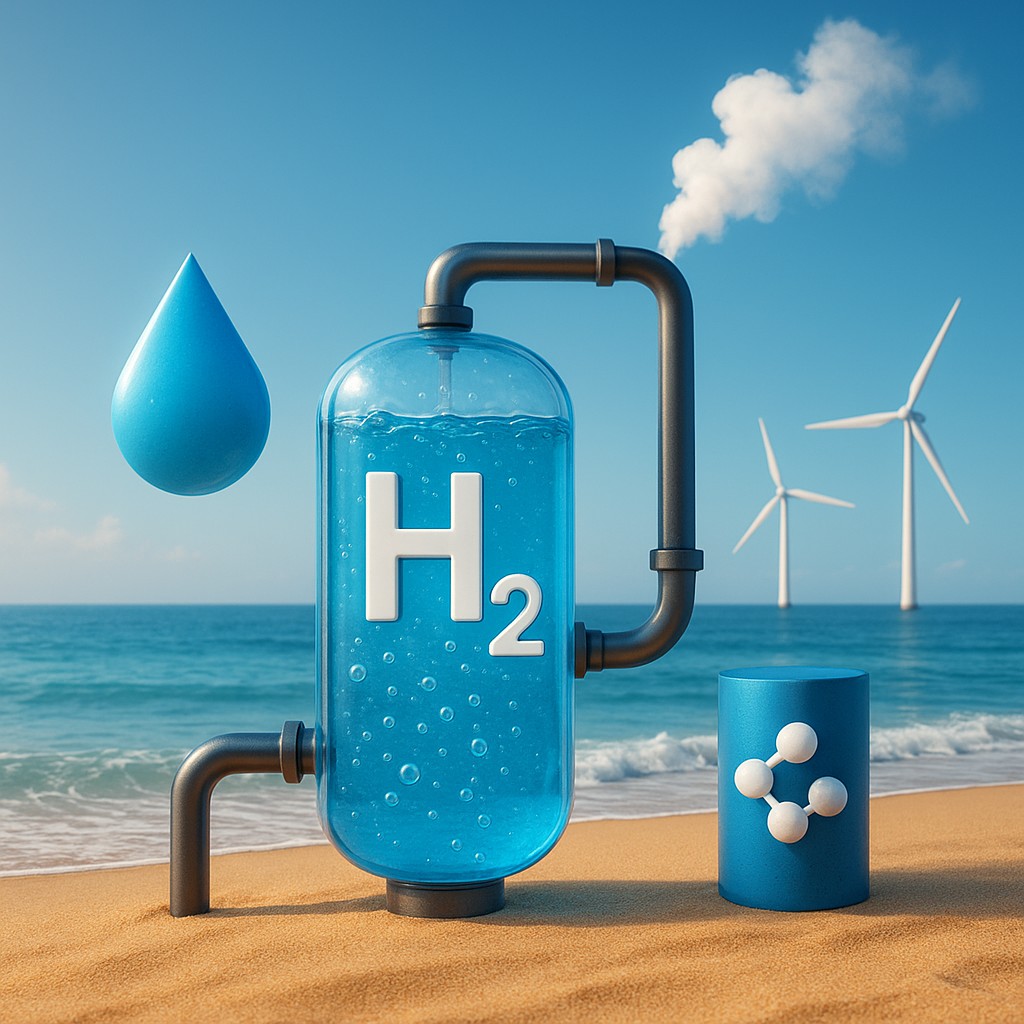
Imagine for a moment that you are standing on a sun-drenched beach, looking out at the vast, shimmering expanse of the Pacific Ocean. To most of us, this is a place for vacations, surfing, or perhaps a quiet moment of reflection. However, to a modern energy engineer, that endless blue horizon represents something entirely different: it is a giant, untapped fuel tank. For decades, the global scientific community has been chasing the dream of "Green Hydrogen," a clean fuel that emits nothing but water vapor when burned. The catch, however, comes with a frustrating irony. To make this "green" fuel, we have traditionally needed massive amounts of incredibly pure fresh water. This is the very resource that is becoming increasingly scarce in the dry, coastal regions where solar and wind power are most abundant.
This resource tug-of-war has long been the "Achilles' heel" of the hydrogen economy. It felt a bit like trying to solve a thirst problem by eating salty crackers. If we want to save the planet from carbon emissions, we shouldn't have to drain our drinking water reservoirs or build multi-billion-dollar desalination plants just to feed our equipment. But a breakthrough is currently rippling through experimental energy hubs around the world. Engineers are testing a radical new process called Direct Seawater Electrolysis. Instead of cleaning the ocean water first, they are inviting the salt to the party. More accurately, they are using clever molecular filters to keep the salt from ruining the equipment while the water molecules are split into hydrogen and oxygen. This shift could effectively turn the global ocean into a massive, liquid battery for the world's power grid.
The Chemistry of Taming the Salty Beast
To understand why this is such a big deal, we have to look at the traditional "recipe" for hydrogen. Normally, an electrolyzer - a machine that splits water - works by passing an electric current through water (H2O). This current acts like a pair of chemical scissors, snipping the bonds to release hydrogen gas at one end and oxygen at the other. If you try this with raw seawater, however, things get messy very quickly. Seawater is a complex soup of sodium, magnesium, calcium, and, most annoyingly, chloride ions. Under the stress of electricity, these chloride ions turn into toxic chlorine gas. Not only is this gas dangerous to breathe, but it is also incredibly corrosive. It eats away at the expensive metal catalysts inside the machine, turning a high-tech energy plant into a rust bucket in just a few hours.
The new experimental approach uses a "divide and conquer" strategy at the molecular level. Instead of a standard electrode, researchers are developing catalysts coated with specialized layers. One popular method involves a "Lewis acid-modified" coating that creates a protected environment around the electrode. Think of it as a VIP velvet rope at a club; it allows the water molecules to pass through easily but blocks the rowdy chloride ions from getting close enough to cause trouble. By managing the chemical balance right at the surface of the catalyst, these machines can operate for hundreds of hours without the salt "poisoning" the system. It is a masterpiece of precision engineering that solves the corrosion problem without needing a massive, energy-hungry purification plant standing next to it.
Skipping the Middleman of Desalination
One might wonder why we don't just use standard desalination to clean the water before we split it. The answer, as it often does in the world of engineering, comes down to the "energy tax." Desalination is a notoriously power-hungry process. Whether you are boiling water or pushing it through filters at high pressure, you are spending a significant portion of your "green" energy just to get the water ready for the fuel-making process. This lowers the overall efficiency of the system and makes the resulting hydrogen much more expensive. By moving to direct electrolysis, we are essentially cutting out a middleman who has been taking a 20 to 30 percent cut of our energy profits.
Beyond the energy savings, there is a logistical beauty to this setup. Many of the world’s best locations for wind and solar power are coastal deserts, such as parts of Australia, Chile, or North Africa. These are places where every drop of fresh water is precious. By using direct seawater electrolysis, we can build "hydrogen hubs" right on the shoreline. These plants can gulp down seawater, use the midday sun to turn it into storable fuel, and then ship that fuel around the world in tankers, much like we do with oil today. The difference, of course, is that a "spill" would be nothing more than water, and the "smoke" from the exhaust would be an invisible mist.
| Feature |
Traditional Green Hydrogen |
Direct Seawater Electrolysis |
| Water Source |
Ultra-pure fresh water |
Raw, unfiltered seawater |
| Pre-treatment |
Heavy desalination/purification |
Minimal to no pre-treatment |
| Primary Waste |
Minimal (clean water byproduct) |
Concentrated brine |
| Infrastructure |
Requires separate purification plant |
Integrated, compact design |
| Corrosion Risk |
Low (clean environment) |
High (requires specialized catalysts) |
| Ideal Location |
Near freshwater lakes or rivers |
Coastal, arid regions |
Balancing the Equation with Brine Management
While the prospect of "burning the ocean" for fuel is exciting, every technological leap comes with a set of trade-offs. In this case, the elephant in the room is the brine. When you pull hydrogen and oxygen out of a gallon of seawater, the salt doesn't just vanish. It stays behind in the remaining liquid, creating a "super-salty" concentrate known as brine. If a massive industrial plant simply pumps this heavy, oxygen-poor brine back into a local bay, it can sink to the bottom and create "dead zones" where fish and sea plants cannot survive. The salt concentration is so high that it literally sucks the life out of small organisms.
Engineers are currently brainstorming ways to turn this problem into a secondary industry. Some projects are looking into "circular" models where the brine is processed to extract valuable minerals like lithium for batteries or magnesium for construction. Others are experimenting with "diffuser" outlets that spray the brine over a wide area to ensure it mixes rapidly with ocean currents, minimizing the local impact. There is even a poetic irony in the works: some experimental setups use the byproducts of the process to help build artificial reefs. By managing the mineral buildup, they can actually encourage the growth of calcium structures, providing a brand-new home for the very sea life that the brine might otherwise threaten.
The Ocean as a Global Power Reservoir
If we manage to scale this technology, the implications for the global power grid are staggering. One of the greatest challenges of renewable energy is that the wind doesn't always blow and the sun eventually sets. Batteries are great for keeping your phone alive or powering a car for a few hundred miles, but they are incredibly expensive and heavy for long-term, city-wide storage. Hydrogen acts as a chemical battery that never loses its charge over time. With direct seawater electrolysis, we can use the "extra" power from a windy night at sea to create a massive stockpile of hydrogen fuel. This fuel can then be burned during a calm, cloudy week to keep the lights on, or used to power heavy-duty industries like steel manufacturing and shipping that electricity alone cannot handle.
We are currently in the "early adopter" phase of this technology. Much like the transition from clunky early cell phones to the sleek devices in our pockets, direct seawater electrolysis is moving from small laboratory tests to larger pilot plants on the coast. The primary goal now is to prove that these specialized catalysts can last for years, not just weeks, under the harsh, constant bombardment of ocean salt. If they pass that test, we will have unlocked the largest resource on our planet to solve its most pressing problem. The ocean, which has always been the cradle of life, may very well become the engine that sustains our modern lifestyle in a clean, sustainable way.
As we look toward the future, the transformation of our energy landscape feels less like a distant dream and more like a series of clever engineering hurdles we are finally clearing. The idea that a coastal village could generate its own fuel, power, and perhaps even mineral wealth just by dipping a high-tech "straw" into the sea is no longer the stuff of science fiction. It is a testament to human ingenuity that we can take the very salt that once destroyed our machines and learn to work with it. By bridging the gap between chemistry and ecology, we are not just making fuel; we are learning how to live in harmony with the natural cycles of our blue planet. This ensures that the progress of tomorrow does not come at the expense of the resources we need today.