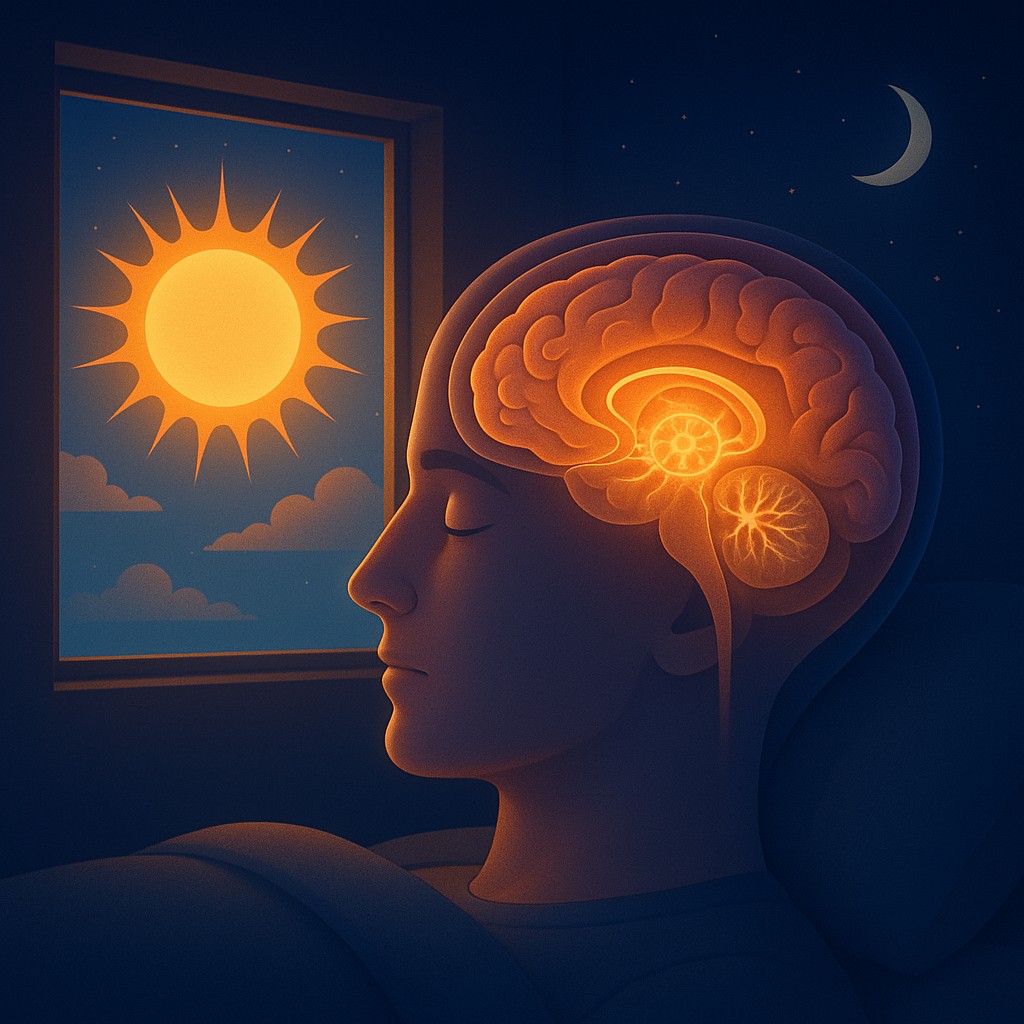
Most of us treat sleep like a light switch. We flip it at 11:00 PM and expect our minds to go dark instantly. When we stay awake tossing and turning, we usually blame the afternoon coffee or a stressful email we read at dinner. However, a good night’s sleep is actually designed fourteen hours earlier, the moment the first rays of morning light hit our eyes. Sleep isn't just something that happens because it's dark; it is a physical reaction to how we handled our relationship with the sun throughout the day.
The secret to this process is a chemical tug-of-war between two phases: stopping the production of melatonin and then releasing it later. We often think of melatonin as a gummy supplement, but in its natural state, it is the body’s "vampire hormone." It comes out in the shadows and hides from the light. By being active in the morning sun, you aren't just staying awake; you are winding a biological spring. The harder you push melatonin down during the day, the more "elastic energy" it builds. This allows it to snap back with more power once the lights dim, pulling you into a deep, healing sleep.
The Master Architect in Your Brain
Deep inside your brain sits a tiny structure with a big name: the suprachiasmatic nucleus, or SCN. This cluster of neurons is about the size of a grain of rice, yet it acts as the lead conductor for every single internal clock in your body. Every cell you own has its own timer, but without the SCN, they would all tick at different speeds and cause internal chaos. The SCN keeps them in sync by using signals from the environment, the most important of which is bright light.
When sunlight enters your eyes, it doesn't just help you see; it travels through a special pathway directly to the SCN, bypassing the part of the brain used for vision. This signal tells the brain the day has officially started, triggering a series of hormonal changes. Most importantly, it tells the pineal gland to stop making melatonin immediately. This morning "cancellation" of melatonin is the main tool that resets your 24-hour clock. Without it, your body stays in a groggy, hungover state where the lines between day and night get blurry, a feeling often called "social jetlag."
The Spring Analogy and the Physics of Sleep
To understand why daylight matters for nighttime rest, imagine a physical spring attached to a wall. This spring represents your "sleep drive." If you leave the spring alone, it stays loose and floppy. This is what happens when you spend all day in a dim office or a room with the curtains closed. Because the brain's master clock never received a strong "stop" signal, melatonin lingers in your system at low levels all day. As a result, there is no pressure built up for the evening.
When you step outside into bright sunlight, you are effectively grabbing that spring and pulling it back with all your strength. By blocking melatonin production through bright light, you are creating a biological "debt" that needs to be paid later. As the day ends and the light fades, you let go of that spring. The harder it was pulled back during the day, the more forcefully it snaps back at night. This results in a sharp, sudden peak of melatonin instead of a weak trickle. That peak is the difference between staring at the ceiling for an hour and falling asleep minutes after hitting the pillow.
Measuring the Gap Between Sunlight and Lightbulbs
Many people assume that because their office feels bright, they are getting enough light to set their internal clocks. However, the human eye is easy to fool. Our pupils adjust to make different settings look similar, but the actual "dosage" of light energy varies wildly. Light intensity is measured in "lux," and the difference between indoors and outdoors is massive.
A typical modern office is lit at about 300 to 500 lux. To your brain, this is basically darkness. Even on a cloudy, gray day, the light outside is usually around 10,000 lux. On a clear, sunny morning, that number can jump to 100,000 lux. When you stay indoors, you are trying to set your watch in a room so dim you can't see the gears. This is why morning walks or sitting by a large, open window are essential for sleep health. You need that massive hit of light to tell the brain to pull the spring back.
| Lighting Environment |
Average Lux Level |
Impact on Melatonin |
| Dim Living Room |
50 - 100 |
None; the body stays in "night" mode |
| Bright Modern Office |
300 - 500 |
Weak; not enough to reset the brain's clock |
| Overcast Day (Outdoors) |
1,000 - 10,000 |
Moderate to Strong; works for most people |
| Direct Sunlight (Noon) |
100,000 |
Maximum; tells the brain to stop melatonin immediately |
| Computer/Phone Screen |
200 - 500 (but very close) |
High impact at night; confuses the brain |
Why Blue Light Is Not the Real Villain
In recent years, "blue light" has become a dirty word in the wellness world. The truth is more complicated. Blue light is actually a wonderful tool; it is the specific wavelength our eyes are most sensitive to for setting our daily rhythms. The sun is a massive source of blue light. In the morning, blue light is your best friend because it is the most efficient at stopping melatonin and boosting cortisol, the hormone that makes you feel alert and ready for the day.
The problem isn't blue light itself; it's the timing. When you look at a smartphone or a bright monitor at 11:00 PM, you are sending a "high-noon" signal to your brain. Your brain sees that blue light and assumes the sun has just risen. It immediately stops the melatonin surge, letting the tension out of your biological spring too early. While blue light filters and "night mode" settings can help, they are just damage control. The real solution is getting as much blue light as possible during the day so your brain is so locked into its daytime cycle that a little evening light can't knock it off track.
The Cortisol Connection and the Morning Spike
While stopping melatonin is the main event, the morning sun also triggers a second important process: the Cortisol Awakening Response. Cortisol is often called the "stress hormone," but for your daily rhythm, it is your internal alarm clock. About thirty minutes after you see bright morning light, your brain triggers a healthy spike in cortisol. This acts like a starting gun, clearing out the chemicals that make you feel sleepy and raising your body temperature.
This rise in temperature is a key part of the sleep equation. Your body follows a heat rhythm where it warms up during the day and cools down significantly to start sleep. By getting sunlight early, you kickstart the warming phase. This ensures your body temperature will peak in the afternoon and start to drop exactly when you want to feel drowsy. If you miss that morning light, your temperature rhythm stays flat, and your body never gets the signal that it is time to cool down and power off.
Adapting Habits to Biology
The best way to use this information is to view light as a "dose" of medicine. On a sunny day, ten minutes of direct light in your eyes (without looking directly at the sun) is usually enough. If it is cloudy, you might need twenty to thirty minutes because there is less light energy. The key is to get this light as soon as possible after waking up. Standard window glass filters out many of the light waves needed for this process, so stepping onto a balcony or opening a window is much more effective than looking through a closed pane.
For people living in the north where winter sun is rare, "light therapy" lamps can work as a substitute. These devices mimic the 10,000 lux of a bright morning. While not as nice as a walk in the park, they give the brain the signal it needs to wind that biological spring. The goal is consistency. Your brain thrives on a schedule. By giving it the same bright signal at the same time every morning, you stabilize your hormones and make sleep an automatic result rather than a desperate hope.
Understanding how light and brain chemistry work together changes sleep from a mystery into a system you can control. We evolved to live under the massive, rhythmic changes of the sky, not the dim, flat glow of lightbulbs. By fixing your relationship with the morning sun, you are engineering your night. You are pulling back the spring, setting the timer, and giving your brain the clarity it needs to move between the waking world and the rest it deserves. Open the curtains today, and your body will reward you when the darkness returns.