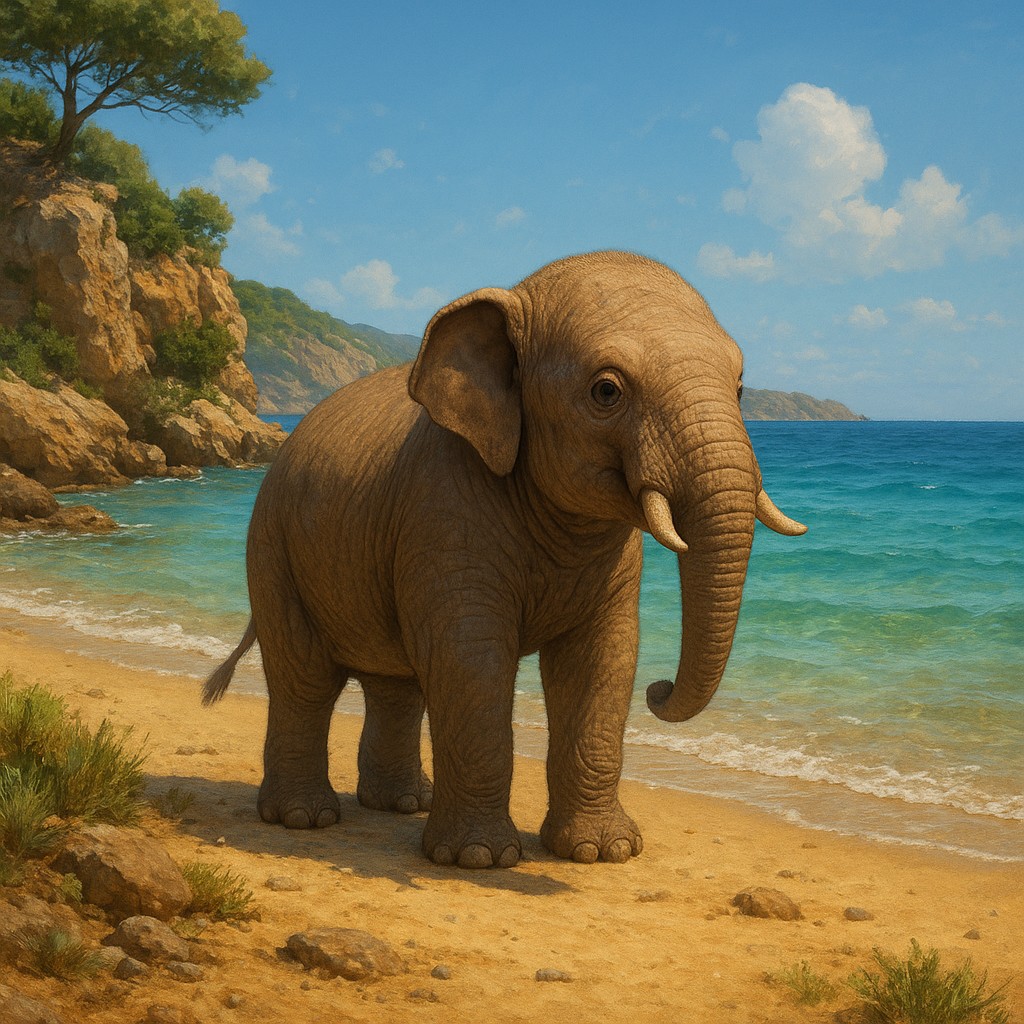
Imagine standing on a lush Mediterranean beach about half a million years ago. You look toward the horizon and see a familiar shape: the unmistakable profile of an elephant. However, as the creature draws closer, you realize its proportions are completely different from what you expected. It isn't the towering giant you envisioned, but a creature roughly the size of a large pony or a sturdy kitchen table. This is no baby elephant, but a full-grown adult of the species Palaeoloxodon falconeri. These tiny titans once roamed the islands of Sicily and Malta, and they remain the classic example of one of nature's most fascinating biological quirks.
In the grand theater of evolution, size is rarely a matter of ego. Instead, it is a cold, calculated response to the environment. On the mainland, being big is often a brilliant survival strategy. It makes you harder to eat, allows you to travel long distances for food, and gives you the physical strength to dominate rivals. But when a population of large animals becomes stranded on an island, the rules of the game change overnight. The majestic advantages of a four-ton body suddenly become a burden in a world with limited space. This sets the stage for island dwarfism, a process where nature takes a giant and, over many generations, shrinks it down to a more manageable, "fun-sized" version.
The Caloric Math of Confinement
The primary reason mainland giants shrink is the harsh reality of the island pantry. On a vast continent, an elephant or a deer can roam hundreds of miles to find fresh grass if their local patch dries up. On an island, your world ends at the shoreline. Resources are strictly limited. In this high-stakes ecological budget, a massive body is essentially an expensive luxury vehicle with a fuel tank the size of a swimming pool. If the island cannot provide the thousands of calories required to maintain that bulk, the large individuals will be the first to starve.
Evolution acts like a sculptor, chipping away at the excess. Smaller individuals in the group need fewer calories to survive, reach breeding age faster, and are more likely to raise healthy young during lean years. Over generations, the genes for a smaller frame become the dominant trait because "living small" is the only sustainable way to live at all. This is not just a theory; it is a mathematical certainty in isolated ecosystems. By reducing the size of each animal, the island can support a larger, more diverse population. This wide gene pool is a much better safety net against extinction than a small group of hungry giants would be.
The speed of this change often surprises researchers. While we usually think of evolution taking millions of years, some studies on wild cattle introduced to isolated islands have shown significant body shrinkage in just a few centuries. When the environmental walls close in, biology finds a way to adapt with remarkable haste. It is a process of optimization, ensuring that the flame of a species continues to burn, even if it has to burn a little less brightly to keep from running out of fuel.
Living Fast and Slow in the Absence of Fear
Food shortages are only half the story. The other half involves the neighborhood bullies, or rather, the lack of them. On the mainland, many animals grow massive as a defense. A rhinoceros or a hippopotamus is much harder for a lion or a wolf pack to kill than a small antelope. This "size as armor" strategy is metabolically expensive, but it pays off by keeping the animal off the dinner menu.
However, many islands lack large predators. Big cats, bears, and wolves rarely manage the long swim or survive a trip on a raft of floating vegetation to reach remote shores. When a large plant-eater finds itself on an island with nothing trying to eat it, the "tax" of being big no longer offers a benefit. The energy that used to go into building massive bones and heavy muscle for defense can now be spent on having babies or simply saved. This "relaxed predation" allows the species to drift toward a smaller size without the fear of being hunted.
Interestingly, this lack of predators often leads to what scientists call a "slow pace of life." Without the constant stress of being hunted, some island dwarfs evolve slower metabolisms and longer lifespans for their size. Recent studies of the bone structure of extinct dwarf elephants from Sicily show that they grew much more slowly than their mainland cousins. They weren't just "shrunken" versions of big elephants; they were biologically reprogrammed to live a slower, more deliberate life in a world where the only real threat was the next drought.
Comparing Island Shifts
While we are focusing on the shrinking of giants, the "island rule" (also known as Foster's Rule) works in both directions. While large animals tend to shrink, small animals often get bigger. To understand how island dwarfism fits into the bigger picture, it helps to see how different creatures react when they are cut off from the mainland.
| Feature |
Large Mainland Species |
Resulting Island Dwarf |
Small Mainland Species |
Resulting Island Giant |
| Primary Pressure |
High Predation / Rare Food |
Limited Food / Low Predation |
High Predation / Competition |
Open Roles / Low Predation |
| Energy Strategy |
High intake, high output |
Low intake, high efficiency |
Rapid reproduction |
Slow growth, large body |
| Growth Rate |
Fast (to reach safe size) |
Slow and steady |
Very fast |
Slow |
| Example |
Mammoths |
Pygmy Mammoths |
Common Rats |
Flores Giant Rats |
| Defense Strategy |
Size and strength |
Hiding or camouflage |
Numbers and speed |
Size and dominance |
This table shows that size is essentially a volume knob that nature turns up or down based on the specific pressures of the environment. For the dwarf, the volume is turned down to save energy. For the giant (like the famous Komodo dragon or the extinct dodo), the volume is turned up because they are filling ecological roles left empty by the absence of other animals.
The Hidden Costs of Specialization
While island dwarfism is a brilliant survival strategy in a stable environment, it comes with a terrifying downside: extreme vulnerability. Evolution is often a trade-off between being a "generalist" who can survive anywhere and a "specialist" who is perfectly tuned to one specific place. Island dwarfs are the ultimate specialists. They have spent thousands of years adapting to a world with no predators and limited food. They have lost the speed, the aggression, and the sheer mass needed to defend themselves.
This vulnerability creates a tragic pattern. When humans eventually arrive on these islands, they often bring along "mainland" stowaways like rats, cats, dogs, and pigs. To a dwarf elephant or a flightless island bird, these newcomers are like aggressive invaders from another world. Having "unlearned" how to handle predators, the island species are often wiped out with staggering speed. This is what happened to the dwarf hippos of Cyprus and the dwarf emus of King Island.
Furthermore, because these animals are often restricted to a single tiny island, they have nowhere to run when their habitat changes. A mainland species can migrate a thousand miles to escape a changing climate, but an island dwarf is trapped. This makes them "canaries in the coal mine" for biodiversity. Their existence is a miracle of adaptation, but their extinction is a warning of how fragile even the cleverest survival strategies can be when the environment changes too fast for biology to keep up.
The Evolutionary Tapestry of the Small
The study of island dwarfism is more than just a curiosity about tiny prehistoric elephants. It is a fundamental lesson in how life responds to limits. It teaches us that "fitness" in evolution does not always mean being the biggest, fastest, or strongest. Sometimes, fitness means being the one who can survive on the fewest blades of grass, or the one who can wait out a long drought because their heart beats just a little slower.
When we look at the skeletons of Homo floresiensis (often called "the Hobbit"), a species of small early humans who lived on the island of Flores in Indonesia, we see that even our own relatives were not immune to these pressures. It is a humbling reminder that we are all products of our environment. The laws of biology apply to everyone, from the smallest beetle to the largest mammal. We are all pieces of a puzzle, shaped by the space we are given to fill and the resources we have to consume.
As you explore the natural world, let the island dwarf be a symbol of resilience. It is a creature that looked at a shrinking world and decided to shrink right along with it, proving that size is relative but the will to survive is universal. Whether it is a pygmy sloth in a mangrove forest or a tiny fox on the Channel Islands, these animals represent the incredible flexibility of life. They remind us that even when the world feels small and resources feel thin, there is always a way to adapt, endure, and find a version of ourselves that can thrive.