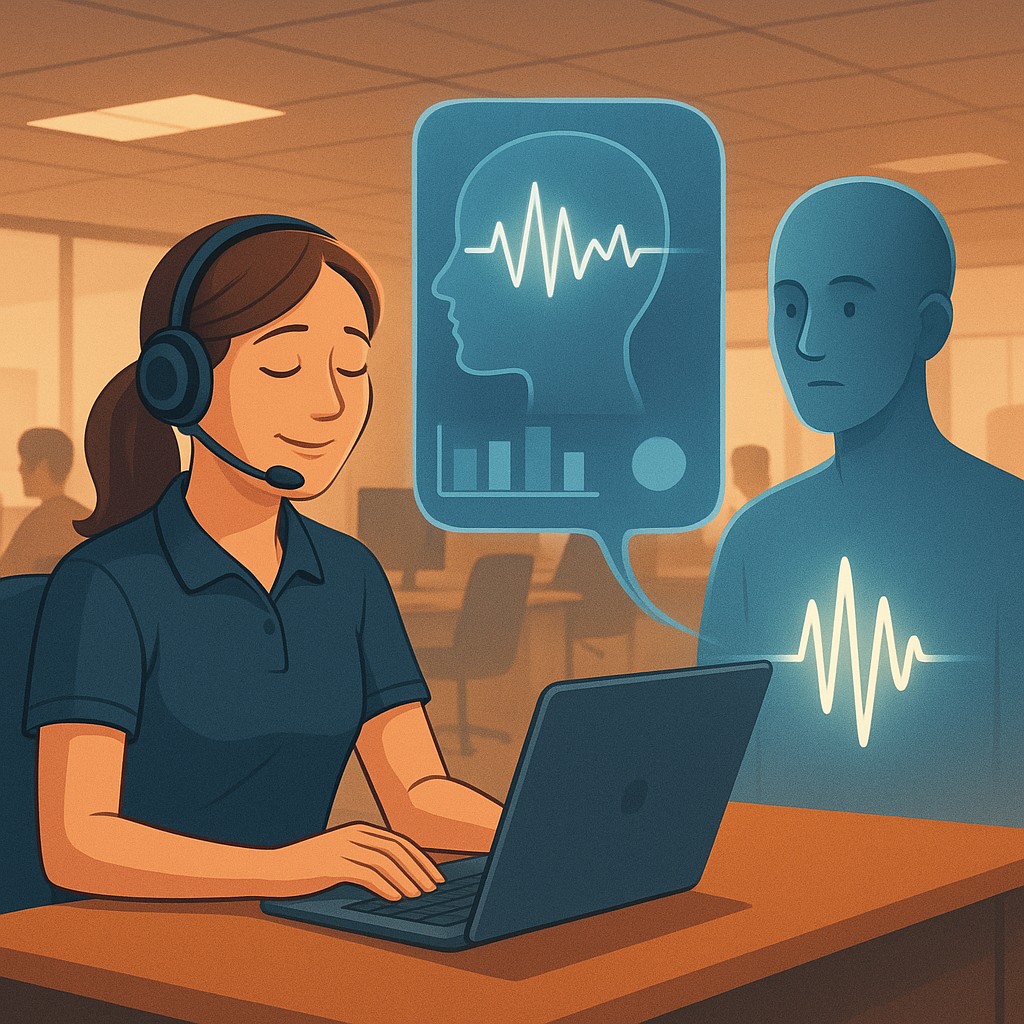
Imagine you are sitting in a busy warehouse office or a brightly lit customer service center. You are exhausted, certainly, but you keep a smile on your face. You follow your training scripts, hit your daily targets, and assume that as long as your numbers look good, your boss is happy. But a silent observer in the room knows you are actually on the brink of an emotional breakdown. It isn't reading your emails or tracking your clock-in times. Instead, it is listening to the microscopic tremors in your vocal cords, the way you stretch your vowels, and the subtle thinning of your pitch. Before you even realize you are heading for burnout, an algorithm has flagged your "vocal fingerprint" as high risk, alerting your manager that you need an intervention.
This isn't a scene from a dystopian thriller; it is the new reality of "vocal sentiment analysis" now used by major retailers and call centers. For decades, management was reactive. Leaders waited for employees to quit or melt down before addressing workplace stress. Now, the goal is "predictive maintenance" for the human soul. By treating the human voice as a biological data stream rather than just a way to speak, companies are trying to decode the subconscious signals of chronic stress. This marks a shift from managing what people do to managing how they feel, fundamentally changing our relationship with our own bodies.
The Biology of a Bad Day
To understand how a machine "hears" burnout, we first have to look at what stress does to the body. When you are under constant pressure, your nervous system stays on high alert. This causes your muscles to tense up, including the delicate ones that control your larynx (voice box) and vocal folds. You might think you sound the same as you did months ago, but to a high-frequency sensor, your voice has become "brittle." Your pitch might climb, your tone may lose its natural melody, and your speaking speed might shift in ways that stray from your usual patterns.
Sentiment analysis software captures audio from help desk calls, virtual meetings, or floor radios and breaks it down into hundreds of acoustic measurements. These systems ignore the actual words you say. You could claim, "I love my job," but if the "acoustic layer" shows high tension and low resonance, the AI flags it. It looks for the "leakage" of your true emotional state through the physical mechanics of speech. Because these signals are controlled by the involuntary nervous system, they are almost impossible to fake, making the voice a more honest reporter of your internal state than you are.
From Human Intuition to Algorithmic Sorting
In the traditional management model, detecting burnout relied on one-on-one meetings, surveys, or a supervisor’s gut feeling. From a corporate efficiency standpoint, this is slow and biased. A manager might overlook a favorite employee’s declining mental health, or a worker might be an expert at "masking" their stress behind a professional front. Predictive analytics aims to standardize this. By constantly monitoring staff, the software creates an emotional "heat map" of the company, spotting departments that are hitting a wall before productivity drops.
This shift creates a new hierarchy of information. In this system, a worker’s own word about their well-being is secondary to the "objective" data from the AI. If an employee says they are fine but the analysis detects "emotional exhaustion," the company might trigger a mandatory break or a shift change. This creates a strange paradox: the company claims to be helping by "hearing" a silent plea for help, yet they are bypassing the worker’s own agency. It treats the human voice less like a tool for conversation and more like a dashboard light that flashes when an engine is overheating.
Comparing Traditional Management and Predictive Analytics
To see the scale of this change, it helps to compare the two management philosophies. Traditional management looks at observable behavior, while predictive analysis looks at involuntary biological signals.
| Feature |
Traditional Management |
Vocal Sentiment Analysis |
| Data Source |
Performance metrics, surveys, and visual cues |
Pitch, jitters, and vocal tension |
| Detection Timing |
Reactive (after a problem happens) |
Predictive (before a problem happens) |
| Control |
Employee chooses what to say |
Employee cannot control vocal tremors |
| Primary Goal |
Evaluating performance |
Monitoring mental and emotional load |
| Bias Risk |
Favoritism or lack of empathy |
AI misunderstanding accents or illness |
| Privacy Level |
High (focused on professional work) |
Low (focused on internal biology) |
The Ghost in the Machine: Accuracy and Ethics
While "stopping burnout before it starts" sounds noble, the technology faces serious hurdles. The biggest is the "baseline problem." Everyone has a different natural voice. Some people naturally sound more tense or flat than others. If a system isn't perfectly tuned to an individual, it risks mislabeling a stoic person as depressed or an energetic person as manic. There is also a major risk of cultural bias. Speech patterns vary across cultures; what sounds like aggression in one language might just be standard emphasis in another.
Beyond technical glitches lies an ethical minefield. Most labor laws protect "conscious data" - the things you choose to share. Vocal analysis taps into "involuntary data." Because you cannot easily control your vocal folds during a long shift, the company is mining your biology for information you didn't consciously agree to give. This creates a "glass human" effect where your private vulnerabilities are visible to your employer. It raises a vital question: do we own our subconscious signals, or does the employer own the "ambient data" our bodies produce while we are on the clock?
The Pressure to Sound "Healthy"
There is a final, subtle danger: the risk of forced emotional conformity. In Greek mythology, a man named Procrustes made travelers fit his bed by either stretching them or cutting off their legs. By using AI to define a "healthy" voice, companies might accidentally force employees into a narrow range of emotional expression. If an algorithm flags "low energy" as a sign of burnout, employees may feel pressured to perform a constant, hyper-energetic "vocal mask" to avoid being flagged.
This creates a feedback loop where the tool meant to reduce burnout actually increases it. The pressure to sound "optimally engaged" is a form of emotional labor. When a machine judges your tone, you aren't just doing your job; you are performing for a sensor. Instead of a workplace that adapts to human needs, we risk creating one where humans must tune their nervous systems to satisfy a software package. This turns well-being into just another metric to be optimized.
Navigating the Future of the Audible Office
As this technology moves from call centers into general offices and retail, we will likely see a fierce debate over "cognitive liberty." The boundary between our private inner lives and our professional roles is disappearing. However, these tools aren't purely a threat. In a high-stress world, a system that tells a manager, "Sarah is struggling and needs a day off," could be a lifesaver for those who find it hard to ask for help.
The challenge for future leaders will be finding the balance between using technology to support health and using it to invade privacy. Used with empathy, vocal analysis could revolutionize workplace support. Used for surveillance, it becomes the ultimate micromanagement nightmare. The future of work will be decided by who gets to listen, what they are listening for, and whether the "voice" of the employee is ever truly heard as a person, rather than just a frequency on a monitor.