Imagine you are standing on a stage, the glare of the spotlights hiding the faces of a thousand expectant people. Or perhaps you are simply staring at a mountain of emails on a Monday morning. In either case, your body reacts with a primitive, ancient physical routine known as the "fight or flight" response. Your heart hammers against your ribs like a trapped bird, your breath becomes short and ragged, and your palms grow damp. This is your amygdala - the brain’s smoke detector - screaming that a predator is in the room. It doesn't matter that the "predator" is just a spreadsheet or an impatient audience. For a long time, the standard advice has been to "just take a deep breath," but that often feels like trying to put out a forest fire with a squirt gun.
The reason simple deep breathing often fails is that it lacks the structure needed to actually "hack" into your nervous system. While a few quick gulps of air might distract you for a second, they don't change the chemical signals that keep your heart racing. To truly calm the storm, you need a method that works like a manual override for your internal wiring. This is where "box breathing" comes in. This technique is famously used by Navy SEALs and elite athletes to stay cool under extreme pressure. By following a strict, rhythmic pattern of four equal steps, you aren't just relaxing - you are performing a precise physical intervention that uses carbon dioxide to force your stress response to hit the brakes.
The Vagus Nerve: Your Body's Brake Cable
To understand why box breathing works, we first have to look at the Vagus nerve. This is a massive "superhighway" of information that travels from your brainstem down through your neck, heart, lungs, and abdomen. The word Vagus is Latin for "wanderer," and the nerve earns its name by touching almost every major organ in your torso. It is the main control circuit for the parasympathetic nervous system, the "rest and digest" mode that acts as the opposite of an adrenaline surge. When the Vagus nerve is stimulated, it releases a chemical called acetylcholine, which tells the heart to slow down. It is essentially the brake pedal for your entire body, and box breathing is the foot that presses it.
Most of our bodily functions happen on autopilot, but breathing is unique because it sits right between the conscious and subconscious mind. You don't have to think about breathing to stay alive, yet you can take control of it at any moment. This makes your breath a "hacking port" into your nervous system. By controlling the rhythm and depth of your breathing - and specifically by adding pauses - you send a physical signal up the Vagus nerve. You are telling the brain that if you have the luxury of breathing in a slow, controlled square pattern, there cannot possibly be a tiger nearby. This creates a loop of calm that the brain eventually accepts as reality.
The Surprising Power of Carbon Dioxide
In our imagination, oxygen is the "good" gas and carbon dioxide (CO2) is the "waste" we need to get rid of as fast as possible. However, this is a major oversimplification. CO2 isn't just trash; it is a vital signaling molecule that tells your body how to behave. One of the most important parts of box breathing is the "hold" phase, where you keep your lungs full or empty for a count of four. During these short pauses, the concentration of CO2 in your blood increases slightly. This is called mild hypercapnia, and while it might sound technical, it is actually the "secret sauce" that makes the technique work.
When CO2 levels rise, they trigger sensors in your neck and brain. These sensors are much more sensitive to CO2 than they are to oxygen. A slight rise in CO2 tells the body to widen the blood vessels and, crucially, it strengthens the "vagal tone." This extra CO2 actually helps the Vagus nerve communicate more effectively with the heart. Furthermore, high CO2 levels help release oxygen from your red blood cells so it can actually enter your tissues - a process known as the Bohr Effect. By holding your breath, you aren't starving yourself of air; you are making the air you already have more useful while signaling your nervous system to chill out.
Mapping the Four Sides of the Box
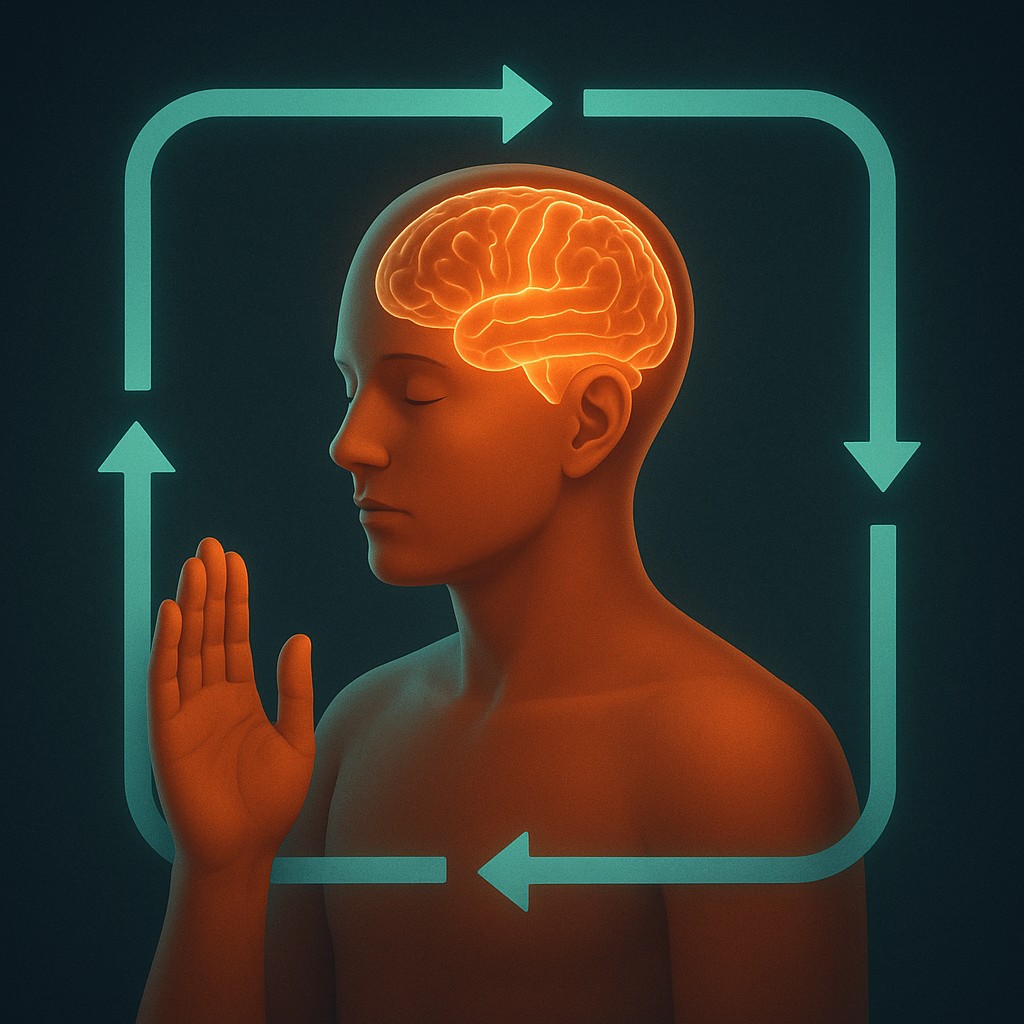
The beauty of box breathing is its simplicity. It gets its name from the four equal parts of the cycle, which you can visualize as drawing the four sides of a square in your mind. This visualization isn't just a mental trick; it provides a predictable pattern that the brain finds deeply comforting. In a state of panic, everything feels chaotic. By using a strict 4-4-4-4 structure, you give your brain a sense of order. You are no longer a victim of your environment; you are the architect of your own rhythm.
| Phase |
Action |
Physical Impact |
| Inhale |
4 Seconds through the nose |
Expands the diaphragm and starts the cycle. |
| Hold (Full) |
4 Seconds with full lungs |
Increases chest pressure and boosts CO2 signals. |
| Exhale |
4 Seconds slowly through the mouth |
Signals the Vagus nerve to lower the heart rate. |
| Hold (Empty) |
4 Seconds with empty lungs |
Resets the breathing drive and deepens the calm. |
During the inhale, focus on filling your belly rather than just your chest. This "belly breathing" physically pushes against the Vagus nerve near the stomach, adding another layer of calm. The "hold" phases are where the magic happens, allowing the CO2 to do its work. The exhale should be smooth, like air escaping through a tiny straw. By the time you reach the final hold, your body has received a clear message: the emergency is over. Repeat this cycle four times, and you will notice a physical shift that no amount of "just relax" slogans could ever achieve.
Debunking the Myths of Deep Breathing
A common mistake is thinking that the best thing to do when stressed is to take the biggest, fastest breath possible. In reality, hyperventilating (taking many quick, shallow breaths) actually dumps too much CO2. This can cause blood vessels in the brain to tighten, leading to lightheadedness and more anxiety. This is why people sometimes breathe into a paper bag during a panic attack; they are trying to breathe back their own CO2 to restore the balance. Box breathing avoids this trap by slowing the pace down to about four breaths per minute, compared to the 12 to 16 we take when resting or the 30 or more we take when panicked.
Another myth is that box breathing is a "cure" for clinical anxiety or a substitute for fixing the root causes of stress. Think of this technique as a physical "reset button" rather than a permanent fix. If your house is on fire, box breathing will help you think clearly enough to find the exit, but it won't put out the flames. It is a tool for the "now," designed to move you from a state of panic to a state of clarity. It is a manual override for the alarm, even if the person who pulled the alarm - your life's stressors - is still standing there.
Using the Manual Override in Daily Life
The true power of this technique is that you don't need any equipment or a special quiet room. You can box breathe during a difficult phone call, while sitting in traffic, or right before a big presentation, and no one will even know you’re doing it. It is the ultimate "stealth" wellness tool. The key is to practice when you are not stressed so that the habit is ready when you actually need it. Think of it like a fire drill; you don't want the first time you use the ladder to be when the hallway is already full of smoke.
As you master the rhythm, you can even lengthen the counts to five or six seconds, deepening the effect. By making box breathing a habit, you are essentially training your Vagus nerve to be more responsive. You are strengthening your biological brakes. Over time, you might find that it takes a lot more to rattle you - not because your life has become easier, but because your internal manual override has become second nature.