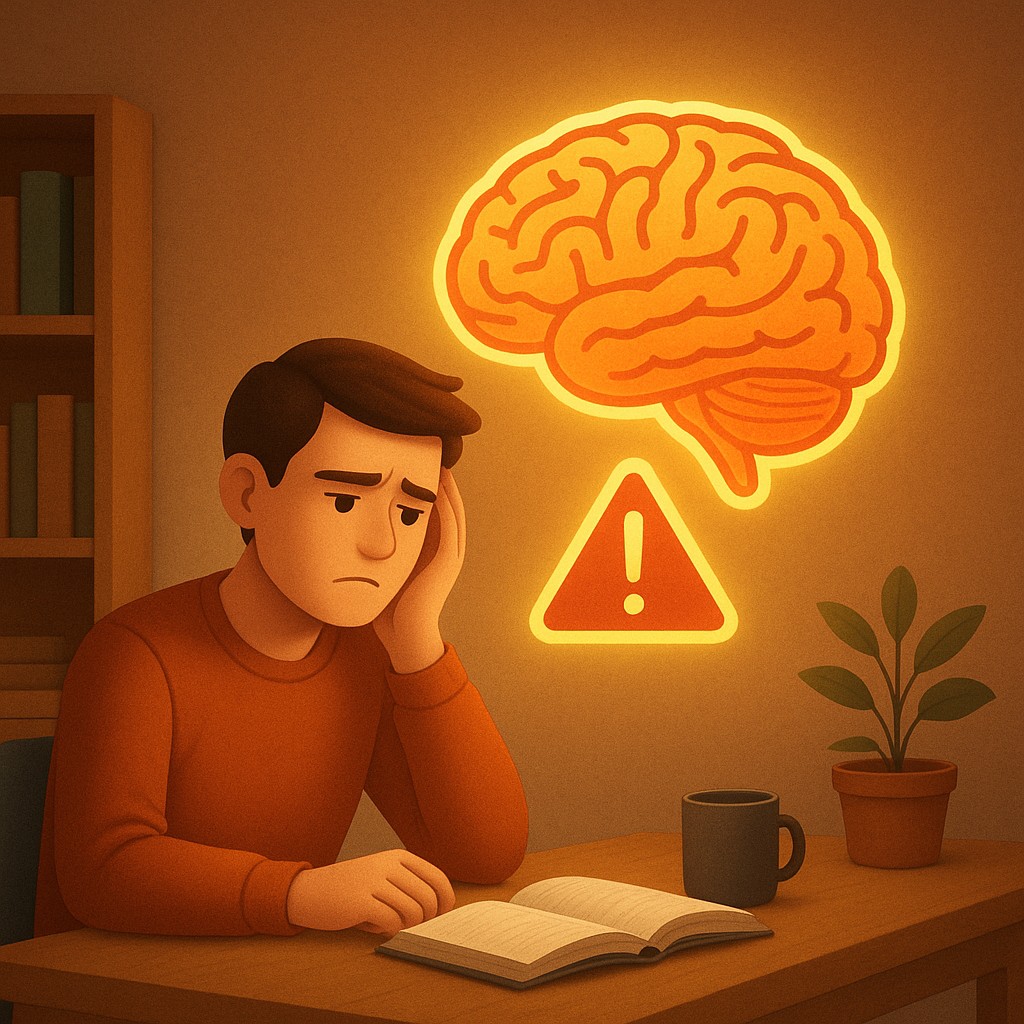
You are sitting in a quiet room, staring at a wall or perhaps scrolling aimlessly through a social media feed you have already refreshed ten times in the last hour. That heavy, restless, slightly agitated sensation crawling under your skin is what we commonly call boredom. Most of us treat it like a personal failing or a sign of a lazy mind, a void that needs to be filled with the nearest possible distraction. We apologize for being bored, we worry about it in our children, and we design our entire digital lives to ensure we never have to face a single unoccupied second. However, this perspective overlooks the biological brilliance of the "itch" you feel when there is nothing to do.
Far from being a sign of mental inactivity, boredom is a high-energy signal from the brain's "command center." It is a sophisticated alarm system, hardwired into your head over millions of years of evolution, designed to solve a very specific problem: the waste of precious fuel on low-value tasks. Your brain is a calorie-hungry organ that demands a significant portion of your daily energy. It does not like to "spin its wheels" on repetitive, empty, or unrewarding activities. When it detects that your current environment or behavior has run out of "juice," it sends up a flare. That flare is boredom, and its purpose is to force you to move, explore, and find something better.
The Mental Budget
To understand boredom, we have to look at the brain as a resource manager. Every action you take, from solving a complex math problem to choosing which berry to pick from a bush, requires an investment of neural energy. Evolution is a ruthless accountant, and it hates a poor return on investment. If you stay in one spot for too long or continue a task that is no longer teaching you anything or yielding fruit, you are essentially losing ground. In the wild, "staying put" when the resources are gone is a recipe for extinction.
Boredom acts as the ultimate "opportunity cost" calculator. It is an internal nudge that says, "What you are doing right now is no longer worth the effort, and there might be something much more valuable just over the next hill." Researchers often call this the "explore-exploit trade-off." Your brain wants to exploit a known resource as long as it is profitable, but the moment the profit drops, it needs a way to snap you into "explore" mode. Boredom is the electricity that powers that snap. It creates an uncomfortable tension that can only be resolved by seeking something new.
The Chemistry of the Search
When you feel bored, your brain isn't "shutting down." It is actually ramping up its demand for a specific chemical messenger: dopamine. We often talk about dopamine as the "pleasure chemical," but that is a bit of a mistake. In the brain's alarm system, dopamine is the chemical of pursuit and anticipation. It is what makes you want to find out what happens next. When your current environment becomes predictable, your dopamine levels dip, creating a motivated state of "information hunger."
This is why boredom feels so restless. It is an active state of seeking. Think of it like a physical hunger pang, but for your mind. Just as your stomach growls to tell you that your fuel is low, your brain "growls" with boredom to tell you that your information intake is low. This drive is so powerful that studies have shown people will actually choose to give themselves mild electric shocks rather than sit in a room with nothing to do for 15 minutes. The brain would literally rather experience pain than the "informational death" of total stagnation.
Telling the Difference Between Signals
It is helpful to look at how boredom compares to its more famous cousin, curiosity. While they both drive us toward learning, they work from different ends of the spectrum. Curiosity is the "pull" toward a specific target, while boredom is the "push" away from a dead end. Understanding the difference helps us realize why boredom can feel so frustrating; it is a general, non-specific urge to change our situation without always knowing exactly where to go next.
| Feature |
Boredom |
Curiosity |
| Main Driver |
Avoiding stagnation and wasted energy |
Seeking specific new information |
| Feeling |
Restless, agitated, and "stuck" |
Focused, energized, and "pulled" |
| Brain's Goal |
Ending a low-reward state |
Filling a gap in knowledge |
| Evolutionary Role |
Forcing a move or transition |
Improving mastery of a subject |
By recognizing boredom as a "push" signal, we can stop seeing it as an enemy. It is a functional tool that prevents us from becoming hyper-focused on things that don't matter. Without boredom, you might spend 20 hours a day staring at a blank wall or repeating the same basic task until you collapsed. It is the gatekeeper that keeps you moving toward growth, novelty, and complexity.
How the Digital World Hacks the Alarm
In the modern world, we have a major problem: we have built a digital environment that is perfectly tuned to silence the boredom alarm without actually satisfying the underlying need. When your brain signals that it is time to "explore" because your current task is dull, you probably reach for your phone. You open an app that provides a rapid-fire sequence of "micro-novelties" - a five-second video, a colorful notification, or a clever headline.
These digital feeds act like a "mute" button on your internal alarm. They provide just enough dopamine to quiet the restlessness, but they don't offer the deep, meaningful engagement or the physical "movement" toward a new environment that the boredom signal was intended to trigger. This is often called "low-value novelty." It tricks the brain into thinking it is exploring and finding new resources, when in reality, it is just staying in the same chair, spinning its neural wheels. This creates a cycle where we are perpetually bored but never actually moved to do anything significant about it.
The Creative Spark
If you can learn to sit with the discomfort of boredom rather than instantly reaching for a digital pacifier, something remarkable happens. Because boredom is a "seeking state," your brain begins to look inward when the outward world is stagnant. This is why our best ideas often come in the shower, on a long walk without headphones, or during a quiet commute. When the alarm isn't silenced by cheap distractions, the brain starts scanning its own internal database, connecting distant ideas and daydreaming.
Daydreaming is not a "useless" activity; it is a high-level mental process where the brain simulates future scenarios, processes past emotions, and solves problems in the background. By treating boredom as a call to action rather than a void to be filled, you unlock the ability to direct that "seeking energy" toward something productive. Instead of asking "How can I stop being bored?", try asking "What is this signal telling me to change?" It might be a sign that you need a harder project, a different environment, or perhaps just a few minutes of quiet reflection to let your creative gears turn.
Navigating the Alarm with Purpose
To make use of this biological signal, we have to change how we respond. High-level performance often requires pushing through the "boring" parts of a task, but long-term happiness and growth require listening to the alarm when it tells us we are truly stuck in a rut. Learning to tell the difference between "useful boredom," like a repetitive practice session, and "existential boredom," like a dead-end job, is a vital life skill. The former is a hurdle to be jumped; the latter is a compass point telling you to pivot.
Next time you feel that familiar itch of restlessness, try to pause before you reach for a distraction. Recognize it for what it is: a brilliant, ancient mechanism trying to protect your time and energy. Your brain is essentially telling you that you are capable of more than what you are currently doing. It is an invitation to upgrade your experience, to seek out deeper information, or to engage in the kind of slow, wandering thought that leads to true breakthroughs. By respecting the alarm, you can turn a moment of empty frustration into a powerful engine for meaningful change.