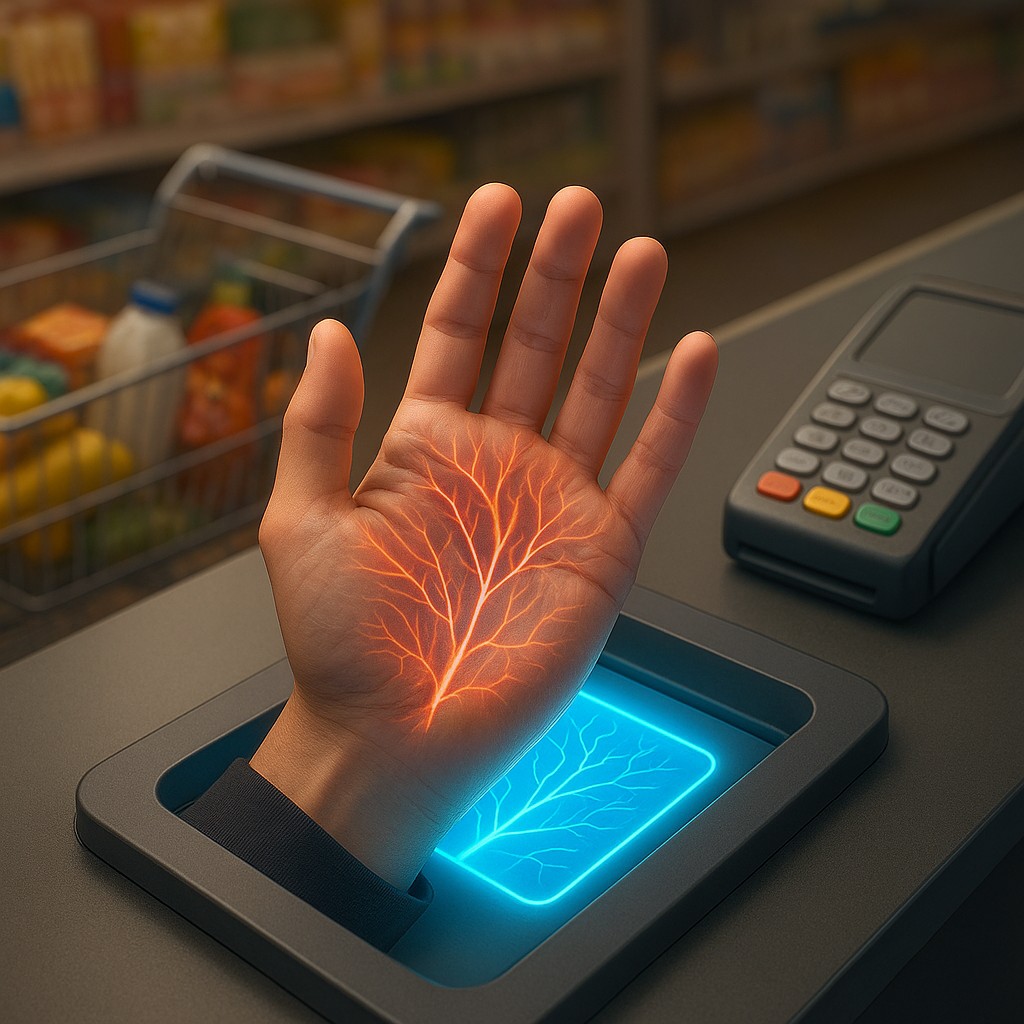
Imagine you are standing at the front of a grocery store line, ready to pay for a mountain of snacks and essentials. Instead of fumbling through your pockets for a wallet or hunting through your smartphone for a payment app, you simply hover your hand over a glowing sensor. In less than a second, the transaction is finished, and you are out the door. This sounds like a scene from a science fiction movie set in the year 2080, but it is already happening in modern stores. We are moving past passwords and plastic cards toward a world where your own body acts as your digital ID.
The magic behind this interaction is not just a high-definition photo of your palm. It is a sophisticated look beneath the surface. The scanner literally looks under your skin to find a map that is entirely unique to you. While we have grown used to using our faces to unlock phones or our fingerprints to enter secure buildings, those methods have weaknesses. For example, high-quality photos or "deepfakes" (AI-generated fakes) can trick facial recognition. Fingerprints can be copied from a coffee glass or smudged until they are unreadable. The blood vessels inside your hand, however, are a different story. They are hidden, complex, and nearly impossible to fake, making them the new gold standard for secure, easy shopping.
Moving from Physical Keys to Internal Biology
To understand why retailers are so excited about vein patterns, we first have to look at how we prove who we are. For decades, we relied on "what we have," like a physical key or a plastic credit card. Then, we moved toward "what we know," such as a PIN or a password. Now, we are moving toward "who we are," which is the world of biometrics (using body measurements for ID). While fingerprints were the first big step in this field, they are only the "front door" of biometrics. They are exposed to the world, get worn down, and are easy for others to see. Vein recognition, often called vascular biometrics, moves the security check to the "inner hallways" of the human body.
The patterns of veins in your palm are set before you are even born and stay mostly the same throughout your adult life. Even identical twins, who share the same DNA and often have very similar fingerprints, have entirely different vein structures. This uniqueness gives retailers a high level of confidence. They aren't just looking at the ridges of your skin; they are looking at a complex, three-dimensional internal highway system that is invisible to the naked eye. This makes it much harder for a criminal to "steal" your identity, as they would need to recreate the internal structure of your hand rather than just a surface image.
The Invisible Light That Proves Your Identity
The technology inside these scanners relies on a clever bit of physics using near-infrared light. Most people think of scanners as cameras that take a simple picture, but a palm vein scanner works more like a specialized flashlight. It shines near-infrared light, which is invisible to humans but reacts with your body in a specific way. As this light passes into your palm, it is absorbed by the deoxygenated hemoglobin in your blood. Hemoglobin is the protein in your red blood cells that carries oxygen. Once it delivers that oxygen to your body and heads back toward the heart, the way it absorbs light changes.
When the scanner's light hits this blood, the blood acts like a sponge, soaking up the infrared rays while the surrounding tissue reflects them. The resulting image captured by the sensor looks like a dark, branching map against a lighter background. This is not a simple photo that sits in a database. Instead, the system uses complex math to identify where veins cross, how thick they are, and the angles of the branches. This data is then turned into a unique code. When you scan your hand, the machine isn't comparing photos; it is checking if the "math" of your hand today matches the code linked to your account.
Making Sure You Are a Living Human
One of the biggest hurdles in biometric security is "spoofing." This is when someone tries to trick a sensor with a fake, like a silicone mold or a photograph. To stop this, these systems use "liveness detection." Because the scanner looks for how blood absorbs light, it requires blood to actually be flowing through a living hand. A static model, a fake limb, or a 3D-printed replica lacks the chemical and heat signatures of a living person.
Liveness detection is the secret ingredient that makes this technology more secure than a standard fingerprint reader. A fingerprint scanner basically checks for a shape; a vein scanner checks for a biological process. The system can detect your pulse and the way light scatters through living tissue. This ensures that the person at the checkout is a living, breathing human who is physically there. It effectively removes the risk of someone using a stolen "image" of your hand because the image alone won't trigger the sensor.
Comparing Biometric Methods
To see how palm vein scanning compares to the methods we already know, it helps to look at them side-by-side. Each method has its own strengths, but internal biometrics offer clear advantages in privacy and security.
| Feature |
Fingerprint |
Facial Recognition |
Palm Vein |
| Visibility |
External / Visible |
External / Visible |
Internal / Hidden |
| Ease of Forgery |
Medium (lifting prints) |
High (photos/deepfakes) |
Very Low (hidden inside) |
| Impact of Environment |
High (must be clean) |
Medium (lighting/glasses) |
Low (veins stay clear) |
| Ease of Use |
Low (must touch) |
Very Low (automatic) |
Low (hovering) |
| Privacy Feeling |
Common / Accepted |
Controversial / Tracked |
High / Privacy-focused |
As the table shows, palm vein technology hits a unique middle ground. It is fast and convenient like facial recognition but has the security of a hidden internal marker. Unlike facial recognition, which can sometimes feel like you are being "watched" by cameras, palm vein scanning is an intentional act. You choose to place your hand over the sensor, giving you control over when and where your identity is used.
Busting Myths About Biometric Storage
A common worry is that a company will keep a "database of hands" or a "folder of faces" that could be leaked in a hack. This is a major misunderstanding of how these systems work. For security and privacy, these systems almost never store actual pictures of your body. If a hacker broke into the server, they wouldn't find a gallery of palm photos. Instead, they would find long strings of encrypted numbers and letters that represent the math of your veins.
This process is called "one-way hashing." Once your vein map is turned into a mathematical code, it is nearly impossible to turn that code back into a picture of your hand. Furthermore, most systems use "template matching," where your data is tied only to that specific store's system. This means your "palm code" at a grocery store might be completely different from your code at a gym or an airport. This separation ensures that even if one database is hacked, your identity cannot be easily used to access other parts of your life.
The Architecture of a Digital Handshake
The journey from a wave of the hand to a finished payment involves a smart digital setup. When you first sign up, the system creates your "baseline" template. The scanner takes several readings to understand how your veins look from different angles or heights. This is important because no one holds their hand exactly the same way every time. The system needs to be flexible enough to recognize you if your hand is slightly tilted, but strict enough to reject someone who isn't you.
Once the template is encrypted and stored in a secure cloud, future checkouts are just high-speed comparisons. When you hover your hand at the register, the local scanner creates a temporary code. It sends this to the cloud, where it is compared against your stored template. Because these codes are very small, the comparison happens in milliseconds. This speed is the main reason stores like the technology; saving just two seconds per customer adds up to a massive increase in efficiency for a busy store.
Balancing Privacy and Convenience
While vein patterns are very secure, the social and ethical side is just as important. Retailers have to balance making life easier for customers with respecting their privacy. They do this through "opt-in" policies. Unlike surveillance cameras that might use facial recognition without your permission, palm vein systems require you to participate. You have to walk up to the device and decide to use it. This "active consent" is key to building public trust.
Additionally, the move toward "phone-free" technology speaks to a desire for more simplicity. In a world where we are always tied to our devices, being able to walk into a store, grab a coffee, and pay with a simple gesture feels more "human." We are no longer defined by the objects we carry, but by our own biology. This doesn't just improve security; it makes interacting with technology feel more natural.
The Future of Universal Identity
Looking ahead, using biometrics for checkout is likely just the beginning. Imagine a world where your palm doesn't just pay for groceries, but also acts as your boarding pass at the airport, your hotel room key, and your ID at the doctor's office. Because vein patterns are so hard to fake and so easy to check, they could eventually replace the dozens of cards and passwords that clutter our lives.
This shift requires us to rethink our relationship with our data. We are moving toward a "portable identity" where our bodies are the only ID we need. There is something poetic about the idea that the blood flowing through our veins, which keeps us alive, also secures our place in the digital world. It is a reminder that even in an age of computer chips, our most sophisticated security system is the one nature gave us.
The next time you see a glowing scanner at a checkout counter, you aren't just looking at a piece of store hardware. You are seeing a bridge between the physical and digital worlds. Embracing this technology means stepping into a future where security is seamless and a simple wave is all you need to navigate the world. As we perfect these biological "passwords," we move closer to a world where technology understands us at the most fundamental level.