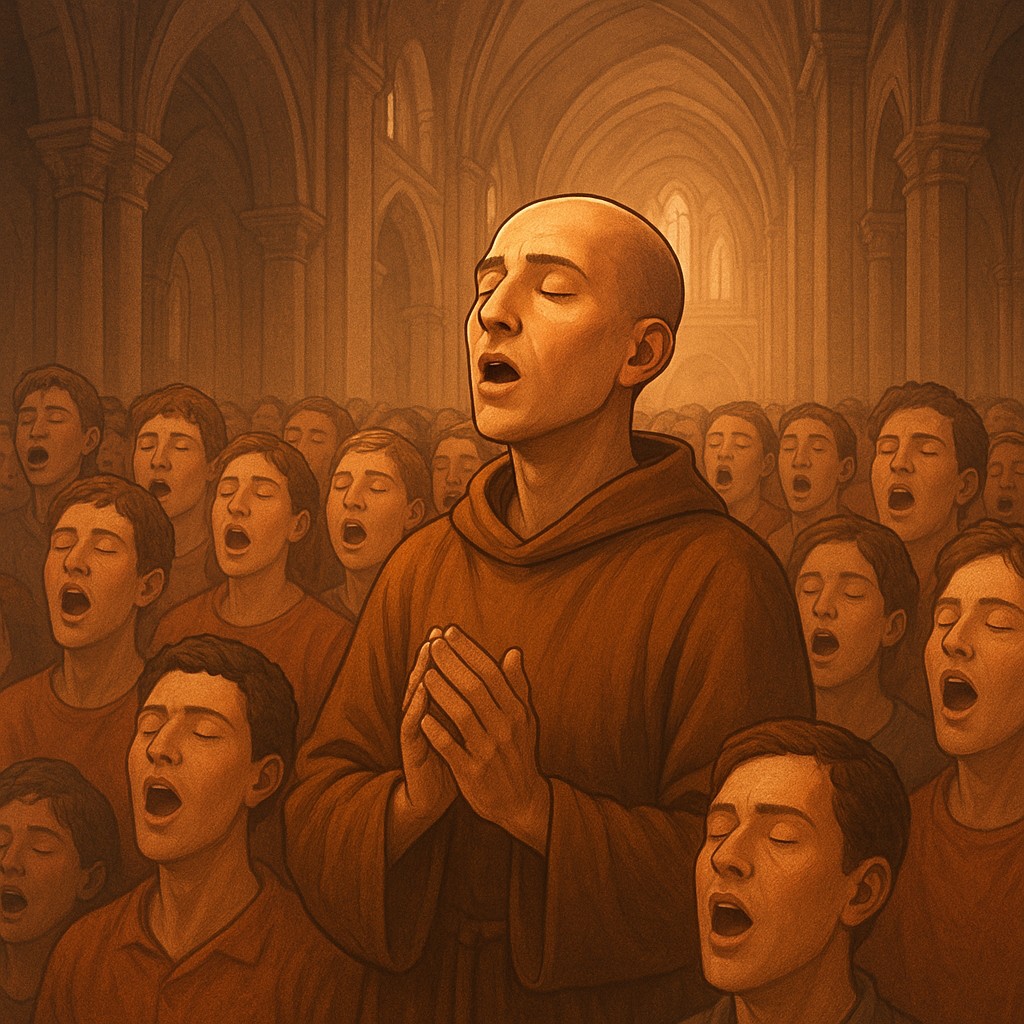
Imagine you are standing in a vast, ancient cathedral or a packed stadium. At first, the crowd is a chaotic collection of individuals, each with their own racing thoughts, unique resting heart rates, and independent breathing patterns. Then, a chant begins. It might be a monk leading a Latin prayer, a crowd at a soccer match roaring a rhythmic anthem, or a yoga class exhaling a long, resonant "Om." Suddenly, the air changes. You feel a strange sense of belonging, a warm wave of "oneness" that seems to dissolve the boundaries of your own skin. You might describe it as spiritual or emotional, but beneath that feeling, something deeply mechanical is happening to your ribcage and your nervous system.
This sensation is not just in your head; it is a literal, biological synchronization of the bodies around you. For centuries, religions and social groups have used rhythmic vocalization as a hidden technology to hack the human nervous system. By forcing a large group to speak or sing the same words at the same pace, these rituals impose a strict breathing pattern on every participant. Because our heart rates are intimately tied to our breath, these shared patterns act like a master conductor, tuning hundreds of individual hearts to beat in a single, unified rhythm. This process transforms a collection of strangers into a single, biological superorganism.
The Vagus Nerve and the Heart's Hidden Rhythm
To understand how a chant can control a heart, we first have to look at the elegant communication system between our lungs and our pulse. This is governed by a phenomenon called Respiratory Sinus Arrhythmia, or RSA. While it sounds like a medical scary story, RSA is actually a sign of a healthy, flexible nervous system. In simple terms, your heart rate is not a steady metronome. It naturally speeds up when you inhale and slows down when you exhale. This happens because of the vagus nerve, a massive "information highway" that runs from your brain to your heart and gut, acting as the primary brake for your nervous system.
When you take a breath in, your brain temporarily suppresses the vagus nerve, allowing your heart to speed up and circulate oxygen-rich blood more quickly. When you breathe out, the vagus nerve "steps on the brake," signaling the heart to relax, and your pulse drops. This constant push and pull creates a healthy variability in your heart rate. In a normal setting, everyone’s RSA is doing its own thing, dictated by how fast they are walking, their stress levels, or even how much coffee they drank. But when a ritual begins, the "script" of the ceremony takes over the controls of this biological brake.
Turning the Crowd into a Single Organism
When a group chants together, the structure of the text dictates exactly when every person must inhale and how long they must exhale. If you are reciting a long Sanskrit mantra or a traditional Catholic rosary, you are forced into a specific, repeating breathing pattern, often around six breaths per minute. This specific frequency is known as the "resonance frequency" for many adults, the point where the heart and lungs reach their peak efficiency. Because everyone is following the same "rhythmic code," their vagus nerves are suppressed and activated at the exact same moments.
The result is a room full of people whose heart rates are rising and falling in a shared wave. This isn't just a metaphor for unity; it is a measurable state of physical connection. Scientists using heart rate monitors on choir members found that as soon as they began to sing in unison, their heart rate graphs began to overlap until they looked like a single line. This synchronization bypasses our conscious minds. You don't have to "try" to connect with the person standing next to you; if you are both following the rhythm of the hymn, your bodies are already conversing at a level deeper than language.
The Chemistry of Collective Effervescence
Sociologists have long used the term "collective effervescence" to describe the electrified, joyous energy people feel during group rituals. While the concept was originally philosophical, we now know the neurochemistry that fuels it. When our bodies synchronize through shared breathing and rhythmic movement, the brain releases a cocktail of chemicals, most notably oxytocin. Often called the "bonding hormone," oxytocin reduces social anxiety and increases trust. It is the biological glue that makes us feel like we belong to a tribe.
This chemical release is a direct byproduct of the physical effort of chanting. The sustained exhalation required for singing or chanting stimulates the parasympathetic nervous system, which is the body's "rest and digest" mode. This creates a state of "relaxed alertness." You feel calm because of the slow breathing, but you feel exhilarated because of the social connection and shared focus. It is a potent combination that can make a religious service or a political rally feel life-changing. The ritual serves as a biological pacer, ensuring that everyone in the room enters the same emotional and physical "frequency" at once.
Comparing Individual vs. Synchronized States
| Feature |
Individual Autonomic State |
Synchronized Ritual State |
| Breathing Pattern |
Random, based on personal activity |
Rhythmic, dictated by the chant meter |
| Heart Rate Coupling |
Low (Independent pulses) |
High (Mirrored heart rate variability) |
| Primary Neurochemistry |
Variable (Cortisol, Adrenaline, etc.) |
High Oxytocin and Endorphins |
| Vagus Nerve Activity |
Irregular and reactive |
Periodic and rhythmic stimulation |
| Subjective Feeling |
Separation and self-focus |
Collective effervescence and unity |
The Mathematical Beauty of the Meter
The actual "code" that allows this to happen is the meter of the prayer or song. In poetry and music, meter refers to the rhythm of stressed and unstressed syllables. Ancient traditions seem to have intuitively discovered the "sweet spot" for human biology. For example, the rhythm of the "Ave Maria" in Latin or certain Buddhist mantras often aligns perfectly with a ten-second breathing cycle. This ten-second cycle (six breaths per minute) is the exact frequency that maximizes the baroreflex, the body's natural system for regulating blood pressure.
By designing rituals around these specific meters, ancient cultures effectively created a technology for public health and social stability. It wasn't just about the words being spoken, but about the specific physical demands those words placed on the body. A nursery rhyme may have a fast, bouncy meter that keeps kids engaged and energized, whereas a funeral dirge has a slow, agonizingly long meter that forces a communal state of quiet, reflective mourning. We are, quite literally, played like instruments by the structural design of the rituals we join.
Breaking the Barrier of the Self
One of the most fascinating aspects of this biological hack is that it works even if you don't necessarily believe in the specific ideas of the group. The body responds to the physical constraint of the breath regardless of the meaning of the words. This explains why people often report feeling "moved" by a religious ceremony in a foreign language, or why secular group chanting sessions have become so popular in modern societies. We have a fundamental, biological hunger for the feeling of synchronization.
In our modern world, we spend a massive amount of time in "de-synchronized" states. We sit in cubicles, stare at individual screens, and move at our own disjointed paces. This can lead to a sense of isolation and high levels of chronic stress, as our vagus nerves are rarely given a rhythmic workout. When we join a group and submit to a shared breathing pattern, we are given a brief vacation from the "ego." The self dissolves because the body is no longer acting as an individual unit; it has become a component in a larger rhythmic machine.
Designing Your Own Synchronous Moments
Once you understand the mechanism of collective effervescence, you start to see it everywhere. You see it in the way military cadences keep soldiers marching in step without tiring, and in the way some offices are experimenting with "breathing breaks" to improve team teamwork. You don't need a cathedral to access this state. You can find it in a small group of friends singing along to a song in a car, or even in a focused exercise class where the instructor coordinates every move with a collective breath.
The key is the shared constraint. If everyone is doing their own thing, the magic doesn't happen. There must be a "pacesetter" that everyone agrees to follow. This could be a drumbeat, a conductor, or the written rhythm of a poem. By consciously choosing to synchronize our physical output, we are choosing to bypass the intellectual friction that often keeps people apart. It is a reminder that, beneath our differing opinions and backgrounds, our nervous systems are all running on the same basic software, waiting for a shared rhythm to bring them into alignment.
The next time you find yourself in a crowd, whether it's at a concert, a church, or a protest, pay attention to the breath of the people around you. Notice when the group starts to speak or sing as one, and feel the way your own heart responds to that collective pressure. It is a powerful realization to know that your sense of "spirit" is actually your body performing a masterpiece of biological coordination. This knowledge doesn't make the experience any less beautiful; if anything, it makes it more wondrous to realize that we are built with the hardware to turn "me" into "us" through nothing more than a simple, shared breath.