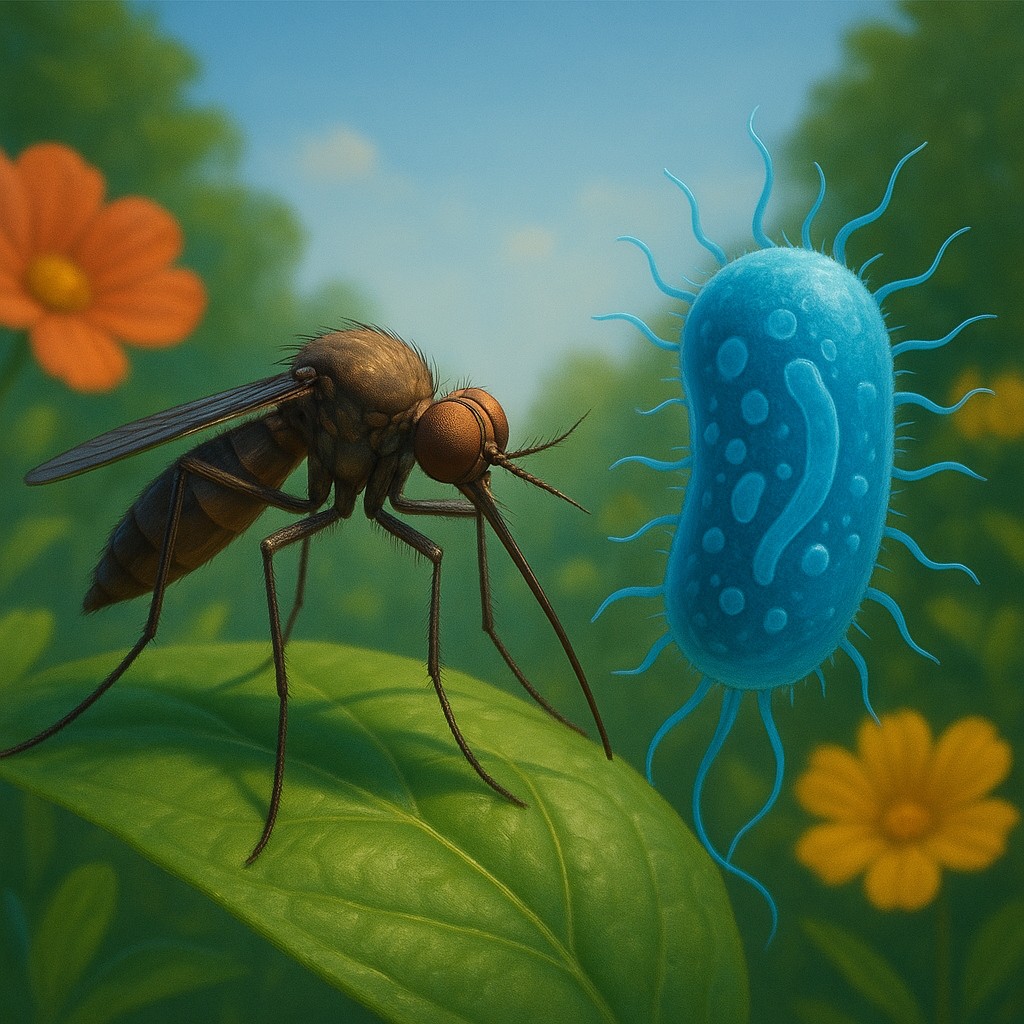
Imagine you are hosting a summer garden party. The snacks are ready, the music is playing, and the mood is perfect, until the uninvited guests arrive. We have all dealt with that high-pitched whine in our ear, followed by the frantic slapping at our ankles. For decades, our main defense against these tiny vampires has been a scorched-earth policy of chemical sprays and foggers. But while these poisons certainly kill mosquitoes, they are increasingly seen as a blunt instrument. They can linger in the soil, wash into the water supply, and, unfortunately, they do not always distinguish between a disease-carrying pest and a hardworking honeybee or a beautiful butterfly.
In recent years, scientists and health officials have shifted toward a strategy that feels like science fiction. Rather than poisoning the environment, they are deploying a microscopic secret agent to handle the job from the inside out. By using a specific type of naturally occurring bacteria, cities are now carrying out a highly targeted, biological "sting" operation. This method does not rely on toxic chemicals or genetic engineering. Instead, it uses a quirk of insect biology to crash mosquito populations with surgical precision. It is a masterclass in using nature’s own rules to solve a human problem.
The Microscopic Roommate with a Mission
The star of this drama is a bacterium called Wolbachia. While it sounds exotic, Wolbachia is actually one of the most common microbes on the planet. It is found in up to 60 percent of all insect species, including many butterflies, dragonflies, and moths. However, it does not naturally live in the Aedes aegypti mosquito, which is the main culprit behind the spread of diseases like Zika, dengue, and yellow fever. For researchers, this absence was a major opportunity. By introducing Wolbachia into these specific mosquitoes in a lab, scientists created a tool that works like a biological key that no longer fits the lock.
When a mosquito carries Wolbachia, the bacteria lives inside its cells and is passed down from mother to offspring. However, the real magic happens during mating. The bacteria essentially "reprograms" the male mosquito’s sperm. If a male carrying Wolbachia mates with a wild female that does not have the bacteria, a mismatch occurs. In simple terms, the sperm and egg are no longer compatible. The female will still lay her eggs, but they will never hatch. Since male mosquitoes do not bite (only females drink blood to produce eggs), releasing these "infected" males into the wild is a way to spread infertility without causing more bites for humans.
A Precision Strike Against the Urban Elite
One of the biggest advantages of this method is how specific it is. Unlike traditional pesticides that create a "kill zone" for almost any insect nearby, the Wolbachia method only affects one species. Because the system relies on the act of mating, it only impacts the exact type of mosquito the lab-raised males pursue. If a city releases Aedes aegypti males, those males have no interest in mating with a bumblebee, a ladybug, or even a different, harmless species of mosquito. This makes it an incredibly "green" technology that protects the local ecosystem while removing a high-risk pest.
It is also vital to know which mosquitoes are being targeted. There are thousands of species worldwide, and many play important roles in the food chain as snacks for birds, bats, and fish. Most of these species do not bother humans at all. Wolbachia programs focus almost entirely on "urban" mosquitoes, the ones that have evolved to live in crowded human environments, breeding in discarded tires and flowerpots. By targeting only these disease carriers, health officials can protect people without causing a ripple effect that hurts local wildlife.
The Logistics of a Mosquito Factory
You might wonder how many mosquitoes it takes to make a difference in a city’s population. The answer is: a lot. To make this work, agencies run specialized facilities that are essentially "mosquito factories." These labs breed millions of mosquitoes, making sure they are all healthy and carrying the Wolbachia bacteria. The most critical step is sorting them. Using high-tech automated systems, the labs separate the males from the females. Because only the males are released, and males do not bite, people do not have to worry about extra itchy welts during the process.
Once the males are sorted, they are transported to target neighborhoods. Some programs use specialized trucks with tubes that "puff" mosquitoes into the air, while more advanced trials have used drones to drop biodegradable capsules filled with mosquitoes over hard-to-reach areas. The goal is to flood the "mating market." If a wild female is surrounded by 50 lab-released males for every one wild male, the odds of her having babies plummet. Over several weeks of steady releases, the birth rate of the local population falls off a cliff.
| Feature |
Traditional Chemical Spraying |
Wolbachia-Based Control |
| How it Works |
Neurotoxins that kill on contact |
Reproductive mismatch |
| Target Range |
Broad (affects many insect types) |
Narrow (only the target species) |
| Environmental Impact |
Possible water and soil runoff |
No chemical residue left behind |
| Human Interaction |
Residents must stay indoors |
No change to daily life |
| Duration of Effect |
Short-term (requires re-spraying) |
Can lead to long-term population crash |
| Public Nuisance |
No increase in insects |
Temporary increase in non-biting males |
Solving the Sustainability Puzzle
While chemical sprays offer instant results, they often lead to a "rebound" effect. Mosquitoes are masters of evolution; over time, they frequently develop resistance to the chemicals we use against them. This forces us to develop even stronger, more toxic formulas, creating an arms race between human chemistry and insect biology. The Wolbachia method takes a different approach. Because the eggs simply do not hatch, there is nothing for the mosquitoes to grow "resistant" to. You cannot develop an immunity to not being born.
Furthermore, depending on how the bacteria is used, the results can sustain themselves. In some versions of the program, scientists release both males and females carrying Wolbachia. In these cases, the goal isn't to crash the population but to "replace" it. Since Wolbachia-infected mosquitoes are less capable of carrying and passing on viruses like dengue, a population that is 100 percent Wolbachia-positive becomes harmless to people. This "replacement" strategy has seen incredible success in places like Indonesia and Singapore, where dengue rates have dropped by over 70 percent.
Addressing the "Franken-Skeeter" Phobia
Whenever humans interfere with how animals reproduce, questions about ethics and safety naturally come up. It is easy to see why some people might feel uneasy about thousands of lab-raised insects being released in their backyard. However, it is important to clarify that this is not "genetic modification" (GMO) in the traditional sense. These mosquitoes have not had their DNA rewritten in a lab. Scientists are simply introducing a bacteria already found in nature into a new host. It is more like giving the mosquitoes a specific probiotic that changes their reproductive compatibility.
Extensive testing by organizations like the EPA and the CDC has shown that Wolbachia is safe for humans, pets, and the environment. The bacteria cannot be passed to humans through a bite (even if a female were accidentally released), and it cannot survive in the blood of mammals. Once a Wolbachia-infected mosquito dies, it simply breaks down like any other insect. By choosing a biological solution over a chemical one, we are moving toward a more natural form of pest control, one that respects the complexity of our ecosystems rather than trying to overpower them with synthetic compounds.
The Future of Living With Our Neighbors
The shift toward Wolbachia-based mosquito control represents a bigger trend in how we interact with the world. We are moving away from the "command and control" mindset of the 20th century, where we tried to dominate nature through force. Instead, we are entering an era of "biological diplomacy," where we study the relationships between microbes and their hosts to find clever, low-impact solutions to our health challenges. It is a smarter, quieter, and more effective way to live.
As you think about the future of our cities, imagine a world where the air is free of chemical mists and the buzz of a mosquito does not carry the threat of a hospital stay. By understanding the microscopic world of Wolbachia, we have found a way to reclaim our summers without harming the planet. This blend of high-tech logistics and ancient biology shows that sometimes the best way to solve a giant problem is to look at the very smallest things. It reminds us that with a little curiosity and a lot of science, we can create a world that is safer for humans and healthier for the nature around us.