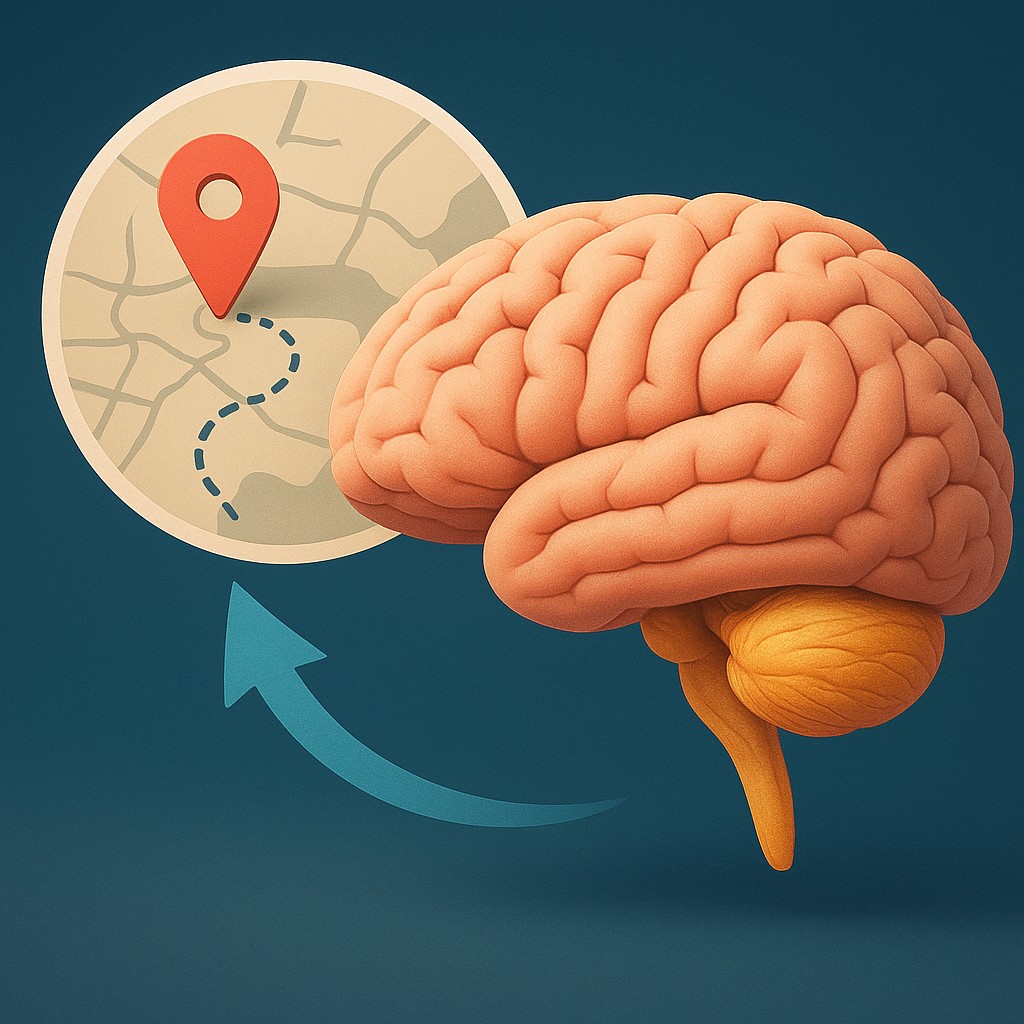
Think back to your first day of high school. You probably do not remember the exact date or what was on the lunch menu, but you can likely see the heavy metal lockers, smell the gym, and picture the exact path you took from the front door to your homeroom. This is not a coincidence or a trick of nostalgia; it is how your brain is naturally programmed to work. We like to think of our memories as a digital database organized by dates or categories, but your brain actually acts more like a primitive scout trekking through the wilderness. It saves information by pinning it to a map.
This explains why you might walk into the kitchen and immediately forget why you went there, only to have the answer hit you the moment you sit back down at your desk. Your brain linked that specific thought to the physical layout of your office chair. When you left that space, you essentially unplugged the "spatial index" that held the memory in place. To understand how we learn, we must first realize that our brains did not evolve to pass multiple-choice tests or memorize spreadsheets. They evolved to find the watering hole and remember which specific bushes grow the poison berries.
The Evolutionary Surveyor in Your Skull
The part of the brain mainly responsible for your memories is the hippocampus, a curved structure tucked deep inside the temporal lobe. For decades, scientists saw the hippocampus as a general record keeper, but recent research suggests its original job was navigation. In the early days of mammalian evolution, survival meant knowing exactly where you were in relation to predators and resources. As our brains became more complex, we did not develop a completely separate system for abstract thinking. Instead, we "hijacked" the existing navigation system to store things like names, facts, and experiences.
Inside the hippocampus, there are specialized neurons called place cells. These cells do not fire at random; they act like a biological GPS. One specific place cell might fire only when you are standing in your kitchen, while another fires only when you are at your front door. When you experience something new, your brain does not just record the event; it records it alongside the place cells that are currently active. This creates a neural "stamp" that glues the fact to the location. Essentially, your brain treats every memory as a destination on a map, making it much easier to find later when you mentally "return" to that spot.
Mapping the Architecture of Thought
If place cells mark the "stops" on your mental journey, another group of neurons called grid cells provides the coordinate system. Discovered more recently, grid cells act like a hexagonal floor tiling that covers your environment. They allow you to understand distance and direction even when you are in total darkness. Together, place cells and grid cells create a high-resolution spatial index. When you learn that Paris is the capital of France while sitting in a coffee shop, your brain builds a link between "Paris," the coordinates of that velvet armchair, and the smell of roasted beans.
This spatial indexing system is incredibly tough because it allows for "relational" memory. If you store information in a straight line, like a list, losing one link in the chain can cause you to lose everything that follows. However, if you store information spatially, you can reach the data from many directions. You might remember a conversation because you recall the park bench where it happened, or you might remember the bench because you recall the talk. This multi-dimensional filing system is the reason humans are much better at navigating complex physical environments than they are at memorizing long strings of random numbers.
The Cognitive Cost of Sameness
While our spatial indexing system is an evolutionary masterpiece, it has a major modern weakness: the office cubicle. In the natural world, every day involved moving through different terrains, which gave the brain a steady stream of new "spatial anchors" to pin memories to. Today, many of us spend eight hours a day in the same chair, looking at the same monitor, in the same neutral-colored room. When your environment never changes, your place cells and grid cells stay mostly still.
This creates a problem called proactive interference, where new memories struggle to find a unique "hook" because the location is identical to a thousand other memories. If you study for chemistry, history, and Spanish all at the same desk, your brain may accidentally store all that information in the same mental drawer. When you try to remember Spanish vocabulary, your brain might pull up the periodic table instead because they are both pinned to the same corner of your office. This is why "changing your scenery" is more than just a cliché; it is a neurological requirement for building distinct memories.
| Memory Feature |
Chronological Filing (List-Based) |
Spatial Indexing (Map-Based) |
| Main Organizing Principle |
Time and Sequence |
Physical Location and Context |
| Retrieval Method |
Recalling what happened before or after |
Visualizing the environment |
| Failure Mode |
Forgetting one link breaks the chain |
"Doorway Effect" (losing context) |
| Best Use Case |
Short-term schedules or routines |
Long-term complex concepts |
| Modern Barrier |
Too much data to manage |
Static, unchanging environments |
Mastering the Method of Loci
The most famous use of spatial indexing is the "Memory Palace," or the Method of Loci. Ancient Greek speakers, who had to give hours-long speeches without notes, realized they could "place" parts of their speech in a familiar building. They would mentally walk through their own home, "leaving" the introduction at the front door, the first argument on the dining table, and the conclusion on the bedside lamp. When it was time to speak, they simply took a mental stroll through the house. Their hippocampus would naturally fire the place cells for each room, which triggered the memory of the speech segments.
You can use this same trick today. If you have a complex project to learn, try "placing" different parts of it in different rooms of your house or at different stops on your commute. By consciously tethering data to a physical layout, you are working with your brain's natural hardware rather than trying to force it to act like a computer chip. This is also why we struggle so much with digital folders and files; there is no "space" on a computer screen. Everything looks and feels the same, which robs the hippocampus of the spatial clues it needs to organize your digital life.
Navigating the Doorway Effect
We have all experienced the "Doorway Effect." You are in the living room, you realize you need your phone charger from the bedroom, you walk through the door, and suddenly you are standing there with no idea what you came for. Researchers have found that doorways act as "event boundaries" in the brain. When you move from one room to another, the brain notices the change in context and essentially "flushes" its current memory to make room for the new environment. Your hippocampus assumes that whatever you were thinking about in the living room is no longer relevant now that you are in the bedroom.
To fight this, you can use "mental tethering." Before you walk through a door, repeat your goal to yourself or picture the object in the new room. By doing this, you load the memory into the new spatial index before you even arrive. This also helps in meetings. If a group moves from a conference room to a breakout area, expect people to forget things during the move. It is always smart to recap the main points once everyone has settled into the new space to make sure the spatial index is updated.
The Future of Spatial Learning
As we move further into the digital age, the tension between our stationary lives and our "nomadic" brains will grow. This is why technologies like Augmented Reality (AR) show so much promise for teaching. Unlike a flat screen, AR allows us to "place" digital information in 3D space. Imagine learning anatomy by walking around a life-sized, 3D model of a human heart in your own living room. By using your place cells to map the heart's valves and chambers as if they were furniture, the information is much more likely to stick.
However, we do not need high-tech headsets to improve our memory. We simply need to respect the hippocampus. This means taking different routes to work, studying in different libraries, or even just rearranging your furniture now and then to give your brain a "fresh map" to work with. When we give our brains spatial variety, we provide the scaffolding needed for complex thought. By treating your mind as a landscape to explore rather than a bucket to fill, you unlock your full potential.
Your brain is not a dusty filing cabinet; it is a sophisticated, living map of every place you have ever been and every person you have ever met. Every time you step into a new environment, you are opening a new notebook, ready to be filled with the sights, sounds, and ideas of that moment. By leaning into this spatial instinct, you can stop fighting your biology and start using it to your advantage. Go for a walk, sit in a different chair, or take your book to the park. Your hippocampus will thank you by holding onto those memories with a grip that a simple list could never match. There is a magnificent world out there waiting to be mapped, and your brain is the perfect tool for the journey.