Why the story of the universe feels important, and why the Big Bang is not just abstract science
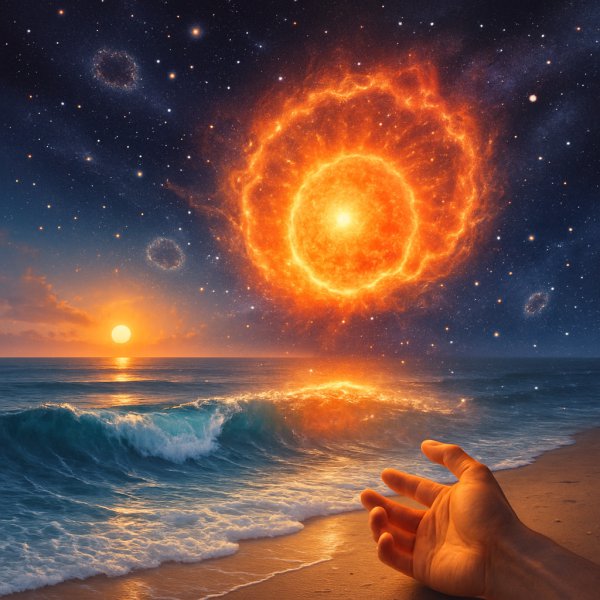
Imagine standing at a beach, watching waves roll in, and realizing each wave remembers an instant when the ocean was smoother, simpler, quieter. The Big Bang is the scientific version of that memory: it is our best account of how the universe looked and behaved when it was far simpler and far hotter than anything we observe today. That matters not only because it answers the question of how everything started to take shape, but because it connects the atoms in your hand to processes that played out 13.8 billion years ago. Thinking about the Big Bang is thinking about your deepest family history, written in light and gravity.
Most people picture the Big Bang as a bomb that blew up inside empty space. That image is misleading, but also humanly compelling. The real picture is subtler and stranger: space itself was once much smaller, and it expanded, carrying everything with it. Because that expansion left measurable traces - a faint glow of microwaves, characteristic element abundances, and galaxies racing away from one another - scientists can test hypotheses about the universe’s birth. Learning this gives you tools to tell apart confident scientific claims from myths, to appreciate a surprisingly testable story about something that seems untestable, and to see how curiosity and precise measurements make the biggest questions addressable.
If you like stories that are both poetic and evidence-based, you will love the Big Bang. It is a tale told with math and telescopes, with microwave receivers and particle colliders, and with analogies that fit in your kitchen. The goal here is to take you from familiar intuition to the core ideas and evidence, clear up common misunderstandings, and leave you with concrete ways to explore further. By the end you should be able to explain the Big Bang to a friend, carry out a simple thought experiment that captures the idea, and know where to look for deeper learning.
What scientists mean when they say "Big Bang" - not an explosion, but an expanding story
When astronomers say "Big Bang," they refer to a model that describes how the universe expanded and cooled from a hot, dense state. It is not an explosion in preexisting space; rather, space itself was compact and has been stretching. A handy analogy is a loaf of raisin bread as it bakes. The raisins represent galaxies, and as the dough expands, every pair of raisins moves away from each other. There is no single raisin that sits at the center - the expansion is everywhere.
The model rests on Einstein's theory of general relativity, which links energy, mass, and the geometry of space. That geometry can expand, contract, or curve, depending on the contents of the universe - matter, radiation, dark matter, and dark energy. The Big Bang describes the evolution of that geometry backward in time to a very hot, dense phase where particles, radiation, and the rules that govern them were in extreme forms. Modern cosmology does not claim to know absolutely everything about the very first instant. Instead, it gives a reliable picture for what happened from a tiny fraction of a second after the hot dense phase forward.
An important point is that "Big Bang" is a model, not a single final answer. Scientists refine it as new evidence arrives. For example, the idea of cosmic inflation, a brief burst of hyper-rapid expansion, was added to explain specific features that the original model left unexplained. New data can confirm, refine, or replace parts of the model, just as in all good science.
Four pillars of evidence - why the Big Bang stands on more than imagination
The Big Bang model is supported by multiple, independent observations that converge on the same story. First, we observe that galaxies are receding from us, with more distant galaxies moving away faster, a relationship known as Hubble's law. That is exactly what you expect if space is stretching; you do not need to imagine galaxies racing through space, they are carried away as the fabric of space grows.
Second, there is the cosmic microwave background, or CMB. This is a faint glow of microwave radiation present in every direction on the sky, discovered in 1965. The CMB is the remnant heat from the early universe, cooled to just 2.7 Kelvin by the expansion. Its very uniform blackbody spectrum is exactly what the Big Bang predicts if the early universe was hot and in thermal equilibrium.
Third, the Big Bang explains the abundance of light elements: hydrogen, helium, deuterium, and traces of lithium. Within the first few minutes, nuclear reactions forged these elements. Observed proportions match the predicted values remarkably well, which is strong evidence that the universe once passed through a hot, dense phase suitable for such reactions.
Fourth, the large-scale distribution of galaxies and the tiny temperature variations in the CMB fit the predictions of a universe that started almost uniform but contained minute quantum fluctuations. Those fluctuations were amplified by gravity to become the cosmic web we see today. When independent methods - like galaxy surveys and CMB measurements - line up on these features, the case for the Big Bang model becomes robust.
A compact timeline of the universe’s earliest acts, summarized for quick memory
Below is a simple table that captures the major phases of the early universe. It compresses vast changes into digestible milestones so you can picture the sequence without getting lost in numbers.
| Time after the start (approximate) |
Temperatures and conditions |
What happened and why it matters |
| 10^-43 seconds |
Planck-scale, unknown physics |
Our current theories break down; quantum gravity needed |
| 10^-36 to 10^-32 seconds |
Extremely hot, inflation epoch |
Space expanded enormously in a tiny fraction of a second, smoothing and stretching tiny fluctuations |
| 10^-6 seconds to 1 second |
Hot soup of quarks and gluons |
Quarks combined into protons and neutrons as the universe cooled |
| 1 second to 3 minutes |
Billion-degree plasma |
Neutrons and protons fused to form light nuclei - Big Bang nucleosynthesis |
| 380,000 years |
~3000 Kelvin, transparent |
Electrons combined with nuclei to form neutral atoms, photons decoupled - this produced the CMB |
| 100 million to 1 billion years |
Cooling, structure formation |
First stars and galaxies formed, reionization of the universe began |
| 9 billion years onward |
Dark energy dominated era |
Expansion accelerates, shaping the present cosmic landscape |
This table is simplified, but it helps you frame what each phase accomplished: making the particles, building the atoms, releasing the fossil light, and knitting together galaxies.
What the first moments might have looked like, told without equations
The early universe started hot enough that particles we now treat as distinct were tangled together. In the first microseconds, protons and neutrons formed from quarks. A few minutes later, light nuclei popped out of the nuclear dance during Big Bang nucleosynthesis. For several hundred thousand years the universe was opaque, because free electrons scattered photons constantly. Once the universe cooled enough for electrons to attach to nuclei - a process called recombination - photons could travel freely, and that light is what we now observe as the CMB.
Before recombination, the universe was like a foggy soup of light and charged particles; afterward, it became a transparent stage on which gravity could sculpt dark matter and baryons into stars and galaxies. Tiny quantum fluctuations that had been stretched during inflation provided the seeds for structure. Over hundreds of millions of years, gravity amplified those seeds into the first stars, which lit up the universe and began producing heavier elements that make planets and life possible.
Though the narrative above feels continuous, our understanding has gaps. The earliest, tiniest fractions of a second are where quantum gravity likely matters. Physicists have plausible ideas, such as inflation and various quantum gravity proposals, but these are active research areas. The Big Bang model shines most strongly for times after inflation or about 10^-32 seconds and onward, where predictions meet observations.
Myths and clarifications that keep the conversation honest
One persistent myth is that the Big Bang was an explosion at a point, which implies a center. That is false. The Big Bang happened everywhere, and every point in space was in that hot, dense state. There is no special center in the observable universe. The “center” idea comes from applying everyday intuition about explosions to a phenomenon that concerns space itself.
Another misconception is to think the Big Bang explains the absolute origin of everything, including why there is something rather than nothing. The Big Bang model describes how the universe evolved from a hot, dense state, but it does not by itself explain why that state exists or what, if anything, preceded it. Questions about "before" the Big Bang often require speculative physics, and current observations cannot yet confirm those speculations.
People sometimes conflate inflation and the Big Bang. Inflation is a proposed epoch of extremely rapid expansion that likely occurred very early on. It is part of many modern Big Bang models because it explains the uniformity of the CMB and the flatness of space-like geometry. However, inflation is not strictly required for a minimal Big Bang scenario; it is an extension that solves specific problems and makes new predictions which are testable.
Finally, the word "singularity" is often thrown around as if it is a physical thing. In cosmology, singularity means the equations we have cease to give predictions. It signals that our models break down at extreme conditions, and that a better theory, probably incorporating quantum gravity, is needed to describe the earliest instants.
How astronomers and physicists read the infant universe - instruments and approaches
Studying the Big Bang is a multidisciplinary detective story that uses telescopes, satellites, particle accelerators, and theory. Space missions like COBE, WMAP, and Planck measured the cosmic microwave background with increasing precision, revealing not just its temperature but tiny variations that encode the seeds of structure. Large ground-based telescopes and galaxy surveys map the distribution of galaxies across the sky, showing how structures grew over billions of years.
Particle accelerators like the Large Hadron Collider explore conditions similar to those a fraction of a second after the Big Bang by producing high-energy collisions. While accelerators do not recreate the universe’s exact conditions, they let scientists probe the fundamental particles and forces that would have been important early on. Gravitational wave observatories add a new sense - potential signals from the early universe could reveal dramatic events like phase transitions or cosmic strings, if present.
Theoretical work ties measurements together and makes predictions. The interplay between data and theory is a hallmark of cosmology: when observations do not match predictions, models evolve. That iterative process is why the Big Bang is strong science, not mythology.
Simple, tangible ways to explore and think like a cosmologist right now
You do not need a PhD to play with the core ideas of the Big Bang. Here are practical, fun steps you can try at home or online to build intuition and curiosity.
- Do the raisin-bread or balloon experiment. Put dots on an inflated balloon, then blow it up. Notice how all dots move away from each other, and how there is no center dot on the surface. This demonstrates how expansion can occur without a central explosion.
- Use free planetarium software like Stellarium or online simulations such as Universe Sandbox to watch structure formation over cosmic time. Seeing galaxies assemble from tiny fluctuations is very clarifying.
- Explore the Planck mission data viewer and simple CMB maps online. Even without technical training, you can see the CMB’s tiny hot and cold spots and read about what they imply.
- Join a citizen science project like Galaxy Zoo. Classifying galaxies not only teaches you morphology, but it also connects you to real research.
- Read or listen to accessible books and podcasts. Start with "A Brief History of Time" by Stephen Hawking for historical context, then "The First Three Minutes" by Steven Weinberg for a classic but approachable narrative, and look for recent podcasts that interview working cosmologists.
Try turning one idea into a short explanation you can deliver in 90 seconds. Teaching someone else is one of the fastest ways to cement your own understanding.
Reflection prompts to sharpen your grasp and spark curiosity
- If space can expand, what happens to the distances between familiar objects like the Earth and the Sun over cosmic time? Does local gravity change that picture?
- Imagine you could send a probe far away and wait billions of years. How would the night sky look to an observer in a distant galaxy today, and what would that tell them about our universe?
- Which piece of evidence for the Big Bang do you find most convincing, and why? Can you think of an observation that would seriously challenge the model?
- How does the idea that tiny quantum fluctuations became entire galaxies alter your sense of scale and causation?
Pause and write brief answers to these; they help move your knowledge from passive to active.
Why the Big Bang matters beyond facts - meaning, curiosity, and practical spin-offs
Understanding the Big Bang changes your perspective on time, causality, and human significance. It reveals that the atoms in your body were once seared by cosmic fires and later forged in the hearts of stars, linking you to a grand physical narrative. The methods used in cosmology - precise measurement, statistical inference, and theory testing - are the same skills that drive progress in many fields.
Practically, technologies developed for cosmology have cross-pollinated into other areas. Instrumentation for sensitive detectors, data analysis methods for huge surveys, and computational models are useful in medicine, communications, and environmental science. But perhaps the most useful outcome is cultural - the humility and wonder that follows from knowing the universe is intelligible, at least in part.
Final nudge - how to keep learning and enjoy the journey
If this topic has ignited even a spark of wonder, give yourself a small, structured next step. Pick one of the activities listed above and schedule 30 minutes to experiment with it this week. If you like reading, choose one accessible book and commit to a chapter every few nights. If you prefer hands-on, the balloon and Universe Sandbox activities will repay your time with aha moments. Remember, understanding the Big Bang is not about memorizing dates and temps, it is about connecting simple physical ideas to observable consequences.
The Big Bang story shows how modern science turns speculative questions into testable, sometimes surprising answers. It invites you to think big, to test assumptions, and to enjoy the combination of imagination and evidence. Keep asking questions, keep pushing for clarity, and let the universe’s origin story remind you that curiosity, pursued patiently, is extraordinarily powerful.