<h2>A fifteen-minute clash that changed a continent: why the Plains of Abraham still matter</h2>
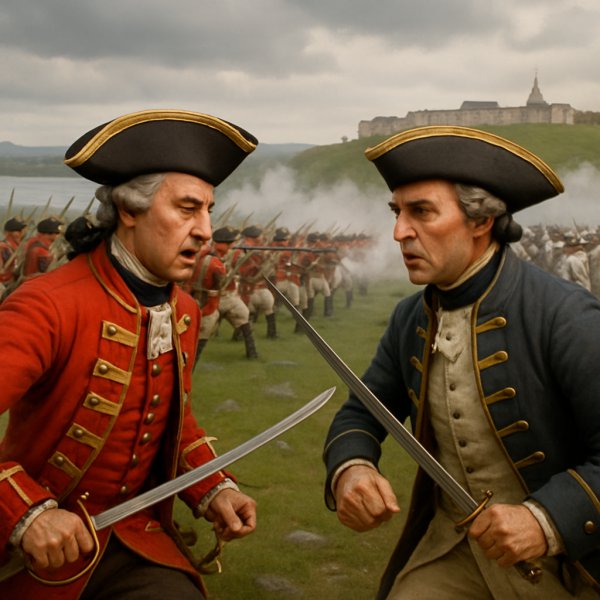
Imagine standing on a gentle, grassy plateau above a wide river, picnic blankets, joggers, children with bright kites. Now picture, instead, the same place on a gray September morning in 1759, muskets and bayonets glinting, bugles nervously stuttering, two armies about to collide in a fight that would decide who ruled much of North America. The Battle of the Plains of Abraham was famously brief - many accounts say the fighting lasted no more than fifteen to twenty minutes - yet its consequences rippled for generations. It is one of those rare moments when a short, violent event accelerates the fate of empires, peoples, and languages.
This narrative will take you from the global contest in which the battle was embedded to the intimate scenes on the field, and then outward again to explain how a rocky plateau above the St. Lawrence River reshaped the political and cultural future of what became Canada. Along the way you will meet two very different generals, explore the tactics and missteps that decided the day, confront myths and misconceptions, and be offered practical ways to learn more or visit the site yourself. I will strive to be both precise and convivial, like a friend with a very readable history book under one arm and a fondness for witty footnotes.
<h3>Why Quebec mattered in the mid-18th century - the prize on the St. Lawrence</h3>
Quebec was not merely a charming colonial city with a superior view. In the 18th century it was the linchpin of French power in North America. The St. Lawrence River was the continent’s great highway; control of Quebec meant control of access to the interior fur trade, to the rich fisheries of the Atlantic, and to a network of alliances with Indigenous nations. New France was smaller in population than the British colonies, but its economy and military posture relied on strategic fortresses, educated diplomacy with Indigenous allies, and crucially, naval support from France. Lose Quebec, and the French route to reinforcements and supplies was jeopardized.
For the British, the capture of Quebec offered far more than a victory on a map. It promised to remove a rival foothold, to open the interior to British traders and settlers, and to block French influence among Indigenous nations. The British naval superiority on the Atlantic made the capture of coastal or river-locked strong points the most effective way to sever colonial lines. Thus, Quebec became the target of a carefully executed campaign during the global conflict of the Seven Years’ War, which in North America is often called the French and Indian War.
<h3>A wider war - the global and local stakes of 1759</h3>
The Plains of Abraham did not spring from local grudges alone. They were a chapter in a worldwide struggle between Britain and France that encompassed Europe, the Caribbean, India, and the Americas. By 1759 the war had become a contest of maritime power and logistics. British fleets could blockade French ports, cut off reinforcements, and move troops with the relative ease that only sea power enables. The result was that pivotal battles in North America often hinged on naval control of the St. Lawrence and the Atlantic approaches.
Locally, alliances mattered. Indigenous nations were not passive bystanders; many exercised agency by allying with the French or the British based on long-standing relationships, trade ties, and strategic interests. The French, though outnumbered in settler population, had strong relations with many First Nations and relied heavily on them for scouting and raiding. British tactics had to adjust between set-piece European-style battles and the irregular warfare of frontier skirmishes. The Siege of Quebec and the subsequent battle were therefore not merely military maneuvers - they were political moves in a larger chess game.
<h2>The two men on the hill - Montcalm and Wolfe, contrasts in character and command</h2>
Charles-Louis de Montcalm stood as a quintessential 18th-century French general - noble-born, experienced in European warfare, and respectful of the old rules of honor. He had a reputation for courtesy and bravery, and he had built his strategy around the strengths of his forces - fortifications, fluency with Indigenous allies, and the use of the city’s terrain. He believed in methods that, in his experience, had brought success: disciplined lines, fortified positions, and judicious diplomacy.
James Wolfe was younger, hard-driving, and informed by a different military sensibility. He was an officer who understood the strengths of the British army’s firing discipline and close-order volley fire, and he had a knack for bold, unexpected moves. Wolfe also had a reputation for being sharp and exacting, which won him loyalty as well as resentment. He was acutely aware that time and morale were crucial variables; he sought not merely to besiege but to compel a decisive confrontation that would render the French resistance untenable.
Their personalities mattered. Montcalm’s caution and concern for civilian lives sometimes made him reluctant to engage in the kind of aggressive manoeuvres that Wolfe favored. Wolfe’s insistence on bold action translated into a daring night operation that brought his forces up onto the Plains. Both men were well aware that the stakes were immense. It is a melancholy historical irony that both would be fatally wounded by the end of the day.
<h3>How the British climbed the cliff - the siege, the night landing, and the Anse-au-Foulon</h3>
The British, having failed in an earlier landing at Beauport, needed an alternative. The St. Lawrence’s currents, cliffs, and wind made landings perilous, but on the night of September 12-13, 1759 British boats slipped quietly past Quebec’s sentries and made for a modest inlet called Anse-au-Foulon. This was not a flashy amphibious assault; it was a careful ascent of a narrow, beaten path up the escarpment behind some French positions. The British moved with surprising steadiness, carrying their cannon and their officers, and by dawn they had formed on the plateau above the city, a position that surprised Montcalm.
Montcalm had not expected the British to be able to disembark and organize on such ground without being detected earlier. Once he realized Wolfe’s force had established a defensive line on the Plains, he felt compelled to attack, partly because the city was at risk and because the presence of a prepared British army left him little choice if he wanted to keep the initiative. The ensuing engagement would test not only firepower but command decisions made under stress.
<ul>
<li>Critical moments: the quiet night landing at Anse-au-Foulon; the formation of British lines at dawn; Montcalm’s decision to attack rather than wait for reinforcements; the British steady volley fire.</li>
<li>Key question to ponder: had the British been detected during the landing, could Montcalm have blunted the attack with fortifications and artillery aimed uphill - or would the naval fire support have changed the calculus?</li>
</ul>
<h2>What happened on the field - a tight, disciplined clash that ended with both commanders mortally wounded</h2>
The battle itself is often described as astonishingly swift. Wolfe had organized his troops into disciplined lines, taking advantage of British advantages in volley fire and drill. When Montcalm ordered a counterattack, his troops - a mix of French regulars, colonial militiamen, and Indigenous allies - advanced in their customary manner, but they were met by controlled, devastating British volleys. The British fire broke the French columns, which then faltered under successive attacks.
In the heat of the struggle both Wolfe and Montcalm were struck. Wolfe was mortally wounded on the battlefield, yet he remained upright enough to learn of the British success before he died. His reputed last words were pious and triumphant - variations of "Now, God be praised, I will die in peace" - words that have been recorded by contemporaries and popularized by later writers. Montcalm, taken to a nearby house, also died of his wounds the same night, reportedly asking to be buried with military honors rather than suffer the humiliation of a public execution - an image that fed the tragic romance around the duel of commanders.
The fight’s outcome was decisive. The British occupied the plateau and effectively held the city. French casualties and the capture of remaining forces in the ensuing weeks tipped the strategic balance. Yet it is worth stressing that the immediate victory was not permanent peace. The French would counterattack at Sainte-Foy in 1760 and win a battlefield engagement, but naval relief did not arrive for New France in time, and siege after siege exhausted French capacity to hold Quebec.
<table>
<tr>
<th>Aspect</th>
<th>British</th>
<th>French</th>
</tr>
<tr>
<td>Commanders</td>
<td>James Wolfe</td>
<td>Charles-Louis de Montcalm</td>
</tr>
<tr>
<td>Approximate strength</td>
<td>~4,000 to 5,000 (estimates vary)</td>
<td>~3,000 to 4,000 (estimates vary)</td>
</tr>
<tr>
<td>Casualties</td>
<td>Several hundred killed and wounded (estimates vary)</td>
<td>Higher numbers of killed, wounded, and captured (estimates vary)</td>
</tr>
<tr>
<td>Duration of main engagement</td>
<td>~15 to 30 minutes</td>
<td>~15 to 30 minutes</td>
</tr>
<tr>
<td>Strategic result</td>
<td>British occupation of Quebec City</td>
<td>Loss of Quebec, eventual surrender of New France</td>
</tr>
</table>
Note about figures - historians do not agree precisely on troop numbers and casualties. Contemporary accounts, like dispatches from Wolfe and memoirs by French officers, provide vivid detail but differing statistics. Modern scholarship emphasizes that tactical discipline and naval advantage were decisive, while also reminding readers that Indigenous allies and local civilians felt deep consequences.
<h3>After the guns went quiet - occupation, counterattacks, and the long diplomatic ending</h3>
Once British forces held Quebec, the city surrendered and the British attempted to govern a population that spoke French, practiced Catholicism, and had deep ties to French institutions. While the military control was immediate, political control required negotiation and lawmaking. The following year, 1760, saw the Battle of Sainte-Foy, where the French won a field victory outside Quebec, but lacked the naval support to capitalize on it. The British navy, returning with reinforcements, sealed France’s loss.
Diplomatically the war ended with the Treaty of Paris in 1763, where France ceded most of its North American territories to Britain, retaining only small islands near Newfoundland and certain Caribbean possessions. For the Indigenous nations, the treaty was a diplomatic blow - they were not party to the negotiations, and their territorial sovereignty was further compromised. For colonists, the end of French rule ushered in new laws and policies under British authority, setting the stage for political tensions that would later feed into the American Revolution and Canadian constitutional development.
<h2>Long-term consequences - language, law, and memory</h2>
The British conquest of Quebec did not simply replace a set of uniforms; it created new political possibilities and cultural frictions. The Quebec Act of 1774, an attempt by Britain to stabilize governance of the former French colony, allowed the free practice of Catholicism and restored French civil law for private matters while keeping British criminal law. This pragmatic accommodation helped to secure the loyalty of many French Canadians during the American Revolution, illustrating that conquest often leads to compromise more than to seamless assimilation.
Culturally the battle became a touchstone for narratives of identity. For Anglophone Britons and their descendants, Wolfe was often celebrated as a heroic conqueror. For Francophone Canadians, Montcalm sometimes became a figure of tragic resistance. Nineteenth-century historians, notably Francis Parkman, dramatized the battle in romantic prose that shaped public memory. Modern historiography has sought to correct simplifications, emphasize Indigenous perspectives, and interrogate the myth-making that surrounded both generals.
<h3>Myths and misunderstandings - separating romance from reality</h3>
Several misconceptions cling to the Plains like ivy. The notion that the battle was a mere 15-minute skirmish that magically decided everything simplifies a complex process of logistics, naval blockades, and months of campaigning. It also understates the role of Indigenous nations and local militia who influenced the strategic environment. Another myth is that British victory was inevitable because of superior numbers. In truth, British naval control and tactical daring combined in a specific set of circumstances - change those circumstances and the outcome may well have been different.
A common romantic image is that Wolfe and Montcalm, noble adversaries, died with mutual respect. There is truth in the poignancy of both deaths, but the real story is messier: politics, miscommunication, and the human cost of command. And while Parkman and later writers helped enshrine certain narratives, modern historians encourage critical reading of primary sources and caution against accepting any single account as definitive.
<blockquote>
"The victory at Quebec was not a work of fate; it was a product of sea power, logistics, and the willingness to risk bold manoeuvres in the face of uncertain odds." - paraphrase of modern scholarship synthesizing naval and land factors
</blockquote>
<h3>How to explore the Plains of Abraham today - practical tips and reading suggestions</h3>
If you can visit Quebec City, a walk on the Plains of Abraham offers visceral context that maps cannot provide. Museums nearby, such as the Plains of Abraham Museum and the Musée de la civilisation, present artifacts, maps, and interactive exhibits that help you imagine the 1759 landscape. Guided walking tours often point out Anse-au-Foulon, the ascent route Wolfe’s men took, and the sites where the generals were brought after being wounded. For armchair explorers, Parks Canada’s website provides primary-source documents and summaries, and many libraries hold collections of Wolfe’s letters and contemporary French dispatches.
Suggested readings: start with a classic, such as Francis Parkman’s Montcalm and Wolfe, but read it with an eye for nineteenth-century romanticism. Pair it with modern military histories that focus on logistics and naval power, and seek out scholarship that centers Indigenous perspectives and social history. A practical exercise: compare Parkman’s account with a contemporary French officer’s journal and a British naval dispatch; note differences in tone, priorities, and reported facts.
Small challenges to try at home - sketch a simple map of the St. Lawrence near Quebec and mark possible landing sites. Ask yourself which geographic features help and hinder landings. Then imagine alternative British choices, or consider how Montcalm might have used a different defensive posture, and write a short paragraph arguing for that alternate approach.
<h4>Questions to carry forward - what ifs and reflections</h4>
What if the British landing had been discovered at dawn and repulsed? Would New France have been able to hold out until a French fleet could arrive? What if Montcalm had chosen to fortify rather than attack on the plain? These counterfactuals teach us to see history as contingent - shaped by contingencies, personalities, weather, and logistics rather than as inexorable destiny.
Reflective questions you can use for discussion or journaling: What responsibilities do historians have when retelling battles that affected civilians and Indigenous peoples? How does national memory shape the story we tell about victory and defeat? Can the romance attached to figures like Wolfe and Montcalm obscure the suffering of ordinary soldiers and inhabitants?
<h4>Closing thoughts - how a single battle can illuminate much larger stories</h4>
The Battle of the Plains of Abraham is a compact history lesson in the nature of imperial warfare, the role of geography and naval power, the interplay of personalities and strategy, and the complex aftermath of conquest. It helps explain why Canada developed as a bilingual, bicultural polity under British rule, why Indigenous nations found their diplomatic options narrowed, and why certain myths about heroism persist.
History made on a grassy plateau in 1759 continues to be alive in stone, in statutes, in schoolbooks, and in the way cultures remember themselves. To stand on the Plains today is to feel the ache of continuity - pleasant picnics overlayed, as it were, on contested memory. If you leave with one clear idea, let it be this - history is not only the story of dates and leaders, it is the story of choices under pressure, of ordinary people swept by events, and of the long, often surprising consequences that follow a single, decisive day.
For further exploration, seek primary accounts, compare historians with different perspectives, visit the site if you can, and keep asking the small what-if questions that make the past feel both proximate and instructive.