When we talk about climate change, our brains often fall back on a simple, intuitive rule: if something is bad, doing less of it should fix the problem. We imagine that if we cut the amount of carbon dioxide we pump into the sky, the planet should stop warming up almost immediately. It feels like a car's accelerator; if you ease off the pedal, the car slows down. This logic is comforting because it suggests that every small reduction in emissions provides instant relief to the atmosphere.
Unfortunately, the physics of our planet follow a different set of rules. This specific misunderstanding is why many people are surprised to learn that even a massive 50 percent cut in global emissions wouldn't actually stop the world from getting hotter.
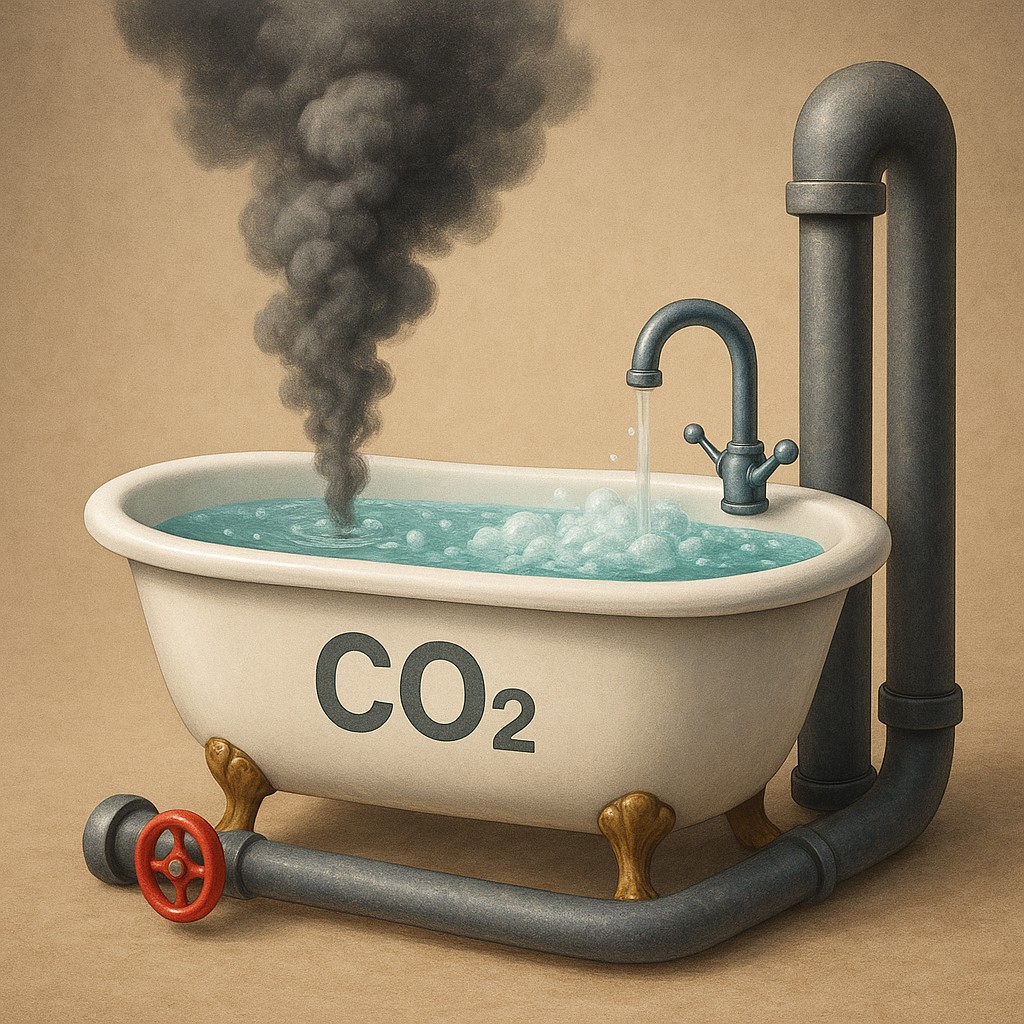
To understand why our intuition fails us, we have to look at the atmosphere not as a moving car, but as a giant, slightly clogged bathtub. This "Bathtub Model" is perhaps the most important mental tool for grasping the urgency of the climate crisis. It shifts the focus away from the year-to-year "flow" of gases and toward the total "stock" that has built up over time. When you realize that the atmosphere is a vessel that stores what we put into it, the math of global warming becomes much clearer, if a bit more sobering. By the time you finish this exploration, you will understand exactly why reaching "net zero" is not just a political slogan, but a physical requirement of the universe we live in.
The Plumbing of the Planet
Imagine you are standing in your bathroom, staring at a bathtub that is quickly filling up. The faucet is wide open, gushing water into the tub at an alarming rate. At the bottom of the tub, there is a drain, but it is small, ancient, and partially blocked. For most of human history, the faucet was barely a drip, and the drain was more than capable of keeping the water level stable. This was the era of the "pre-industrial" climate, where the amount of carbon dioxide released by natural processes, like rotting forests and breathing animals, was perfectly balanced by the amount absorbed by oceans and growing plants. The tub stayed at a safe, predictable level for thousands of years, allowing human civilizations to flourish.
Then, about two centuries ago, we found a way to turn the faucet handle much further. By burning coal, oil, and gas, we added a massive second faucet to the tub. At first, the water level rose slowly, and the drain even sped up a little bit to compensate. But as our industrial appetite grew, the new faucet was opened to its maximum setting. Today, we are pouring roughly twice as much carbon dioxide into the atmosphere as the Earth's natural systems can drain away. The tub is no longer just "full"; it is beginning to spill over the sides, and the water is soaking into the floorboards of our global home.
The mistake many of us make is thinking that if we simply turn the faucet down by 20 percent, the water level will go down. In reality, as long as the faucet is pouring water in faster than the drain can suck it out, the water level in the tub will continue to rise. If you are pouring ten gallons a minute into a tub that only drains five gallons a minute, the tub is still getting fuller. To stop the rising water, you don't just need to slow the faucet; you need to turn it down until the flow is no greater than the drain's capacity. And because our natural "drain" is currently quite sluggish, that means the faucet has to be turned almost all the way off.
Slow Drains and Stubborn Molecules
One of the most frustrating aspects of the carbon bathtub is just how slow the drain actually is. In our metaphor, the drain represents "carbon sinks," which are the natural systems that remove CO2 from the air. The primary sinks are the oceans, which dissolve the gas, and the terrestrial biosphere, where trees and plants "eat" carbon through photosynthesis. While these systems are remarkably efficient in their own way, they have hard physical limits. The ocean, for instance, can only absorb so much gas before it becomes too acidic or too warm to take in more. Similarly, we can't simply plant enough trees to offset all our fossil fuel use because there isn't enough land on Earth to support a forest of that size.
To make matters more complicated, carbon dioxide is a remarkably stable molecule. Unlike some other pollutants that wash out of the air with the next rainstorm, a significant portion of the CO2 we emit today will stay in the atmosphere for centuries. Roughly twenty percent of the carbon dioxide released from your car’s tailpipe this morning will still be floating in the sky a thousand years from now, trapping heat and adding to the water level in the tub. This "long tail" of carbon residence time means that we aren't just dealing with a daily waste problem; we are managing a permanent change to the chemistry of the sky.
The following table helps illustrate the difference between the "Flow" (what we do every year) and the "Stock" (how much is already up there), and how they interact with our natural drainage system.
| Action Taken |
Impact on the "Faucet" (Emissions) |
Impact on the "Tub Level" (Atmospheric CO2) |
Resulting Temperature |
| Business as usual |
Faucet opens further every year |
Rises rapidly and accelerates |
Warming accelerates sharply |
| Modest reductions |
Faucet is turned down slightly |
Continues to rise at a slower pace |
Warming continues to increase |
| 50% reduction |
Faucet is at half-strength |
Still rises (because it's more than the drain) |
Warming continues to increase |
| Net Zero |
Faucet matches the drain's speed |
Level finally stabilizes |
Warming stops (but stays at a high level) |
| Carbon removal |
Faucet is off; drain is boosted |
Level finally begins to drop |
Planet begins a very slow cooling |
The Trap of Linear Thinking
One reason we find the bathtub model so counter-intuitive is that humans are naturally "linear thinkers." We tend to expect that a change in input will result in a proportional and immediate change in output. If you eat half as many cookies, you expect to stop gaining weight immediately. In the climate system, however, the relationship is "cumulative." The total warming we experience is determined not by how much carbon we emitted this specific year, but by the total mass of carbon that has built up in the tub since the start of the Industrial Revolution. This is often called the "Carbon Budget."
Because we have already filled the tub so close to the brim, we have very little budget left. Every year that the faucet remains open wider than the drain, we are using up the remaining space. This creates a sense of "locked-in" warming. Even if we stopped all emissions tomorrow, the water wouldn't magically disappear. The tub would stay full at its current level for a very long time because the drain is so slow. This is why scientists emphasize that "stopping the warming" and "reversing the warming" are two very different goals. Achieving net-zero emissions accomplishes the first part - it stops the water from rising - but it doesn't empty the tub.
This distinction is vital for public policy. When a government promises to reduce emissions by 30 percent by 2030, they are promising to turn the faucet down. That is a great first step, but the bathtub model tells us that even after that 30 percent cut is achieved, the atmosphere will still be gaining more carbon every single day. The "water level" will still be higher in 2031 than it was in 2030. To truly solve the problem, we have to look past the year-to-year flow and focus on the hard reality of the total volume. Success isn't just about slowing down; it's about reaching the point where we aren't adding a single drop more than the Earth can handle.
Fixing the Plumbing and Turning the Faucet
Once we accept the reality of the bathtub, two clear strategies for the future emerge. The first, and most urgent, is "mitigation": we must turn the faucet off as quickly as humanly possible. This means transitioning our energy systems to renewables, switching to electric transport, and rethinking agriculture. Every bit we turn the faucet down buys us more time before the tub overflows. This is the part of the plan we hear about most often, and for good reason - it is a lot easier to stop pouring water in than it is to fix a clogged drain.
The second strategy, which is gaining more attention in scientific circles, is "carbon removal." In bathtub terms, this is like taking a bucket and manually scooping water out of the tub or using a chemical cleaner to try and speed up the drain. Technologies like Direct Air Capture, which pulls CO2 straight from the sky, or enhanced weathering of rocks aim to suck carbon out of the air and lock it away underground. While these technologies are currently expensive and only exist on a small scale, the bathtub model shows why we might eventually need them. If we want the water level to go back down to "safe" pre-industrial levels within our lifetimes, we can't wait for the slow natural drain to do the work. We have to help it.
It is also important to remember that the "drain" isn't a fixed constant; it is something we can accidentally damage. As we continue to warm the planet, we risk clogging the natural drain even further. For example, as oceans warm, they become less efficient at absorbing CO2. If the Amazon rainforest dries out and turns into a savanna due to heat, it stops being a drain and actually becomes a second faucet as the dying trees release their stored carbon. This creates a "feedback loop" where a fuller tub makes the drain work even slower, causing the tub to fill even faster. Understanding these dynamics is what drives the "tipping point" warnings you hear from climate scientists.
Finding Hope in the Physics
While the bathtub model can feel overwhelming, it actually provides a very clear and empowering roadmap for action. It strips away the confusing jargon of carbon credits and international treaties and replaces them with a simple physical goal: balance the flow. We know exactly what needs to happen to stabilize our climate. We don't need to wonder if a 10 percent cut is "enough" - the physics tells us it isn't. This clarity allows us to measure our progress against the only metric that truly matters: the concentration of CO2 in the atmosphere.
The beauty of the model is that it rewards every single effort to turn the faucet. Even if we don't reach net zero tomorrow, every gallon we don't pour into the tub is a gallon that doesn't have to be drained out later. It reframes climate action from a vague sense of "doing less bad" to a precise engineering challenge of "restoring balance." When we move from a mindset of slowing down a car to one of managing a vital reservoir, we start to see the planet as a system we have the power to stabilize.
As you go about your day, try to visualize the invisible bathtub above your head. Every time you see a coal plant's chimney or hear an engine roar, imagine the water level in the global tub ticking up just a fraction. But also, think about the vast forests and the deep, cold oceans working silently to pull that water back out through the drain. We are the masters of the faucet, and for the first time in history, we fully understand how the plumbing works. With that knowledge comes the incredible opportunity to finally reach out, grab the handle, and turn it toward zero, ensuring the tub never overflows for the generations to come.