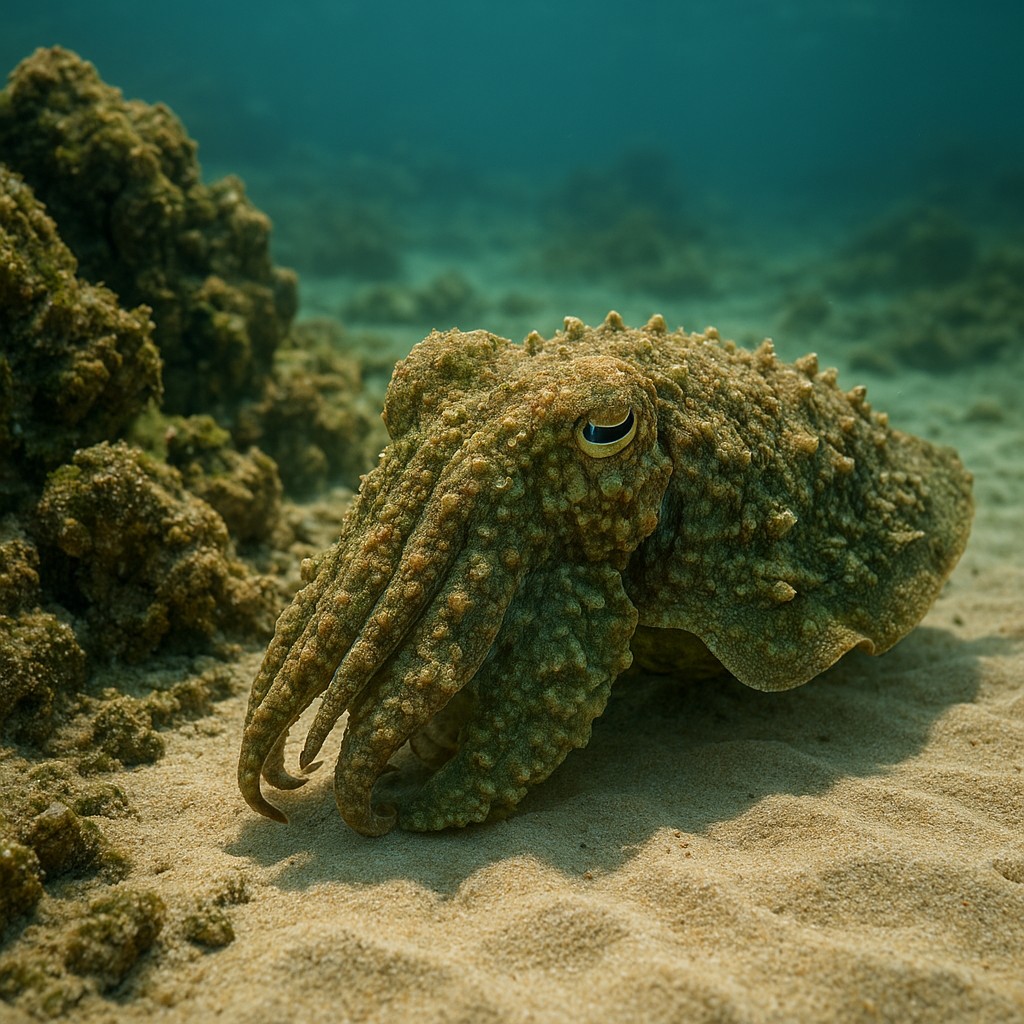
Imagine you are floating over a shallow tropical reef, scanning the seabed for signs of life. To your left, a cluster of jagged, algae-covered rocks sits still; to your right, a patch of rippling sand stretches out. You could swim past a cuttlefish a dozen times without ever realizing it was there. These "chameleons of the sea" are famous for their ability to change color in the blink of an eye, using specialized cells called chromatophores to paint their skin with intricate patterns. But color is only half the story. If a cuttlefish remained perfectly smooth while sitting on a craggy reef, its silhouette would give it away instantly. To truly vanish, it must become a master of 3D geometry, physically reshaping its skin to match the bumps, spikes, and ridges of its environment.
This feat is accomplished through an anatomical marvel known as papillae. These are tiny, complex bundles of muscle that allow the cuttlefish,s skin to erupt into elaborate textures on command. Unlike humans, who rely on a rigid internal skeleton for structure and movement, the cuttlefish is a masterpiece of soft-body engineering. It uses the principles of fluid dynamics and muscular tension to transform its body from a sleek, hydrodynamic arrow into a rough, seaweed-mimicking stone. This happens in a fraction of a second, driven by a neural system so precise it can match the specific texture of surrounding pebbles. Learning how these creatures manipulate their "liquid" bodies offers a profound lesson in how nature solves complex mechanical problems without using a single hard part.
The Mechanical Logic of a Muscular Hydrostat
To understand how a cuttlefish expands its skin, we must first look at the physics of water. Most biological tissues are primarily composed of water, which is famously incompressible. If you fill a balloon with water and squeeze the middle, the liquid does not disappear, it simply moves to where there is less pressure. This is the fundamental principle of a "muscular hydrostat." Our own tongues and the trunks of elephants work this way. By contracting muscles in one direction, the animal forces the fluid-filled tissue to expand in another. In the case of the cuttlefish, this principle is applied at a microscopic scale across the entire surface of its mantle.
The papillae are organized into a hierarchical system of concentric rings. When the cuttlefish decides to spike up, it sends a signal to these circular muscle groups. As the outer rings contract, they squeeze internal tissue inward and upward. Because the skin and the fluids inside have nowhere else to go, they are forced to bulge outward, creating a protrusion. Depending on which specific muscles are activated, the cuttlefish can create long, thin spikes or broad, rounded bumps. This allows the animal to transition from a streamlined swimmer to a textural twin of its surroundings without needing to grow new tissue or wait for a slow biological process.
Engineering the Perfect Disguise
The architecture of a papilla is not just a random heap of muscle; it is a highly structured network designed for specific topographic outputs. Scientists have identified different classes of papillae that serve different camouflaging needs. Some are small and granular, designed to mimic the texture of sand or fine gravel. Others are large and branched, capable of mimicking the fronds of kelp or the complex surface of a coral head. By combining these different tools across its skin, the cuttlefish creates a high-definition 3D map of its surroundings.
| Feature |
Smooth Skin (Relaxed) |
Textured Skin (Active) |
| Muscle State |
Circular muscles are relaxed; internal tissue is spread thin. |
Circular muscles contract tightly, squeezing tissue inward. |
| Hydrodynamic Profile |
Low drag; optimized for fast swimming and jet propulsion. |
High drag; optimized for stationary camouflage and blending in. |
| Energy Consumption |
Low; the default state of the skin mantle. |
High; requires constant muscular tension to maintain the shape. |
| Visual Effect |
Reflective and sleek; can show vibrant color patterns. |
Matte and jagged; breaks up the animal's silhouette. |
What makes this system even more impressive is the speed of the transition. A cuttlefish can change its texture in less than 500 milliseconds. This is essential for survival in a world of fast-moving predators like sharks and dolphins. If a cuttlefish detects a threat, it can drop to the seafloor and become a rock before the predator has a chance to lock onto its movement. This rapid response is possible because the nervous system bypasses the complex cognitive processing we might expect, instead using direct neural pathways that trigger the muscular hydrostats almost instinctively.
The High Cost of Maintaining the Illusion
While the cuttlefish makes this transformation look effortless, there is a significant metabolic price to pay for being a shapeshifter. In the world of biology, nothing is free. Moving a bone with a muscle is relatively efficient because the bone provides a rigid lever that stays in place once moved. However, maintaining a raised papilla is like holding a heavy weight at arm's length. Since there is no lock mechanism or skeletal support, the circular muscles must stay constantly contracted to keep the tissue pushed outward. This requires a continuous expenditure of energy in the form of ATP, the body's cellular fuel.
Research has shown that cuttlefish generally prefer to remain smooth when they are not actively trying to hide or communicate. If you watch a cuttlefish in a tank, you will see it deflate the moment it feels safe or when it needs to swim quickly. The drag created by a spiky body is also a disadvantage for movement, so the animal is constantly balancing the need for camouflage with the need for energy conservation. This trade-off is why cuttlefish are such patient hunters. They often sit perfectly still for long periods, relying on their texture to bring prey within reach, rather than wasting energy chasing it down while looking like a jagged rock.
Beyond Camouflage into the World of Communication
Interestingly, the ability to change texture is not reserved exclusively for hiding. Cuttlefish are highly social and intelligent creatures, and they use their skin as a canvas for complex signaling. During mating season or territorial disputes, a cuttlefish might raise specific papillae to appear larger or more intimidating to a rival. The texture can accentuate certain color patterns, such as eye spots or zebra stripes, making them appear more vivid or three-dimensional. This adds a layer of non-verbal communication that is almost unique in the animal kingdom.
Think of it as a form of tactile semaphore. By raising its eyebrow papillae, a cuttlefish can signal agitation or alertness. In some species, males will use a combination of smooth and textured skin on different halves of their bodies, appearing as an attractive mate to a female on one side while showing a fierce, textured warning to a competing male on the other. This dual-processing capability shows that the control over papillae is not just a whole-body reflex, but a localized and highly nuanced tool for interacting with the world.
Bio-Inspiration and the Future of Soft Robotics
The cuttlefish’s liquid hydraulic system has caught the attention of engineers and material scientists far beyond the world of marine biology. Current robotics is often limited by the hard nature of components, which makes machines clunky and dangerous to operate around humans. By studying how cuttlefish use muscular hydrostats, researchers are developing soft robots made of flexible polymers that can change shape, squeeze through tight gaps, and adapt their grip to fragile objects. The cuttlefish provides a blueprint for machines that do not just move through their environment but actually become part of it.
Imagine a surgical tool that can enter the body as a smooth, soft tube and then, upon reaching a specific site, sprout spikes or grippers to perform a delicate task without the need for rigid joints. Or consider camouflage technology for search-and-rescue drones that need to blend into rubble to avoid detection while monitoring dangerous areas. The cuttlefish teaches us that structure does not have to be permanent. Resilience and versatility come from the ability to flow, squeeze, and reshape ourselves according to the pressures of the moment.
The next time you look at a photo of a cuttlefish, do not just look at the mesmerizing colors. Imagine the thousands of tiny hydraulic pumps working beneath the surface, the circular muscles squeezing with rhythmic precision to turn a soft mantle into a jagged mountain. It is a reminder that nature often finds the most elegant solutions in the places we least expect, proving that you do not need a backbone to be one of the toughest, most adaptable engineers on the planet. By mastering the art of the squeeze, the cuttlefish reminds us that flexibility is often more powerful than strength.