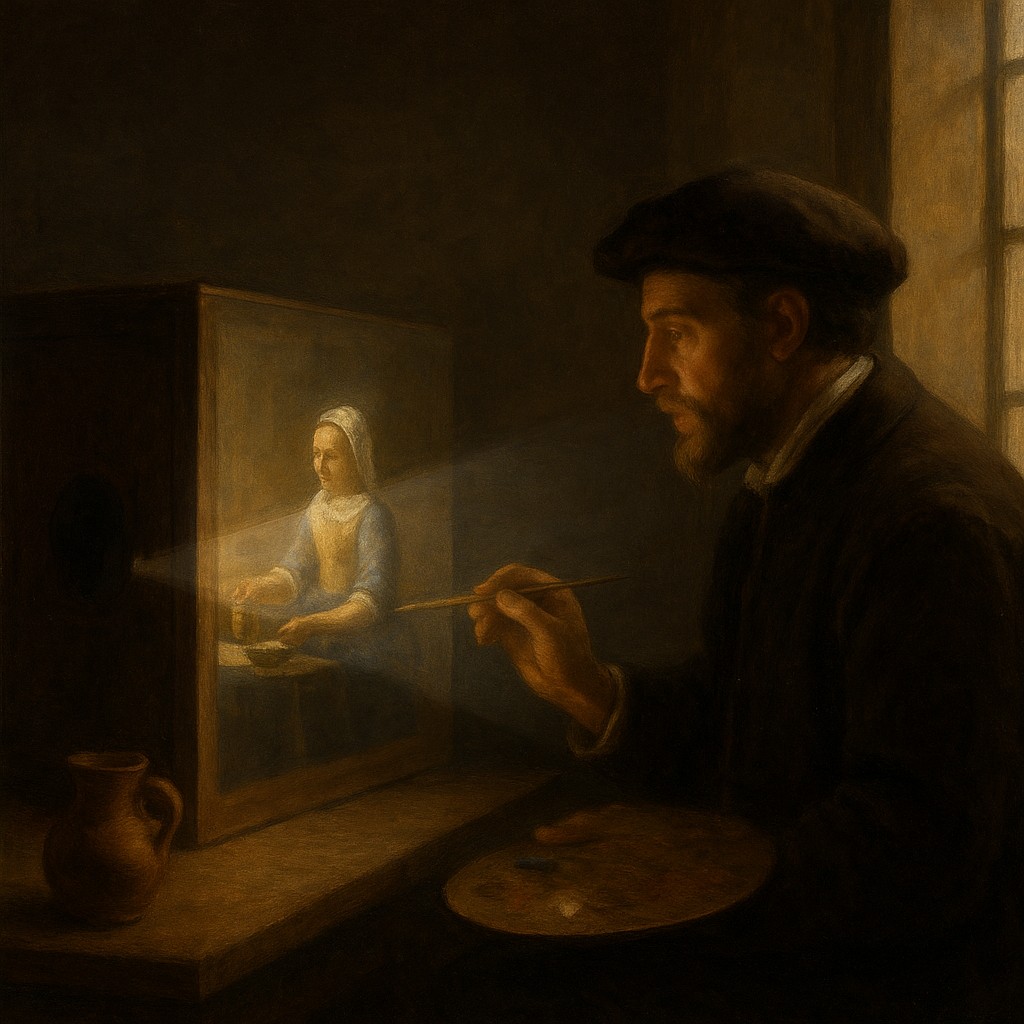
History often paints great masters as solitary geniuses vibrating with divine inspiration, standing before a canvas with nothing but a brush and a burning vision. We imagine Johannes Vermeer in his quiet studio in Delft, perhaps catching a stray sunbeam and pinning it to the ceiling through sheer force of will. But what if the secret to that haunting, photographic stillness was not just a divine gift, but a savvy, pragmatic collaboration with the laws of physics?
When we look at a Vermeer, we are not just seeing a portrait of a woman pouring milk or a girl with a pearl earring; we are seeing a carefully engineered optical capture. Vermeer was, in a very real sense, an early adopter of high-tech imaging tools. By embracing the camera obscura, a device that uses a lens to project a real-world image into a dark space, he bypassed the limitations of human perception to reveal how light actually behaves in the wild. This was not cheating, and it certainly did not diminish his talent. It was the ultimate, symphonic marriage between human observation and mechanical reality.
The Dark Chamber and the Birth of Optical Honesty
The camera obscura is essentially the simplest possible camera, minus the film. At its most basic, it consists of a darkened room or box with a tiny opening on one side. Light rays pass through this pinhole or lens, crossing over one another to project an upside-down and reversed image of the world outside onto the opposite surface. Before we had the silicon chips and digital sensors that define our modern lives, the camera obscura provided a way to step inside the eye of the universe.
For an artist like Vermeer, this was a revelation in how light interacts with matter. The human brain is a heavy-duty editor, constantly filtering out visual distractions, simplifying edges, and correcting for color shifts so we can navigate the world without getting dizzy. Our eyes are great for survival, but they are terrible at being objective recorders. The camera obscura, however, does not care about your survival. It captures the diffusion of photons, which creates those soft, slightly blurry highlights we call "circles of confusion" or, more technically, bokeh. When you look at Vermeer’s paintings, you see these soft-focus textures on velvet or glassware, and that is precisely because he was transcribing optical artifacts that the naked eye usually glosses over.
Deciphering the Geometry of Hidden Light
Vermeer’s mastery lay in his ability to translate the transient distortions of the camera obscura into permanent, solid pigments. While his contemporaries were often building up surfaces with bold brushwork and clearly defined outlines, Vermeer was obsessed with the way light fell across planes. The projection allowed him to study how color bleeds into shadow and how intensity fades as a surface curves away from the light source.
This practice allowed him to sidestep the rigidity of classical drawing. Instead of forcing a figure to fit into a preconceived notion of human anatomy, he could trace the light itself. This is why his subjects feel so eerily alive, as if you have caught them in a moment of breath between the painting and reality. He understood that light does not arrive at our eyes as a series of crisp, black outlines. It arrives as complex energy. By using a mechanical lens, he was able to mimic that energy with an accuracy that was essentially a biological version of early photography.
The Mechanics of Artistic Perception
To understand how this shift in process changes our perception of art as a whole, it helps to compare the traditional manual artist against the optically assisted master. The manual artist works from a conceptual understanding of objects, while the optically assisted master works from the physical data provided by the environment.
| Aspect of Painting |
The Manual Approach |
The Camera Obscura Approach |
| Edge Detection |
Distinct, defined boundaries |
Softened, diffuse transitions |
| Light Intensity |
Consistent, even illumination |
Variable, physically accurate falloff |
| Geometry |
Idealized shapes based on memory |
Distorted perspectives based on optics |
| Focus |
Uniform across the frame |
Selective, mirroring focal depth |
This table highlights the friction between how we think the world looks and how it actually projects onto a lens. The manual artist tends to draw what they know to be true, whereas Vermeer chose to paint what the physics of light showed to be true. This led to his trademark realistic light effects, which gave his works that signature glow that seems to come from within the paint itself. He was not just painting a vase; he was painting the specific way the room’s light folded itself around the ceramic.
The Myth of Raw Talent versus Systemic Mastery
One of the most persistent misconceptions in art history is that using a tool somehow cheapens the result. We like to think that the genius artist is a superhero whose eyes are perfect, unwavering sensors. However, recognizing that Vermeer used a camera obscura does not make his hands less steady or his color choices less brilliant. Instead, it elevates him to the status of an innovator who understood his own limitations and sought tools to overcome them.
If physics provides a map of reality, the artist is the traveler who chooses which path to take. Vermeer used the camera obscura to expand his visual vocabulary. He did not just trace images; he synthesized the information gained from his optical experiments to create compositions that were, in many ways, more real than the subjects themselves. He was leveraging a hardware system - a dark box and a glass lens - to enhance his own internal software - his understanding of tone, color, and emotional composition.
Embracing the Lens of Inquiry
Looking back at the trajectory of human progress, we often find that the greatest leaps forward occur when we stop relying solely on our biological senses and begin building extensions for them. From the telescope that allowed Galileo to see the moons of Jupiter to the camera obscura that allowed Vermeer to perceive the nuance of shadow, our best work has always been a collaboration with the physical world.
You have the same opportunity in your own life to leverage systems and tools that sharpen your perception. Whether it is using data analytics to understand your habits, employing mental frameworks to navigate complex decisions, or simply picking up a camera to explore how light hits the world around you, you are participating in the same tradition of applied curiosity that made Vermeer a legend.
Vermeer did not lose his soul by looking through a lens; he found the truth hiding in the light. He taught us that art is not just a performance of skill, but a rigorous investigation of reality. So the next time you find yourself staring at an obstacle, remember that there is no shame in using a tool to gain a better vantage point. Grab your own version of the camera obscura, look past the surface of what you think you see, and start mapping the light exactly as it falls. You might just catch a sense of wonder that has been hidden in plain sight all along.