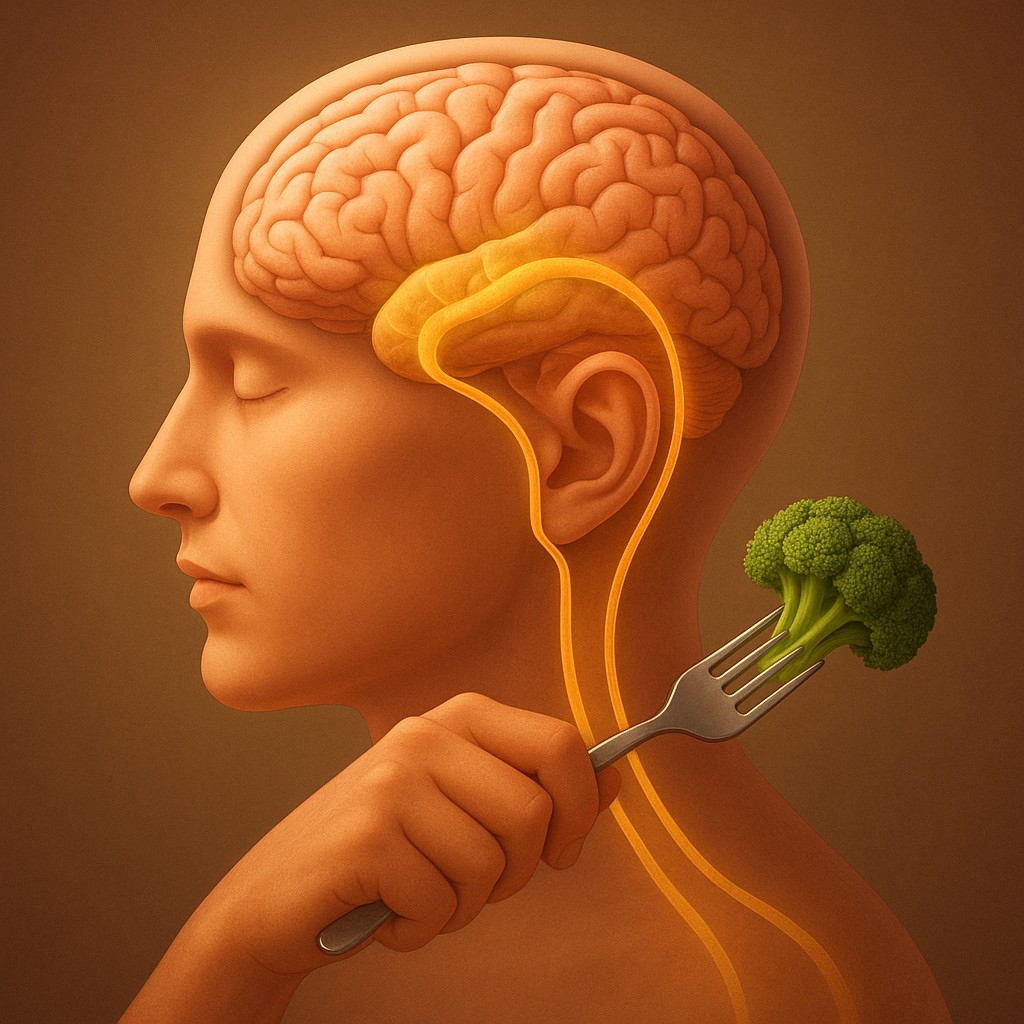
Imagine sitting at a dinner table, lost in conversation, as you reach out to spear a piece of broccoli. You don’t stop to calculate the distance between your knuckles and the fork. You don’t think about the physics of leverage or how much the metal can bend. Instead, you simply "feel" the broccoli through the fork. At that moment, your brain has decided the fork isn’t just a piece of silverware; it is a temporary extension of your own body. This isn’t a poetic metaphor. It is a literal event happening inside the folds of your parietal lobe, the part of the brain that handles sensory information.
This phenomenon is called "remapping," and it is the secret ingredient behind human civilization. While other animals might use a stick to fish for termites, humans have a unique, high speed ability to rewrite their internal body blueprints on the fly. When you pick up a tool, your brain performs rapid calculations that shift the boundaries of your "self." The gap between where your skin ends and the world begins starts to blur. If you have ever felt a phantom "ouch" when you scraped your car while parking, or felt a bump in the road through your bicycle tire as if it touched your own heel, you have experienced your body map expanding in real time.
The Map Inside Your Head
To understand how a hammer becomes an arm, we first have to look at the "Homunculus," or the "little person" inside your head. Deep within the brain lies the somatosensory cortex. This is a strip of tissue that acts as a map of your entire body. Every square inch of your skin is assigned a specific "plot" of land on this map. Your lips and fingertips, which are very sensitive, take up huge amounts of space. Your back and thighs get smaller, less detailed sections. For a long time, scientists thought this map was set in stone once you became an adult.
However, we now know this map is incredibly flexible. It is less like a paper atlas and more like a high tech GPS that updates in real time. When you hold a screwdriver, your brain doesn’t see it as an outside object. Instead, the mental image of your arm literally stretches. Brain scans show that after just a few minutes of using a tool, the brain begins to process signals from the tip of that tool as if they were coming from your own fingertips. The "border" of your body moves from your skin to the end of the metal bit.
This remapping is what allows for the incredible precision found in skilled crafts. A surgeon using a robotic tool isn't just "moving joysticks." Their brain has mapped those robotic pincers to be their own fingers. The delay between thought and action disappears because the brain has adopted the machine. This lets the surgeon feel the tension of a stitch as if their own nerves were woven into the mechanical parts.
Feeling Through the Machine
The magic of remapping relies on how our brains interpret vibrations. If you drag a stick across sandpaper, you don’t feel the vibration in your palm; you feel the texture of the sandpaper at the very tip of the stick. This is a clever trick of the mind called "distal attribution." Your brain takes the vibrations traveling through the tool and projects them to the far end of the object. This is why a blind person using a cane can "feel" the difference between a concrete sidewalk and a patch of grass. The cane is no longer an object; it is a sensory organ.
Experiments with monkeys and humans show this shift happens at the cellular level. When monkeys were trained to use a rake to grab food, the specific neurons that usually fired only when something touched their hand began to fire when something touched the rake. The brain had rewritten its definition of "me" to include the wood and plastic.
| Concept |
Traditional View |
The Remapping Reality |
| Body Schema |
A fixed, biological map of skin and bones. |
A shifting blueprint that expands to include tools. |
| Tool Interaction |
Using muscles to move an outside object. |
Adopting the object as a temporary part of the body. |
| Touch Perception |
Feeling vibrations at the point of contact (the palm). |
Feeling textures at the far end of the tool. |
| Injury Response |
Pain is felt only when the physical body is hurt. |
The brain feels a "shock" when a tool it is using breaks. |
This integration is so deep that it changes how we see the space around us. Psychologists talk about "peripersonal space," the bubble of room around our bodies that we consider to be within reach. Normally, this bubble is only as long as our arms. However, the moment you pick up a tool, your brain expands that bubble. You are no longer a person with a three foot reach; you are now a system with a six foot reach. Your brain treats every object in that new circle as if it were right next to your skin.
Why a Broken Tool Feels Like a Broken Bone
Because the brain integrates tools so deeply into our sense of self, losing or breaking a tool can cause a genuine shock. If you are a carpenter and your favorite hammer snaps in half, the feeling isn't just about the money or the annoyance. For a split second, your brain experiences a "glitch" in its body map. The part of the map that included the hammerhead suddenly has no input, similar to the "phantom limb" sensations felt by people who have lost an arm or leg.
This link explains why masters of a craft are so protective of their tools. It is not just about the cost; it is about how they perceive themselves. A chef’s knife is calibrated to their specific hand and reach. When they use it, they aren't "cutting"; they are simply moving their hand through a vegetable, and the knife is the edge of that hand. If the blade is dull, the chef’s own "body" feels off. The tool has become a part of their identity.
This also explains why it is hard to learn to drive. At first, you are very aware of the car as something "outside" of you. You worry about the fenders and feel disconnected. But after a few years, the car becomes "you." You can feel how the tires grip a wet road through your seat and the steering wheel. You don’t think, "I am turning the wheel to move the car"; you think, "I am turning left," and your expanded body, a two ton hunk of steel, follows your command.
The Cost of Switching Maps
While the brain is efficient at remapping, it does take energy. Every time we switch tools, the brain has to reset. If you spend all day using a heavy sledgehammer and then try to sew with a needle, you will likely be clumsy. This is because your brain is still using a body map designed for a heavy, high momentum tool. It takes a few moments for the "undo" command to work through your system and return your hands to their natural size.
This flexibility is what separates human intelligence from AI. While a robot can be programmed to use a tool, it does not have a "body map" that can grow and shrink. Humans can go from using a spoon to a car to a smartphone with almost no "boot up" time. This allows us to navigate a world full of objects that were never part of our evolution but are now part of our daily biological reality.
Interestingly, this isn't limited to physical tools. Research suggests that even digital cursors on a screen become part of our body maps. When you move a mouse, your brain eventually stops seeing the arrow as an icon and starts seeing it as a digital finger. If someone "attacks" your character in a video game, you might feel a physical stress response. Your brain has mapped those pixels into your personal space. We are the first species capable of living in multiple "bodies" at once, shifting from physical to digital in the blink of an eye.
Embracing the Cyborg Within
Understanding remapping changes how we look at human progress. We often think of technology as something that moves us away from our "natural" selves, but the science suggests the opposite. We are biologically wired to use tools. Our brains evolved to be incomplete without them. From the first stone axe to the latest surgical robot, our brains look at the world and ask, "What part of this can I make a part of myself?"
This should inspire wonder the next time you pick up a pen or a steering wheel. You aren’t just using an object; you are performing a neurological miracle. You are stretching your sense of self into the world, turning wood, metal, and plastic into bone and muscle. This ability to rewrite our own blueprints is what makes us human. It allows us to go beyond our physical limits and reach further than our arms ever could.
The next time you feel the texture of the road through your shoes, remember that your brain is a master architect. It is constantly redrawing its borders to help you master your environment. You are not a static being trapped in a body; you are a growing system of potential. The world is not just a place you live; it is something you can literally become.