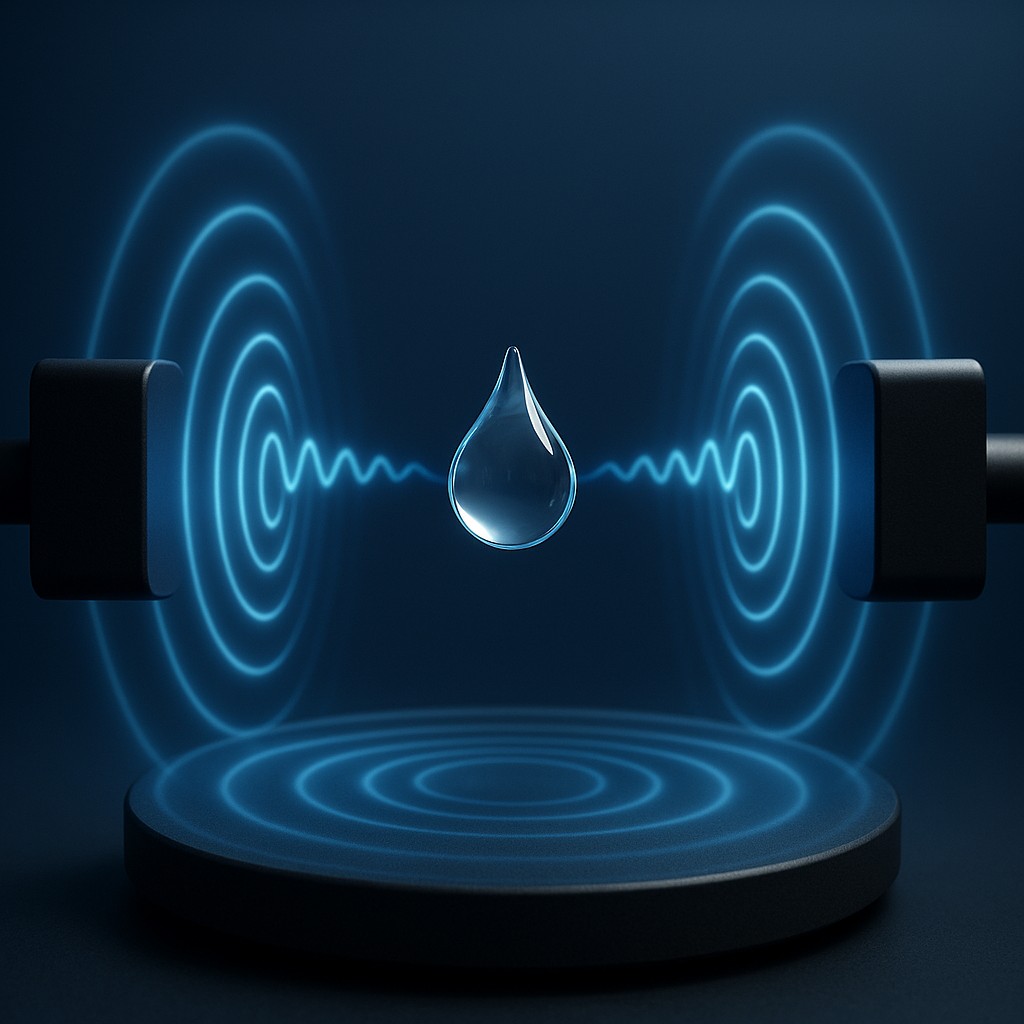
We tend to think of sound as something that hits our ears, vibrates our eardrums, and eventually fades into our background chatter. It is easy to view sound as a fleeting energy, a wave that passes through us rather than a tool that can physically move the matter around us. Yet, if you turn the volume up to a frequency the human ear cannot detect and trap that energy between a source and a reflector, you create something like an invisible, rhythmic cage. This is the world of acoustic levitation, where we trade the brute force of magnets or mechanical claws for the subtle, pressure-based geometry of sound.
It feels like a magic trick pulled straight from a science fiction novel, yet it is grounded in the rigid mechanics of physics. By using ultrasonic transducers to bounce sound waves back and forth, researchers can create a standing wave, effectively pinning objects in mid-air. The beauty of this process lies not in the loudness of the sound, but in the precision of its alignment. When we understand how these sound waves create localized pockets of stillness, we stop seeing sound as just noise and start seeing it as a precise, invisible architecture for handling the delicate components of our future.
The Geometry of Stillness
To understand why a tiny droplet can hover magically in a vacuum or a room, we first need to visualize the invisible architecture of a standing wave. Imagine throwing a stone into a pond and watching the ripples travel outward until they hit a wall, where they bounce back. When the incoming waves and the reflected waves overlap perfectly, they create a pattern where the peaks and troughs no longer appear to move. This is the foundation of a standing wave, and it turns the medium - be it air or water - into a stable, static pattern of energy.
At the heart of these standing waves are specific points known as nodes. Think of a node as a region of structural balance where the sound pressure fluctuates to create a localized pocket of zero net force. If an object is placed inside this pocket, it is essentially squeezed into place from all sides. Because the sound pressure is high on either side of the node, the object is trapped in the middle, unable to escape because moving in any direction would mean pushing against an increase in sound pressure. It is essentially a gravitational trap built entirely out of vibrating air, allowing us to suspend matter without ever touching it.
Why We Cannot Levitate a Person Through Music
The most common question following a demonstration of acoustic levitation is whether we could one day build a sound-based elevator or lift heavy objects like furniture or ourselves. The answer, unfortunately, is buried in the mathematical relationship between the sound frequency and the size of the object being moved. The wavelength of the sound must be roughly proportional to the size of the target object to create the pressure gradient necessary for stable trapping. To levitate a human being, we would need to generate sound waves with massive wavelengths, which would require an impractical amount of power and a colossal acoustic setup that would likely shake the very foundations of the building.
Furthermore, we must account for the destructive power of the sheer decibel level required to exert that much force. When we demonstrate levitation in laboratories, we use ultrasonic frequencies that sit well above the range of human hearing, keeping the experiment surprisingly quiet. However, scaling up that force to support a person would turn our quiet levitation chamber into a sonic weapon of immense power. The energy density required to move a human would create high-intensity vibrations that could shatter glass and damage human tissue long before it achieved a gentle, floating lift.
Protecting the Purity of Science
Beyond the flashy spectacle of levitation, the true utility of this technology lies in its ability to handle materials that are far too sensitive for standard laboratory equipment. In traditional chemistry, researchers move liquids and solids using pipettes, beakers, or tweezers, each of which introduces the risk of contamination. Every surface an object touches is a potential source of impurities, especially when dealing with biological samples or reactive chemical compounds. By using acoustic fields to hold a sample in place, scientists create a container-less environment where the only thing touching the substance is the air itself.
This technique is particularly revolutionary for experiments in chemical synthesis, where the vessel itself can sometimes act as a surface that triggers unwanted reactions. Think of it as a pristine laboratory environment reduced to the size of a few millimeters. By isolating a droplet of a chemical reaction, researchers can observe the process in real time, apply external factors like heat or radiation, and ensure that the reaction remains uninfluenced by the container. It turns the entire air space into a controllable, sterile, and non-reactive workspace that preserves the integrity of the sample from start to finish.
Comparing Traditional and Acoustic Handling Methods
To fully appreciate the shift that acoustic levitation represents in modern experimental science, it helps to contrast it with the standard tools we have used for centuries. While mechanical grip remains the standard for moving heavy weight, acoustic levitation steps in whenever precision and purity are the non-negotiable priorities.
| Attribute |
Traditional Mechanical Handling |
Acoustic Levitation Handling |
| Contact Surface |
Requires direct physical contact |
Contactless - uses sound pressure |
| Contamination Risk |
High - from tools and vessels |
Virtually non-existent - air only |
| Scalability |
High - can lift heavy objects |
Low - limited to small, light matter |
| Precision |
Variable - human error and tool drift |
Very High - node-locked stability |
| Environmental Needs |
Minimal |
Requires controlled, reflective environments |
The table above highlights that we are not necessarily replacing mechanical tools with sound, but rather adding a powerful, specialized instrument to our collective kit. The trade-off is clear: we sacrifice bulk weight-bearing capacity for an unparalleled level of sterility and purity. This makes acoustic levitation an essential tool for the next generation of nanotechnology and pharmaceutical research, where the smallest impurities can derail years of development.
Solving the Misconception of Levitation Strength
There is a lingering myth that acoustic levitation is inherently weak because it is invisible and quiet. People often equate the invisible nature of the force with a lack of power, leading them to believe that the objects must be flimsy or weightless. In reality, the force exerted by an ultrasonic field is quite strong relative to its scale. It is not that the sound is weak; it is that the laws of wave physics impose a hard limit on how much force can be concentrated at a single node without causing the sound system to fail or the air to become ionized.
We must also clarify that acoustic levitation is not simply about pushing objects upward, but about managing the balance of forces. The transducer creates the standing wave, but the object itself plays a role, as its shape and density influence how the sound waves reflect and interact around it. It is a dance between the machine and the matter. This realization helps move us away from viewing levitation as a form of anti-gravity and toward understanding it as a master-class in fluid dynamics and vibration control. We are not turning gravity off; we are simply providing a counter-force that is more precise than any robotic gripper we could design.
Into the Future of Non-Contact Engineering
As we look toward the future, the integration of these acoustic systems into automated laboratory workflows is becoming more sophisticated. We are moving toward a future where lab-on-a-drop platforms will allow us to conduct hundreds of independent reactions simultaneously, each held in its own floating acoustic trap, orchestrated by automated arrays. This would allow for high-throughput screening of drug candidates or catalysts, essentially accelerating the discovery process of new medicines or materials by an order of magnitude. It is a quiet revolution happening in the nodes of invisible sound waves, away from the eyes of the public but deeply impacting the future of innovation.
Just imagine your next breakthrough, whether in science, medicine, or architecture, beginning with a tiny, suspended droplet that never touched a glass dish or a contaminated surface. The constraints of our physical world often force us to design around the tools we have - beakers, test tubes, and cranes. When we choose to step outside those constraints and manipulate matter with nothing but energy and geometry, we unlock possibilities that were previously hidden by the weight of our own traditional methods. Keep your curiosity tuned to the edge of the perceptible, because sometimes the greatest leaps forward happen exactly where the waves are perfectly still.