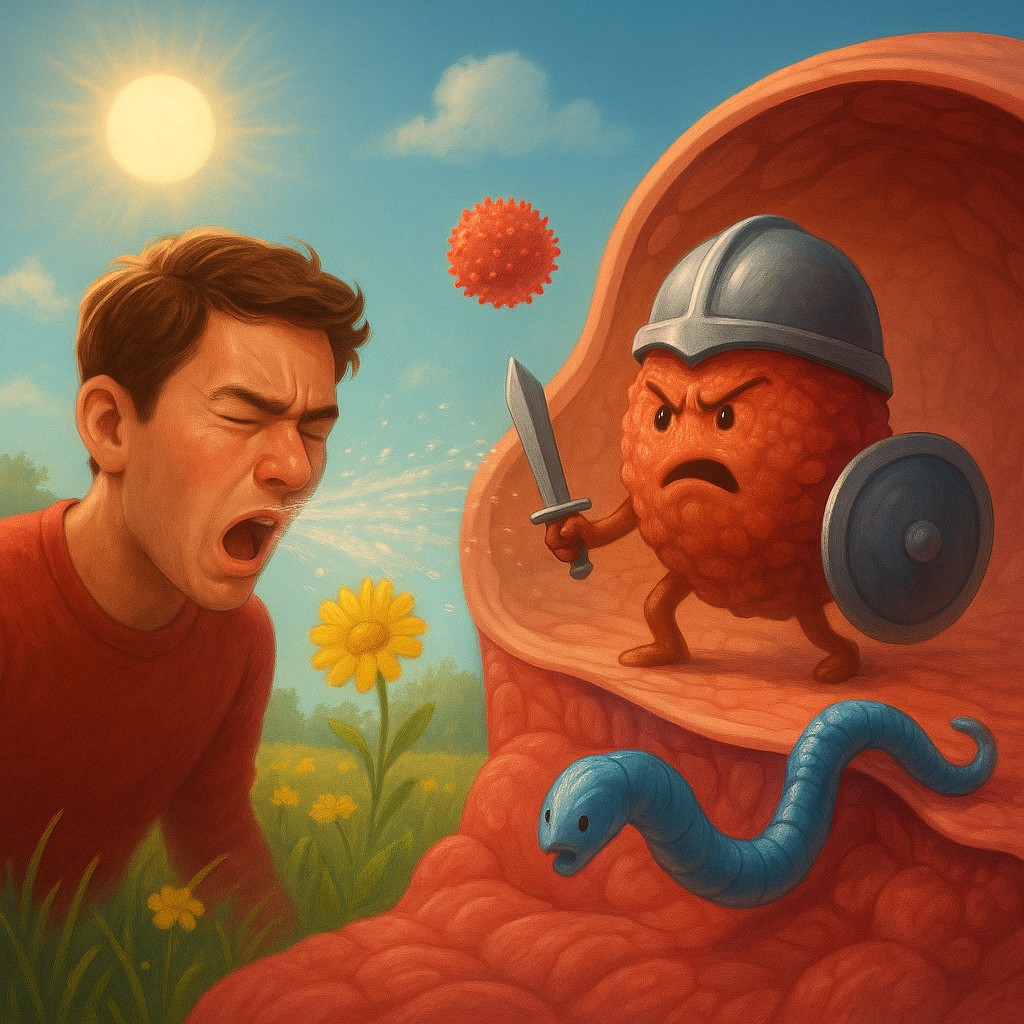
Imagine standing in a sunny meadow and taking a deep breath of spring air, only to be hit by a sneeze so sudden it feels like it might knock you over. Your eyes start to itch, your throat tickles, and your nose begins to run like someone turned on a faucet. To you, it feels like nature has betrayed you, but inside your body, a much more dramatic scene is playing out. Your immune system, a highly trained defense force with millions of years of experience, has just spotted what it thinks is a deadly invader. It does not care that the "invader" is just a harmless grain of ragweed pollen; it is convinced that you are being attacked by a parasitic worm.
This reaction does not mean your body is weak or broken. In fact, it is the exact opposite. Your immune system is doing the job it perfected over countless generations of human history. For most of our past, the biggest threats to our survival were not viruses or bacteria, but giant, wriggling parasites like tapeworms and hookworms. These creatures tried to live inside our guts and tissues, so we developed a powerful, high intensity defense team to deal with them. In today’s clean, indoor world, that team is bored, overly cautious, and prone to mistaking the jagged shell of a flower's pollen for the skin of a prehistoric parasite.
The Molecular Art of Mistaken Identity
To understand why your body treats a daisy like a death sentence, we have to look at the world through the eyes of an antibody. Antibodies are the "Wanted" posters of the immune system. They are Y-shaped proteins designed to recognize very specific shapes on the surface of intruders. The specific branch of this system that causes allergies is called Immunoglobulin E, or IgE. In a world full of parasites, IgE is a hero. It patrols the wet surfaces of your body, like your nose and throat, looking for the specific protein patterns found on the tough, leathery skin of worms. When it finds a match, it sounds an alarm to trigger a violent physical response meant to kick the worm out immediately.
The problem comes down to a concept called molecular mimicry. Nature tends to reuse successful designs. It turns out that the evolutionary tricks needed to make a pollen grain tough enough to fly through the wind are very similar to the tricks that make a parasite's skin tough enough to survive inside a host. When birch or ragweed pollen enters your nose, your IgE antibodies see a protein structure that looks just like a hookworm. They do not have eyes to see the whole grain; they only see the chemical pattern on the surface. Because the shapes are so similar, the IgE locks on, convinced it has found a parasite, and launches a full-scale counter-attack that we call an allergic reaction.
The Explosion of the Mast Cell Mines
Once the IgE antibodies identify a threat, they do not do the fighting themselves. Instead, they act as sensors for a second type of cell called a mast cell. Think of mast cells as biological landmines scattered throughout your skin, nose, and lungs. These cells are packed with tiny storage sacs full of a powerful chemical called histamine. When an allergen connects two IgE molecules on the surface of a mast cell, it sends a signal that makes the cell "degranulate." Essentially, the cell explodes its contents into the surrounding area.
This release happens in seconds, which is why hay fever can start the moment you step outside. Histamine is a powerful vasodilator, meaning it forces your blood vessels to expand and become "leaky." This allows fluid to rush into the area, bringing more immune cells to the scene of the supposed infection. Unfortunately, in your nose, this extra fluid results in swelling and a massive amount of mucus. The itching and sneezing are your body’s attempt to physically throw out the "worm." From your immune system's perspective, it is trying to wash away a parasite; from your perspective, you are just running out of tissues.
A Legacy of Combat in a Sterile World
Why is this system so aggressive? To find the answer, we have to look at how our ancestors lived. For almost all of human history, clean water and sterile food did not exist. People lived in constant contact with soil, animals, and untreated water, all of which were full of parasites. Our immune systems evolved to have a "hair-trigger" response. If you were too slow to react to a parasite, it would drain you of nutrients and energy. Therefore, it was better to have a few false alarms than to miss a real infection.
In the modern era, we have mostly wiped out these parasites through clean living and medicine. While this is a miracle of progress, it has left the IgE system with nothing to do. This leads to the "Hygiene Hypothesis." This theory suggests that because our immune systems are not trained by real parasites during childhood, they become hypersensitive to harmless things in the environment. Without the proper practice from real-world threats, the system begin to "hallucinate" enemies in the form of cat dander, dust mites, and pollen. It is like a high-tech home security system that is so sensitive it sets off the alarm every time a leaf blows past the window.
Comparing the Threat and the Response
To visualize how the immune system confuses these two different things, we can look at the similarities in how the body reacts to both pollen and real parasites.
| Feature |
The Real Threat (Parasitic Worms) |
The Mistaken Identity (Allergies) |
| Main Defender |
IgE Antibodies |
IgE Antibodies |
| Support Cell |
Mast Cells / Eosinophils |
Mast Cells / Eosinophils |
| Main Chemical |
Histamine and Leukotrienes |
Histamine and Leukotrienes |
| Biological Goal |
Flush the worm out of the body |
Flush the "intruder" out of the nose |
| Human Symptom |
Stomach cramps, diarrhea, itching |
Sneezing, runny nose, watery eyes |
| Outcome |
Survival against infection |
Annoying hay fever and congestion |
The Calibration Problem of Modern Life
The tragedy of allergies is that the immune response is a "dumb" system. It cannot learn from its mistakes the way our brains do. Even if you tell yourself, "It is just a flower," your IgE antibodies are not listening. They are programmed at a cellular level to react to specific molecular shapes. This creates a calibration problem. In an environment that is "too clean," the special cells that normally keep the immune system in check do not get the signals they need to calm down. The system stays on high alert, waiting for a war that never comes, and eventually takes out its frustration on the nearest oak tree.
Some researchers are even testing "Helminthic Therapy," where patients are intentionally given harmless, non-reproducing worms to give their immune systems something to focus on. Early results suggest that when the IgE system is busy fighting a real, controlled parasite, it stops bothering with pollen. While most people would prefer a nasal spray over a pet worm, this research shows how deeply our health is tied to our past. We are biological machines built for a rugged, dirty world, currently trying to function in a sterilized one.
Finding Balance in a Pollen-Filled World
Understanding the "why" behind your allergies can change how you view your body. Instead of seeing yourself as sickly, you can recognize that you have a powerful, highly vigilant defense force that is simply over-eager. Managing allergies often involves trying to trick this system into calming down, whether through antihistamines that block the signals or "allergy shots" (immunotherapy) that slowly retrain the system to recognize pollen as a friend rather than an enemy.
As you go through the next allergy season, remember that your sneezing and sniffling are actually signs that your ancestors were survivors. You are the product of people who successfully fought off some of the toughest parasites on Earth. While it is frustrating to feel like you are losing a battle against a ragweed plant, take heart in the fact that your internal defenders are standing ready, armed to the teeth and fiercely protective of your well-being. Your immune system is not failing you; it is a veteran of an ancient war, still standing watch in a time of peace. It just needs a little help learning that the "worms" of today are nothing more than the dust of spring.